
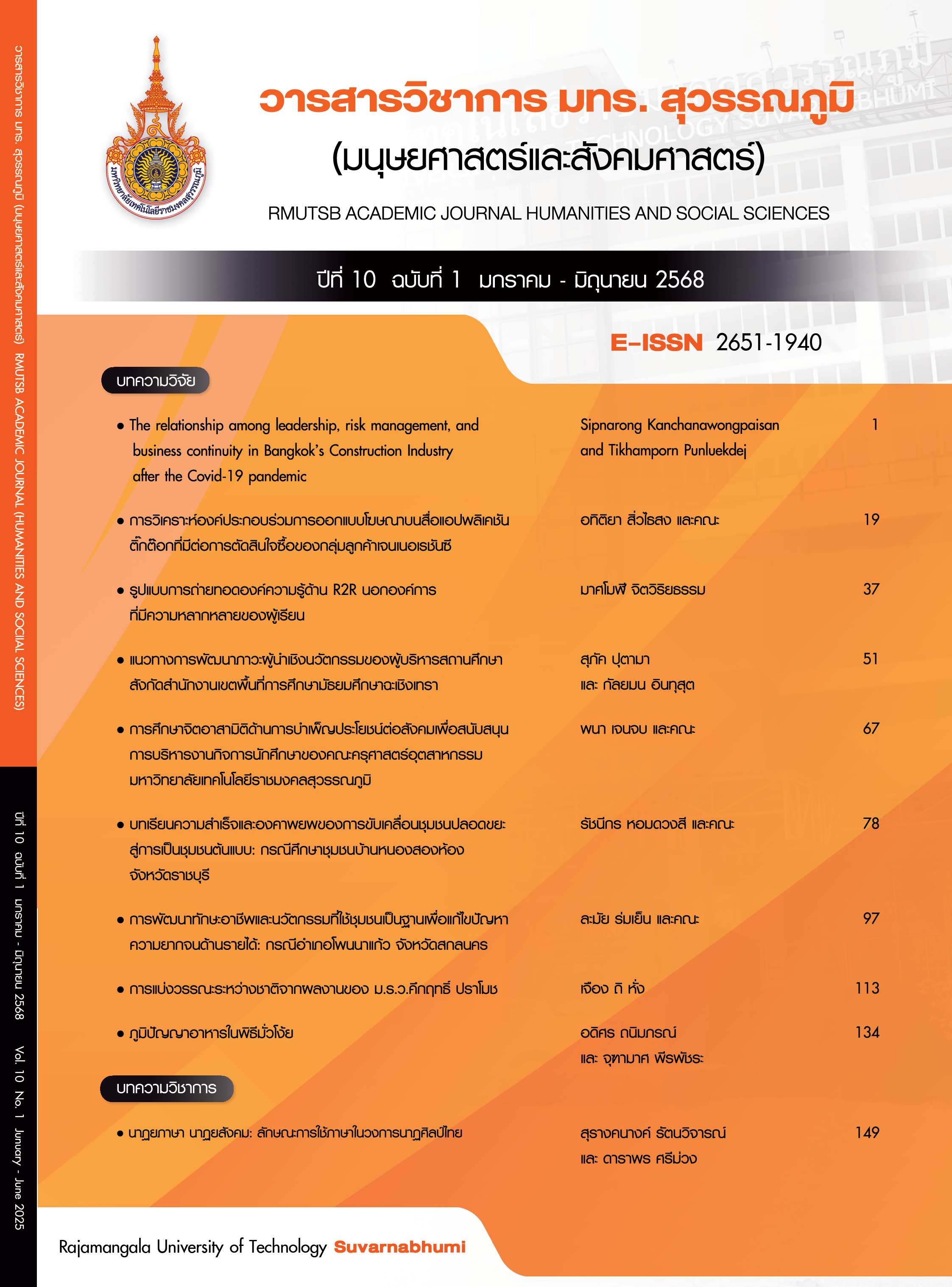
The relationship among leadership, risk management, and business continuity in Bangkok’s construction industry after the COVID-19 pandemic
Article Sidebar
Main Article Content
Abstract
This research investigated the influence of leadership management on the continuation of company operations in Bangkok's construction sector during the COVID-19 epidemic. It also emphasized the significance of risk management as an intermediary in the relationship above. The study examined various aspects of leadership, including vision, communication, motivation, decision-making, adaptation, team building, delegating, continuous development, and ethical conduct. A study using the G*Power software tool resulted in a sample size of 751 construction enterprises. The effect size was determined to be 0.3, with a power of 0.95 and 151 degrees of freedom. Structural Equation Modeling (SEM) using AMOS software was employed to demonstrate the substantial impact of leadership management on company continuity through risk management.
The statistical analysis results showed X2 = 267.988, df = 106, X2/df = 1.258, p = .053, GFI = .958, AGFI = .984, CFI = .973, TLI = .957, RMSEA = .048, RMR = .014, and NFI = .957. These findings suggested that leadership traits, including flexibility and ethical behavior, were critical in risk management and company continuity. This highlighted the need to incorporate thorough leadership and risk management practices to improve the long-term sustainability of enterprises. The findings underscored the importance of leadership styles that promote proactive risk management. Additionally, it proposed the incorporation of leadership and risk management as a means to enhance the resilience of corporate operations.
Article Details

This work is licensed under a Creative Commons Attribution-NonCommercial-NoDerivatives 4.0 International License.
References
Almandoos Alblooshi, M. A., Mohamed, A. M., & Yusr, M. M. (2023). Leadership, crisis management, and business continuity. South Asian of Social Sciences and Humanities, 4(1), 112-128.
Ametepey, S. O., Frempong-Jnr, E. Y., & Cobbina, J. E. (2022). Leadership style of construction project managers in Ghana. International Journal of Technology and Management Research, 7(1), 53-71.
Antonakis, J., Avolio, B., & Sivasubramaniam, N. (2003). Context and leadership: An examination of the nine-factor full-range leadership theory using the multifactor leadership questionnaire. The leadership quarterly, 14(3), 261-295.
ASEAN. (2017). ASEAN Integration report 2017. Jakarta: ASEAN Secretariat.
Banaitiene, N., & Banaitis, A. (2012). Risk management in construction projects. In N. Banaitiene (Ed.), Risk management - Current issues and challenges (pp. 429-448). London: Intech.
Bass, B. (1990). From transactional to transformational leadership: Learning to share the vision. Organizational Dynamics, 18(3), 19-31.
Carlyle, T. (1841). On heroes, hero-worship, and the heroic in history. London: Chapman & Hall.
Chen, J. (2023). Risk-return tradeoff: How the investment principle works. Retrieved 07 March 2023, from Investopedia: https://www.investopedia.com/terms/r/riskreturntradeoff.asp
Drewitt, T. (2013). A manager's guide to ISO22301. Cambridge: IT Government Publishing.
Durongkaveroj, W. (2023). The Covid-19 pandemic in Thailand: With special reference to informal workers’ problems. In C. Aspalter (Ed.), Covid-19 pandemic (pp. 213-228). Singapore: Springer.
Faul, F., Erdfelder, E., Lang, A.-G., & Buchner, A. (2007). G*Power 3: a flexible statistical power analysis program for the social, behavioral, and biomedical sciences. Behavior Research Methods, 39(2), 175-191.
Fiedler, F. E. (1967). A theory of leadership effectiveness. Ney York: McGraw Hill.
Fresh Editorial. (2022). Bangkok market report – impact of Covid-19. Retrieved 20 August 2022, from Fresh Property: https://freshbangkok.com/bangkok-market-report-impact-of-covid-19/
Galaitsi, S., Pinigina, E., Keisler, J. M., Pescaroli, G., Keenan, J. M., & Linkov, I. (2023). Business continuity management, operational resilience, and organizational resilience: Commonalities, distinctions, and synthesis. International Journal of Disaster Risk Science, 14(6), 1-10.
Gamil, Y., Al-Sarafi, A., & Najeh, T. (2023). Post COVID-19 pandemic possible business continuity strategies for construction industry revival a preliminary study in the Malaysian construction industry. International Journal of Disaster Resilience in the Built Environment, 14(5), 640-654.
Ghosh, S. (1958). A note on stratified random sampling with multiple characters. Calcutta Statistical Association Bulletin, 8(2-3), 81-90.
Habani, M. A., & Kamaruddin, S. (2021). The influence of strategic leadership, business continuity planning and supply chain resilience on organizational performance: Instrument validation. Business Management and Strategy, 12(2), 228-237.
Hair, J. F., G. Tomas, H. M., Ringle, C. M., Sarstedt, M., Danks, N. P., & Ray, S. (2021). Partial least squares structural equation modeling (PLS-SEM) Using R. Cham, Switzerland: Springer.
International Organization for Standardization. (2018). ISO 31000:2018 - Risk management - Guidelines. Geneva: ISO.
Khan, R., Fatima, T., Ramayah, T., Awan, T. M., & Kayani, Z. K. (2021). Community safety behavior in response to the Coronavirus Pandemic. Illness, Crisis & Loss, 31(1), 73-99.
Likert, R. (1932). A technique for the measurement of attitude. New York: The Science Press.
Lisdiono, P., Said, J., Yusoff, H., & Hermawan, A. A. (2022). Examining leadership capabilities, risk management practices, and organizational resilience: The case of state-owned enterprises in Indonesia. Sustainability, 14(1), 1-14.
Low, S. P., Liu, J., & Sio, S. (2010). Business continuity management in large construction companies in Singapore. Disaster Prevention and Management, 19(2), 219-232.
Margherita, A., & Heikkilä, M. (2021). Business continuity in the COVID-19 emergency: A framework of actions undertaken by world-leading companies. Business Horizons, 64(3), 1-14.
Mercuria. (2020). Impact of COVID-19 on Bangkok real estate market 2020. Retrieved 20 August 2022, from Mercuria Investment (Thailand): https://www.mercuriathailand.com/content/1195/impact-of-covid-19-on-bangkok-real-estate-market-2020
Müller, R., & Turner, R. (2010). Leadership competency profiles of successful project managers. International Journal of Project Management, 28(5), 437-448.
NSO. (2023). Statistics on the number of cases, number of houses, and construction area of those permitted to construct Construction area for buildings and buildings not used. Retrieved January 10, 2023, from National Statiscal Office Thailand: https://www.nso.go.th/nsoweb/index?set_lang=en
Pal, I., & Shaw, R. (2022). Pandemic risk, response, and resilience: COVID-19 responses in cities around the world. Oxford: Elsevier.
Piwowar-Sulej, K., & Iqbal, Q. (2023). Leadership styles and sustainable performance: A systematic literature review. Journal of Cleaner Production, 382, 1-14.
Riglietti, G., Piraina, M., & Trucco, P. (2022). The contribution of business continuity management (BCM) to supply chain resilience: a qualitative study on the response to COVID-19 outbreak. Continuity & Resilience Review, 4(1), 145-160.
Schumaker, R. E., & Lomax, R. G. (2010). A beginner's guide to structural equation modeling. New York: Taylor & Francis.
Supriadi, L. S., & Pheng, L. S. (2018). Business continuity management in construction (Management in the built environment). New York: Springer.
Szymański, P. (2017). Risk management in construction projects. Procedia Engineering, 208, 174-182.
UOB. (2020). Effected of COVID-19 toward construction business. Bangkok: UOB.
Vegas-fernandez, F., & Rodríguez Lopez, F. (2019). Risk management improvement drivers for effective risk-based decision-making. Journal of Business Economics and Finance, 8(4), 223-234.
Yarrow, R. (2023). Thailand’s economic dilemmas in post-pandemic Asia. Singapore: ISEAS.
Zheng, E., & Marly, M. (2016). Managing uncertainty in projects: A review, trends and gaps. Revista de Gestão e Projetos, 7(2), 95-109.
