
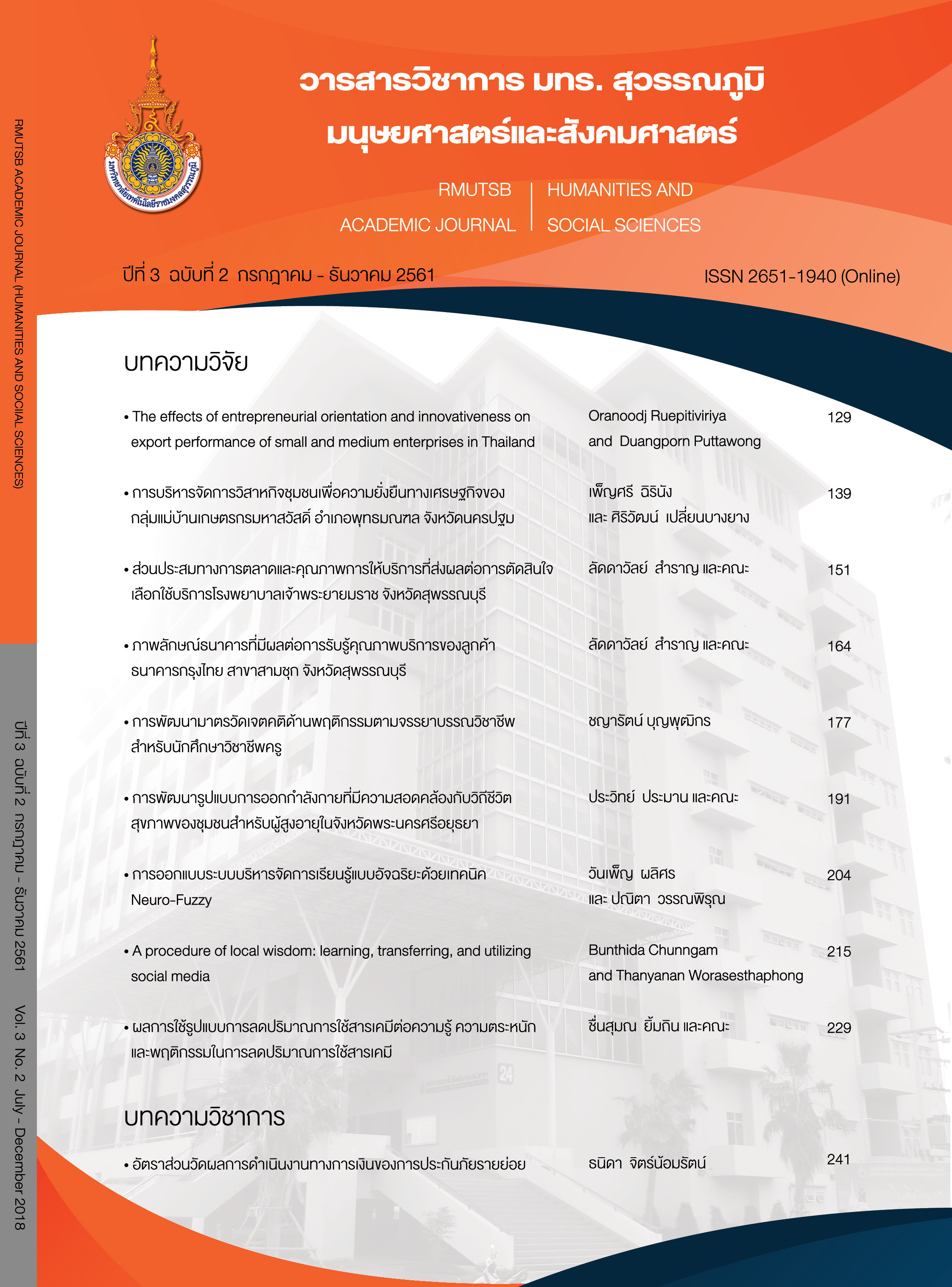
การพัฒนามาตรวัดเจตคติด้านพฤติกรรมตามจรรยาบรรณวิชาชีพสำหรับนักศึกษาวิชาชีพครู
Article Sidebar
Main Article Content
บทคัดย่อ
งานวิจัยนี้มีวัตถุประสงค์เพื่อพัฒนามาตรวัดเจตคติด้านพฤติกรรมตามจรรยาบรรณวิชาชีพสำหรับนักศึกษาวิชาชีพครู และเพื่อสร้างเกณฑ์การแปลความหมายคะแนนของมาตรวัดที่ได้พัฒนาขึ้น ซึ่งการดำเนินการวิจัยแบ่งออกเป็น 2 ขั้นตอน ได้แก่ ขั้นตอนที่ 1 การพัฒนามาตรวัด โดยการตรวจสอบความตรงเชิงเนื้อหาตามจรรยาบรรณวิชาชีพครู การหาค่าความเที่ยงของมาตรวัด และการวิเคราะห์คุณภาพรายข้อของข้อคำถามตามทฤษฎีการตอบสนองข้อสอบ ขั้นตอนที่ 2 การสร้างเกณฑ์การแปลความหมายคะแนนของมาตรวัดเจตคติด้านพฤติกรรมตามจรรยาบรรณวิชาชีพครู กลุ่มตัวอย่าง ได้แก่ นักศึกษาชั้นปีที่ 4 หลักสูตรทางการศึกษา ปีการศึกษา 2560 จากสถาบันผลิตของหน่วยงานภาครัฐ กลุ่มมหาวิทยาลัยราชภัฏ 7 สถาบัน จำนวน 537 คน ได้มาจากการสุ่มแบบหลายขั้นตอน ผลการวิจัยมีดังนี้
1. มาตรวัดเจตคติด้านพฤติกรรมตามจรรยาบรรณวิชาชีพสำหรับนักศึกษาวิชาชีพครูมีข้อคำถามทั้งสิ้นจำนวน 34 ข้อ โดยข้อคำถามทุกข้อผ่านเกณฑ์การตรวจสอบความตรงเชิงเนื้อหา (I-CVI ≥ 0.80) มีค่าความเที่ยงทั้งฉบับเท่ากับ 0.92 และข้อคำถามผ่านเกณฑ์การวิเคราะห์คุณภาพรายข้อตามทฤษฎีการตอบสนองข้อสอบ โดยมีค่าความสอดคล้องของข้อคำถามอยู่ระหว่าง 0.56 ถึง 0.77 และมีค่าสถิติ OUTFIT MNSQ ทั้งฉบับอยู่ระหว่าง 0.63 -1.37 และค่าสถิติ INFIT MNSQ ของทั้งฉบับอยู่ระหว่าง 0.67-1.38
2. เกณฑ์การแปลความหมายคะแนนของมาตรวัดที่พัฒนาขึ้นประกอบด้วย คะแนนดิบ ตำแหน่งเปอร์เซ็นต์ไทล์ คะแนนซี คะแนนทีและสเตไนน์ ซึ่งแบ่งระดับเจตคติด้านพฤติกรรมตามจรรยาบรรณวิชาชีพของนักศึกษาวิชาชีพครูออกเป็น 5 ระดับ (ดีมาก ดี ปานกลาง ค่อนข้างไม่ดี และ ไม่ดี)
Article Details
เอกสารอ้างอิง
ชัยวิชิต เชียรชนะ. (2013). Multidimensional analysis. วารสารศึกษาศาสตร์, 32(4), 13-22.
ราชบัณฑิตยสถาน. 2556. พจนานุกรมฉบับราชบัณฑิตสถาน พ.ศ. 2554 (พิมพ์ครั้งที่ 2). กรุงเทพฯ: นานมีบุคส์พับลิเคชั่นส์.
สุกัญญา ทองนาค, ศิริชัย กาญจนวาสี, และ สุพจน์ เกิดสุวรรณ์. (2013). การพัฒนาแบบทดสอบวัด สมรรถนะนักศึกษาครุศาสตร์/ศึกษาศาสตร์ ตามมาตรฐานวิชาชีพครูที่มีการตรวจให้คะแนนแบบพหุวิภาค. SDU Research Journal Humanities and Social Sciences, 9(1), 169-188.
สมนึก ภัททิยธนี. (2549). การวัดผลการศึกษา (พิมพ์ครั้งที่ 5). กาฬสินธุ์: ประสานการพิมพ์.
Alfadl, A. A., Ibrahim, M., I. b. M., & Hassali, M. A. A. (2013). Scale development on consumer behavior toward counterfeit drugs in a developing country: a quantitative study exploiting the tools of an evolving paradigm. BMC public health, 13(1), 829-837.
Baghaei, P. (2008). The Rasch model as a construct validation tool. Rasch measurement transactions. Retrieved 29 May 2009, from: http://www.rasch.org/rmt/rmt221a.htm
Crocker, L., & Algina, J. (2008). Introduction to classical and modern test theory. United States of America: Cengage Learning.
Edmonds, W. A., & Kennedy, T. D. (2017). An applied guide to research designs: Quantitative, qualitative, and mixed methods. Los Angeles, USA: Sage.
Graveto, J. M., Cardoso, R. J., & Silva, F. A. (2015). Construction and Validation of the Escala de Comportamentos de Abordagem aos Média por Enfermeiros (Scale of Media Use Behaviours by Nurses). Revista de Enfermagem Referência, 4(7), 61-71.
Gregory, R. J. (2007). Psychological testing: history, principles, and applications. Boston: Pearson/Allyn and Bacon.
Hair, J. F., Black, W. C., Babin, B. J., Anderson, R. E., & Tatham, R. L. (2006). Multivariate data analysis (6th ed). New Jersey: Pearson Education.
Hambleton, R. K., Swaminathan, H., & Rogers, H. J. (1991). Measurement methods for the social sciences series, Vol. 2. Fundamentals of item response theory. Thousand Oaks, CA, US: Sage.
Miller, L. A., Lovler, R. L., & McIntire, S. A. (2013). Foundations of psychological testing: A practical approach (4th ed). Los Angeles: Sage.
Nunnally, J. C., & Bernstein, I. H. (1994). Psychometric theory (3rd ed). New York: McGraw-Hill.
Oguz, A. (2012). Developing a scale for attitudes towards the curriculum development and instruction course. Educational Sciences: Theory and Practice, 12(2), 854-860.
Polit, D. F., & Beck, C. T. (2008). Nursing research: Generating and assessing evidence for nursing practice (8th ed). Philadelphia: Lippincott Williams & Wilkins.
Renthlei, M. L., & Malsawmi, H. (2015). Construction of an attitude scale towards teaching profession: A study among secondary school teachers in Mizoram. International Journal of Art, Humanities and Management Studies, 1(4), 29-36.
Samajima, F. (1994). Estimation of reliability coefficients using the test information function and its modifications. Applied Psychological Measurement, 18(3), 229-244.
Thomas, M. L. (2011). The value of item response theory in clinical assessment: A review. Assessment, 18(3), 291-307.
Uyanik, G. (2016). Investigation of the self-efficacy beliefs in teaching science and attitudes towards teaching profession of the Candidate teachers. Universal Journal of Educational Research, 4(9), 2119-2125.
Wright, B. D., Linacre, J. M., Gustafson, J. E., & Martin-Lof, P. (1994). Reasonable mean-square fit values. Rasch measurement transactions, 8(3), 370.
