
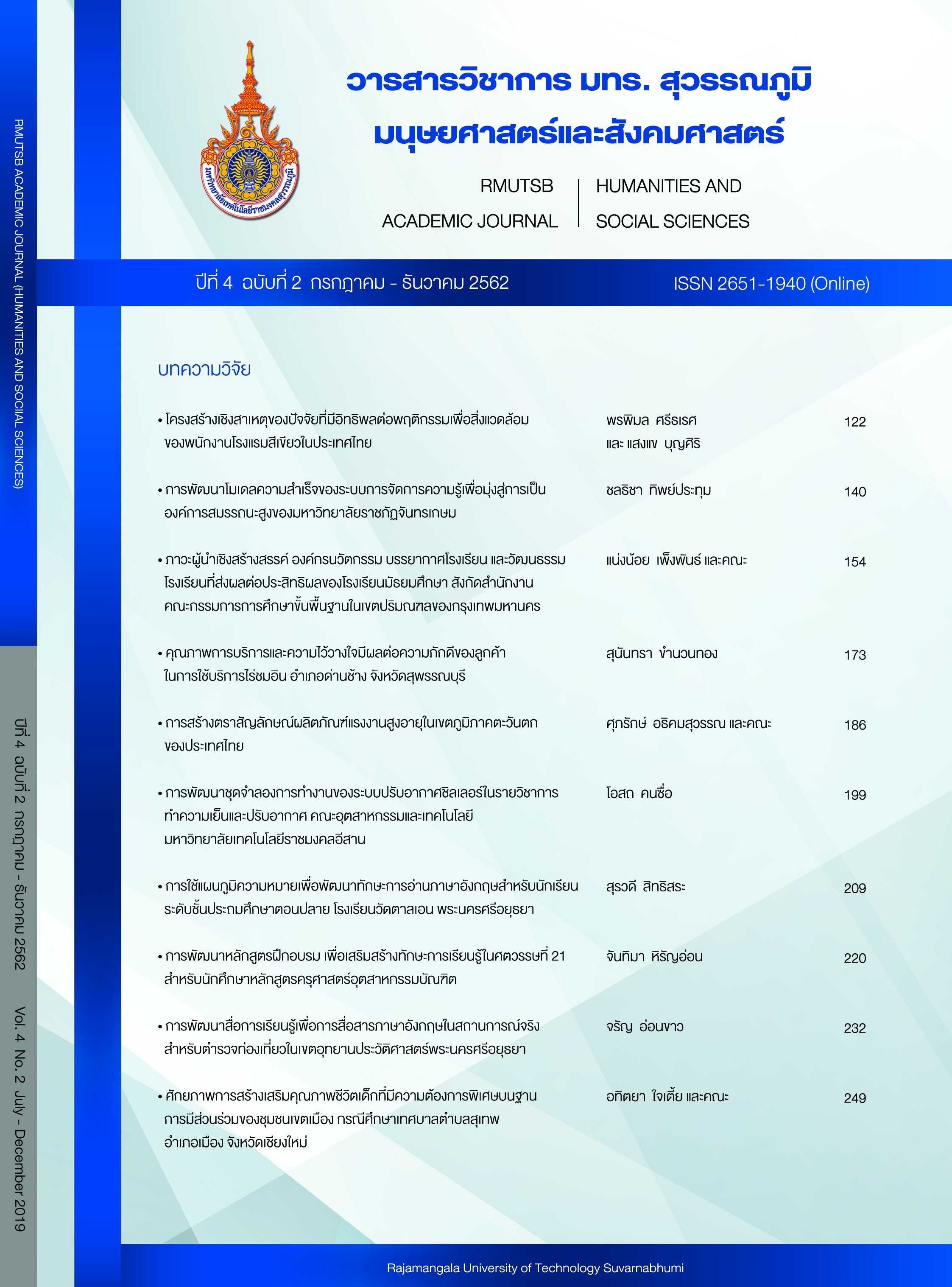
ศักยภาพการพัฒนาคุณภาพชีวิตเด็กที่มีความต้องการพิเศษบนฐานการมีส่วนร่วมของชุมชนเขตเมือง กรณีศึกษาเทศบาลตำบลสุเทพ อำเภอเมือง จังหวัดเชียงใหม่
Article Sidebar
Main Article Content
บทคัดย่อ
การศึกษาครั้งนี้มีวัตถุประสงค์เพื่อศึกษา 1) บทบาทแกนนำสุขภาพชุมชนต่อการสร้างเสริมคุณภาพชีวิตเด็กที่มีความต้องการพิเศษ 2) สังเคราะห์ศักยภาพของชุมชนในการสร้างเสริมคุณภาพชีวิตเด็กที่มีความต้องการพิเศษ ใช้การวิจัยเชิงพรรณนาแบบภาคตัดขวาง ณ เวลาใดเวลาหนึ่ง กลุ่มตัวอย่างเป็นแกนนำสุขภาพชุมชน จำนวน 96 คน และผู้มีส่วนได้เสีย จำนวน 19 คน ในพื้นที่เทศบาลตำบลสุเทพ อำเภอเมือง จังหวัดเชียงใหม่ เก็บรวบรวมข้อมูลด้วยแบบสอบถาม การสัมภาษณ์แบบไม่เป็นทางการ และการสัมมนาเชิงปฏิบัติการณ์แบบมีส่วนร่วม วิเคราะห์ข้อมูลโดยใช้สถิติเชิงพรรณนาและการวิเคราะห์เชิงเนื้อหา ผลการศึกษา พบว่า การปฏิบัติงานตามบทบาทการพัฒนาคุณภาพชีวิตเด็กที่มีความต้องการพิเศษของแกนนำสุขภาพชุมชนโดยรวมเฉลี่ยมีการปฏิบัติระดับปานกลาง (ค่าเฉลี่ยเท่ากับ 1.82) ส่วนศักยภาพชุมชนได้สะท้อนความพร้อมด้านบุคลากรและความต้องการการมีส่วนร่วมในการพัฒนาคุณภาพชีวิตเด็กที่มีความต้องการพิเศษในชุมชน แต่ยังขาดองค์ความรู้ด้านการรักษาโรคที่อยู่ในระดับน้อย และความไม่เพียงพอของงบประมาณจากองค์กรปกครองส่วนท้องถิ่น
Article Details
เอกสารอ้างอิง
Chaiwatthanakunwanit, S., & Rukspollmuang, C. (2016). Alternative edicatopmal provision model to improve quality of life of children with special needs. Journal of Education Graduate Studies Research, 9(1),192-201. (in Thai)
Charatcharungkiat, N., & Wacharasindhu, A. (2013). Quality of life among caregivers of children with autistic spectrum disorders and associated factors. Journal of Psychiatric Association of Thailand, 58(3), 233-244. (in Thai)
Cronbach, L. J. (1951). Coefficient alpha and the internal structure of tests. Psychometrika, 16, 297-334.
Department of Empowerment of Person with Disabilities. (2017). Information on person with disabilities in Thailand 2018. Bangkok: Ministry of Social Development and Human Security. (in Thai)
Division of Public Health and the Environment. (2016). Annual report 2016. Mimeograph. (in Thai)
Kijpredaborisuthi, B. (1988) Social research methodology. Bangkok: Samcharoen Panich. (in Thai)
Matthew, B. M., & Michael, A. H. (1994). Qualitative data analysis: An expanded sourcebook (2nd ed.). California: SAGE.
National Center for Education Statistic. (2018). Children and youth with disabilities. Retrieved November 21, 2018, from https://nces.ed.gov/programs/coe/indicator_cgg.asp
Nitiwatana, D. (2016). Guidelines for relationship building and support for the welfare system for the disabled: Case study Soknoktean Tumbol, Amphur Phon, Khon Kaen Province. Research Community, 128, 91. (in Thai)
The Global Partnership for Education. (2018). Children with disabilities. Retrieved August 2, 2018, From https://www.globalpartnership.org/focus-areas/children-with-disabilities
Tungpunkom, P., & Chailangkarn, K. (2004). Barriers and needs for autistic children care. Retrieved 2 November 2018, from http://www.jvkk.go.th/researchnew/qrresearch.asp?code=0101779 (in Thai)
Wichai, P., & Phon-ngam, P. (2016). A research and development of driving mechanism for community welfare: A case study in Thapho Sub-District, Muang District, Phitsanulok Province. Humanity and Social Science Journal, 7(1), 103 -127. (in Thai)
World Health Organization (WHO). (2011). World report on disability. Retrieved November 12, 2018, from file:///C:/Users/sm/Downloads /9789240685215_eng.pdf
