
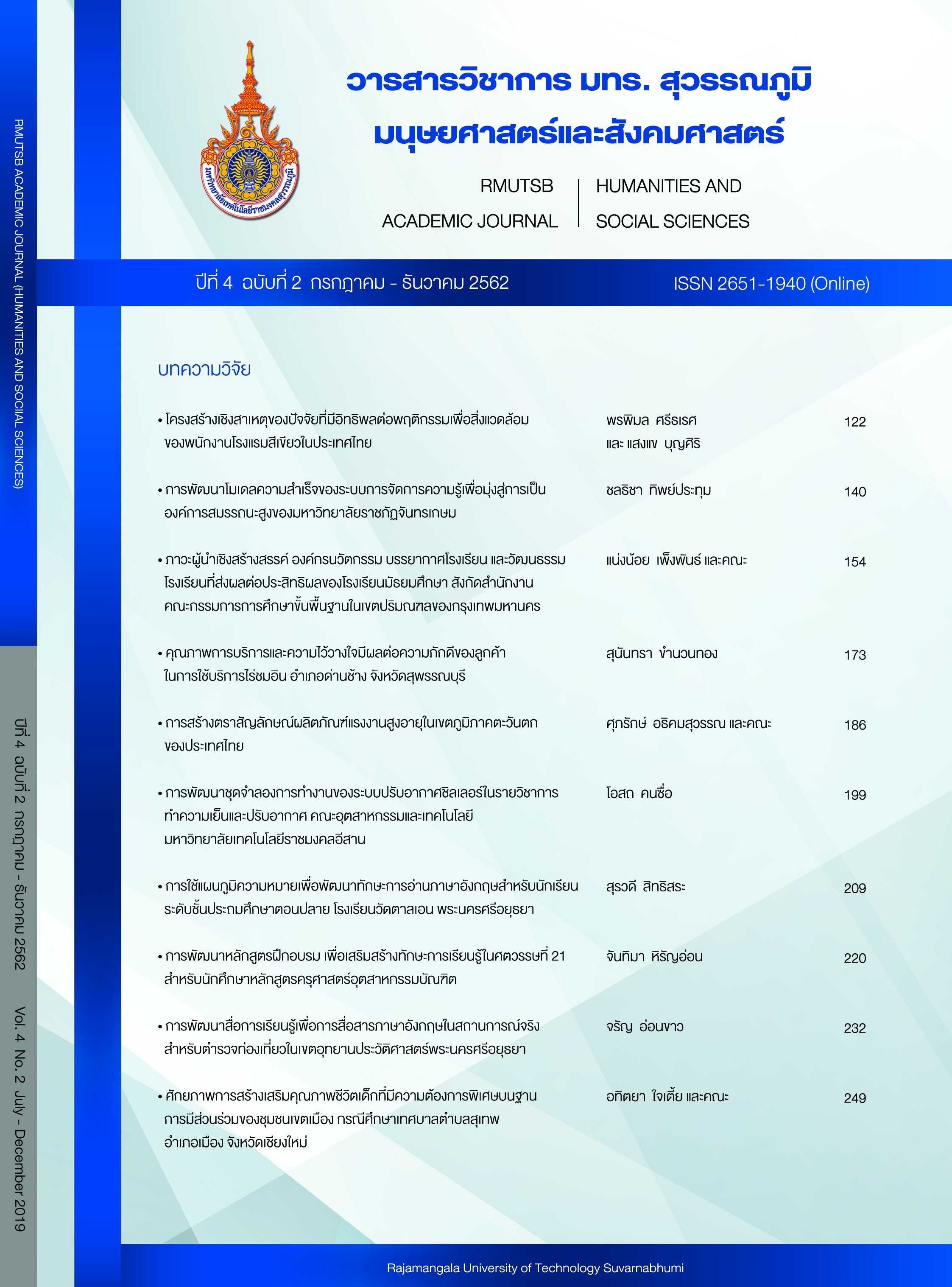
ภาวะผู้นำเชิงสร้างสรรค์ องค์กรนวัตกรรม บรรยากาศโรงเรียน และวัฒนธรรมโรงเรียนที่ส่งผลต่อประสิทธิผลของโรงเรียนมัธยมศึกษา สังกัดสำนักงานคณะกรรมการการศึกษาขั้นพื้นฐานในเขตปริมณฑลของกรุงเทพมหานคร
Article Sidebar
Main Article Content
บทคัดย่อ
การวิจัยนี้มีวัตถุประสงค์เพื่อ 1) ศึกษาความสัมพันธ์ระหว่างภาวะผู้นำเชิงสร้างสรรค์ของผู้บริหารสถานศึกษา องค์กรนวัตกรรม บรรยากาศโรงเรียน และวัฒนธรรมโรงเรียน กับประสิทธิผลของโรงเรียนมัธยมศึกษา 2) สร้างและตรวจสอบความสอดคล้องระหว่างรูปแบบสมมติฐานกับข้อมูลเชิงประจักษ์ และ 3) ศึกษาขนาดและเส้นทางอิทธิพลของภาวะผู้นำเชิงสร้างสรรค์ของผู้บริหารสถานศึกษา องค์กรนวัตกรรม บรรยากาศโรงเรียน และวัฒนธรรมโรงเรียน ที่ส่งผลต่อประสิทธิผลของโรงเรียนมัธยมศึกษา กลุ่มตัวอย่าง คือ ครูจากโรงเรียนมัธยมศึกษา 54 แห่ง จำนวน 795 คน ซึ่งได้มาโดยวิธีการสุ่มตัวอย่างแบบแบ่งชั้นตามสัดส่วน เครื่องมือที่ใช้ในการวิจัยคือ แบบสอบถาม มีค่าความเชื่อมั่นเท่ากับ 0.89 วิเคราะห์ข้อมูลด้วยโปรแกรมสำเร็จรูป ผลการวิจัยพบว่า 1) ตัวแปรที่มีความสัมพันธ์กับประสิทธิผลของโรงเรียนมัธยมศึกษา มี 3 ตัวแปร ได้แก่ ภาวะผู้นำเชิงสร้างสรรค์ บรรยากาศโรงเรียน และวัฒนธรรมโรงเรียน 2) รูปแบบความสัมพันธ์ของตัวแปรที่ส่งผลต่อประสิทธิผลของโรงเรียนมัธยมศึกษา ประกอบด้วย ภาวะผู้นำเชิงสร้างสรรค์มีอิทธิพลทางตรง อิทธิพลทางอ้อม และอิทธิพลรวมอย่างมีนัยสำคัญทางสถิติที่ระดับ 0.01 และส่งอิทธิพลทางอ้อมผ่านบรรยากาศโรงเรียนและวัฒนธรรมโรงเรียน ส่วนบรรยากาศโรงเรียนและวัฒนธรรมโรงเรียนมีอิทธิพลทางตรง และอิทธิพลรวมอย่างมีนัยสำคัญทางสถิติที่ระดับ 0.01 สำหรับองค์กรนวัตกรรมไม่มีอิทธิพลทั้งทางตรง ทางอ้อม และอิทธิพลรวมต่อประสิทธิผลของโรงเรียนมัธยมศึกษา โดยมีความสอดคล้องกับข้อมูลเชิงประจักษ์ (= 90.86, df=92, p=0.51,
/df=0.98, GFI=0.99, AGFI=0.97, NFI=1.00, NNFI=1.00, CFI=1.00, RMR=0.00, SRMR=0.01, RMSEA=0.00) และ 3) ประสิทธิผลของโรงเรียนมัธยมศึกษาได้รับอิทธิพลทางตรงจากภาวะผู้นำเชิงสร้างสรรค์ วัฒนธรรมโรงเรียน และบรรยากาศโรงเรียน โดยมีค่าขนาดอิทธิพลเท่ากับ 0.30, 0.30 และ 0.42 ตามลำดับ และได้รับอิทธิพลทางอ้อมจากภาวะผู้นำเชิงสร้างสรรค์ ผ่านวัฒนธรรมโรงเรียนและบรรยากาศโรงเรียน โดยมีค่าขนาดอิทธิพลเท่ากับ 0.57
Article Details
เอกสารอ้างอิง
Boonchuay, N. (2010). Strategic plan for developing creative leadership suitable for school administrators (Doctoral dissertation). Valaya Alongkorn Rajabhat University, Pathum Thani. (in Thai)
Boonin, R. (2016). factors affecting the effectiveness of schools under the Office of Chonburi Primary Educational Service Area 1 (Master’s thesis). Burapha University, Chonburi. (in Thai)
Casse, P., & Claudel, G. (2007). Philosophy for creative leadership: How philosophy can turn people into more effective leaders. Oregon: Athena Press.
Chaniam, I. (2015). Administrative behavior and school atmosphere affecting the effectiveness of Buddhist Scripture School Department of General Education under the National Buddhism Office (Doctoral dissertation). Kasetsart University, Bangkok. (in Thai)
Chernin, P. (2001). Creative leadership: The strength of ideas the power of the imagination. Vital Speeches of the Day, 68(8), 245.
Cleary, C. (2011). The relationship between positive behavioral interventions and supports implementation level and school climate (Doctoral dissertation). University of Virginia, USA.
Cohen, E., Pickeral, T., & McCloskey, M. (2008). The challenge of assessing school climate. Retrieved 13 August, 2017, from http: //www.ascd.org/publications/educational_leadership.aspx
Cohen, E., Mccabe, E. M., Michelli, N. M., & Pickeral, T. (2009). School climate: Research, policy, practice, and teacher education. Teachers College Record. 111(1), 180-213.
Cordero, A. (2015). Academic resilience of Latino boys attending single-sex high schools in New York city: An examination of four school climate factors (Doctoral Dissertation). University of Virginia, USA.
Couto, A., & Eken. C. (2002). To give their gifts: Health, community, and democracy. Vanderbilt University Press.
Davar, S. (1994). Creative leadership: the people-oriented task approach. USB Publ: Distrib.
Decharin, P. (2003). The importance of innovation in modern competition. Retrieved 20 August 2017, from https:// www.pasu.net (in Thai)
Glickman, C. D., Gordon, S. P., & Ross-Gordon, J. M. (2001). Supervision and instructional Leadership a developmental approach (5th ed.). U.S.A.: Allyn and Bacon.
Hay Group. (2005). The innovative organization: lessons learned from most admired companies. Hay Insight Selections. Retrieved 15 August, 2017, from https://www.haygroup.com/downloads/es/Hay_Insight_Selections_ April_2005.Pdf
Holder, J., & Matter, G. (2008). The innovative organization. Retrieved 9 August, 2017, from https://www.geocities.com/College Park/Library/1048/innova.html
Hoy, K., Smith, P. A., & Sweetland, S. R. (2002). The development of the organizational climate index for high schools: Its measure and relationship to faculty trust. High School Journal, 38(12), 38-49.
Hoy, K., & Furguson, J. (1985). Theoretical framework and exploration organization effectiveness of schools. Educational Administration Quarterly, 21(2), 117-134.
Hoy, K., & Miskel, C. (2001). Educational administration: Theory, research, and practice (6th ed.). New York: McGraw-Hill.
Hoy, W. K., & Miskel, C. G. (2005). Educational administration: Theory, research and practice (7th ed.). New York: McGraw-Hill.
Hoy, W. K., & Miskel, C. G. (2008). Educational administration: Theory, research, and practice. (8th ed.). New York: McGraw-Hill.
Indarapichai. (2009). The relationship between the change of leadership style of the executive and organization climate Chonradsadonamrung School under the Chonburi Educational Service Area Office 1 (Master’s thesis). Burapha University, Chonburi. (in Thai)
Jaimipak, A. (2015). Factors affecting the effectiveness of good schools in the district under the office of Phayao Primary Educational Service Area 1 (Master’s thesis). Phayao University, Phayao. (in Thai)
Kangsamrong, S. (2016). The influence of school administrators' leadership on the effectiveness of educational institutions under the office of Maha Sarakham Primary Education Area Office 1 (Master’s thesis). Maha Sarakham Rajabhat University, Maha Sarakham. (in Thai)
Khejornnan. (2008). Organizational behavior. Bangkok: SE-ED Ucation. (in Thai)
Kuczmarski, D. (2003). What is innovation? and why aren’t companies doing more of it?. Journal of Consumer Marketing, 20(6), 536-541.
Marzano, J. (2003). What works in schools: Translating research into action. Alexandria, VA: Association for Supervision and Curriculum Development.
Miron, J. (2014). school principal influence actions, climate, culture, and school performance. (Doctoral dissertation). Florida Atlantic University, USA.
Muangthong, S. (2010). Factors affecting the effectiveness of ordinary private schools in the eastern region (Doctoral dissertation). Burapha University, Chonburi. (in Thai)
Ngonsai, S. (2009). School climate factors and learning organization affecting school effectiveness under the office of Sa Kaeo Educational Service Area (Master’s thesis). Burapa university, Chon Buri. (in Thai)
Office of Administration of Upper Secondary Education. (2017). Project to develop educational institutions to "Thai Secondary Standard 4.0". Retrieved 20 October 2017, from https://secondary.obec.go.th (in Thai)
Omolade, A. (2007). A systems test of effectiveness of elementary schools in Nigeria. Retrieved 10 August 2017, from https://search.proquest.com.
Ouanwijit, R. (2011). Causal relationship model effectiveness of small elementary schools (Doctoral dissertation). Christian University, Nakhon Pathom. (in Thai)
Palus, J., & Horth, M. (2005). The leader’s edge: Six creative competencies for navigating complex challenges. San Francisco: Jossey Bass.
Patiphan, K. (2012). Creative leadership structure equation model of basic school administrators (Doctoral dissertation). Khon Kaen University, Khon Kaen. (in Thai)
Petkrajang. (2016). Moral change leadership organization culture, learning organization and school effectiveness under the office of primary education area in Nakhon Sawan Province: route analysis. Journal of the Research Society, 21(3), 62-74. (in Thai)
Phakdeelao, W. (2011). The study of the characteristics of the innovation organization: a case study of an organization that has received the Innovation Award (Master’s thesis). National Institute of Development Administration, Bangkok. (in Thai)
Phaphonngam. (2011). School culture and elementary school climate in Thailand (Doctoral dissertation). Khon Kaen University, Khon Kaen. (in Thai)
Poopha. (2015). The study of corporate culture of Dad Darunee School Chachoengsao (Master’s thesis). Burapha University, Chonburi. (in Thai)
Purkey, C. & Smith, S. (1985). School reform: The district policy implications of the effective schools literature. Elementary School Journal, 85(3), 353-389.
Ritbamrung, S. (2013).The creative leadership of school administrators affecting the effectiveness of schools under the Office of Secondary Educational Service Area 30 (Master’s thesis). Khon Kaen University, Khon Kaen. (in Thai)
Robinson, G. (2007). Sexuality and quality of life. Journal of Gerontological Nursing 33(3), 19-27.
Sammons, P., Hillman, J., & Mortimore, P. (1995). Key characteristics of effective schools: A review of school effectiveness research. Retrieved 9 October 2017, from https://files.eric.ed.gov/fulltext/ED389826.pdf.
Sawasdee (2007). Multilevel analysis of variables influencing the effectiveness of secondary schools (Doctoral dissertation). Burapha University, Chonburi. (in Thai)
Scott, C. (2003).Organizational effectiveness: Its relationship to teacher efficacy and school climate. Retrieved 9 October 2017, from https://search.proquest.com.
Seayyongka, M. (2013). Development of creative leadership indicators of school administrators office of the Non-Formal and Informal Education Office of the Permanent Secretary for Education (Doctoral dissertation). Rajabhat Maha Sarakham University, Maha Sarakham. (in Thai)
Seifer, H., & Vornberg. A. (2002). The new school leader for the 21st century: The principalship. Lanham. MD: Scarecrow Press.
Sergiovanni, J., Burlingame, M., Coombs, F. S., & Thurston, P. (1987). Education governance and administration. Englewood Cliffs, NJ.: Prentice-Hall.
Sergiovanni, J. (1991). The principalship: A reflective practice perspective. Needham Heights: Allyn and Bacon.
Sherwood, D. (2001). Smart things to know about innovation and creativity. Oxford: Capstone Publishing Limited.
Sikunchoy, J. (2015). Creative leadership of school administrators affecting school climate under the Office of Chachoengsao Primary Educational Service Area 2 (Master’s thesis). Rajanagarindra Rajabhat University, Chachoengsao. (in Thai)
Simpson, D. (2014). School climate and building highly effective school: How student perception of school structure and supportive learning environments affect their enjoyment of school (Doctoral dissertation). University of Missouri, USA.
Solomon, D., Battistich, V., Watson, M., Schaps, E., & Lewis, C. (2000). A six-district study of educational change: Directs and mediated effects of the child development project. Social Psychology of Education, 4(1), 3-51.
Sousa, A. (2003). The leadership brain: How to lead today's schools more effectively. California: Corwin Press.
Stamm, V. (2008). Managing innovation, design creativity. England: John Wiley & Sons.
Sternberg, J. (2006). The nature of creativity. Retrieved 9 October, 2017, from https://www.cc.gatech.edu/
classes/AY2013cs7601_spring/papers/sternberg_Nature-of-creativity.pdf.
Stoll, L., & Temperley, J. (2009). Creative leadership learning project: an enquiry project for senior leadership teams and local authority officers in South Gloucestershire: final report. Creating Capacity for Learning and South Gloucestershire LA. n.p. (Unpublished report).
Suksrimuang, P. (2014). The relationship between learning organization and school effectiveness under the Office of Nakhon Si Thammarat Primary Education Area Office 3. Journal of Graduate Studies, 11(53), 133-142. (in Thai)
Taengkhao, P. (2013). Development of the effectiveness indicator of high competitive secondary schools under the Office of the Basic Education Commission. Journal of Educational Administration Burapa university, 7(2), 82-83. (in Thai)
Tanguthairuang. (2014). Causal relationship model of effectiveness of small primary schools under the Office of Basic Education Commission in the central region of Thailand (Doctoral dissertation). Christian University, Nakhon Pathom. (in Thai)
Thayotyingyong, Y. (2013). Factors and basic principles of innovation organization. Retrieved 18 October 2017, from https://www.gotoknow.org. (in Thai)
Thongtap, S. (2014). School culture development to promote quality of education in primary schools in the northeast. Journal of Management and Technology Eastern University, 11(1), 77-90. (in Thai)
Tidd, J. Bessant, J., & Pavitt, K. (2001). Managing Innovation. Chicester: John Willey and Son.
Tschannen-Moran, M., Parish, J., & Dipaola, M. (2006). School climate: The interplay between interpersonal relationships and student achievement. Journal of School Leadership, 16(7), 11-14.
Wiratchai, N. (1999). LISREL model: Statistical analysis for research. Bangkok: Chulalongkorn University. (in Thai)
Wiwattananon. S. (2005). Multiple level factors affecting the effectiveness of public secondary schools in Bangkok. Journal of Education, 17(2), 47-62. (in Thai)
Yotyingyong, K. (2009). Organization of innovation: concepts and processes. Bangkok: Chulalongkorn University. (in Thai)
