
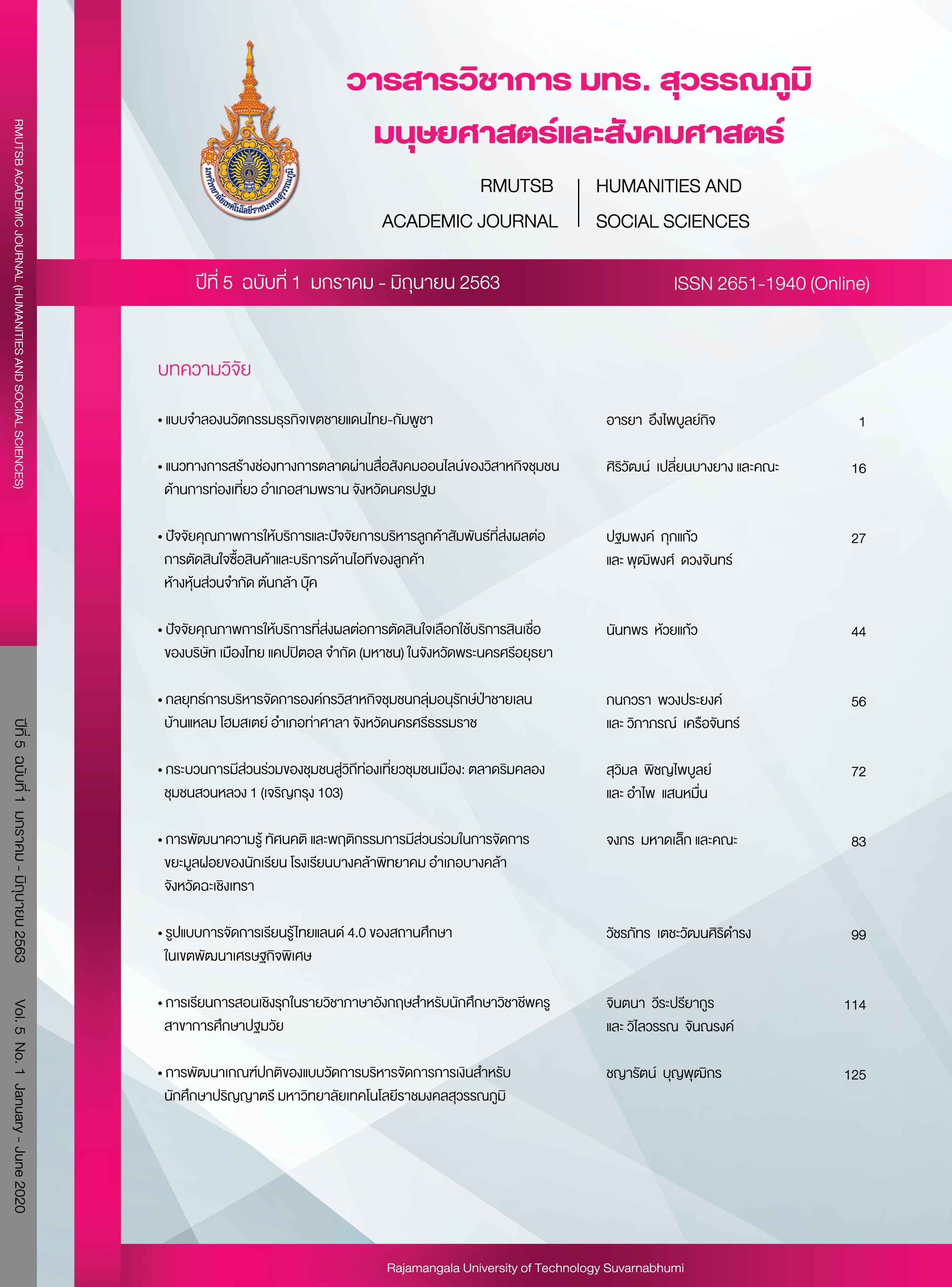
แบบจำลองนวัตกรรมธุรกิจเขตชายแดนไทย-กัมพูชา
Article Sidebar
Main Article Content
บทคัดย่อ
การวิจัยครั้งนี้มีวัตถุประสงค์เพื่อสร้างแบบจำลองนวัตกรรมธุรกิจเขตชายแดนไทย-กัมพูชา กลุ่มตัวอย่าง คือ วิสาหกิจขนาดกลางและขนาดย่อมในจังหวัดบุรีรัมย์ ศรีสะเกษ และสุรินทร์ จำนวน 600 แห่ง ใช้การสุ่มตัวอย่างแบบหลายขั้นตอน เก็บข้อมูลตั้งแต่เดือนมีนาคม ถึงเดือนกรกฎาคม 2562 โดยใช้แบบสอบถาม การวิเคราะห์ข้อมูลด้วยแบบจำลองสมการโครงสร้าง ผลการวิจัยพบว่า แบบจำลองแบบนวัตกรรมธุรกิจเขตชายแดนไทย-กัมพูชา สอดคล้องกับข้อมูลเชิงประจักษ์ โดยตัวแปรทุนทางปัญญา การมุ่งเน้นตลาด องค์การแห่งการเรียนรู้ มีอิทธิพลต่อนวัตกรรม นอกจากนี้ยังพบว่า ตัวแปรนวัตกรรม ทุนทางปัญญา การมุ่งเน้นตลาด และองค์การแห่งการเรียนรู้ มีอิทธิพลต่อผลการดำเนินงาน
Article Details
เอกสารอ้างอิง
Adriansyah, A., & Afiff, A. Z. (2015). Organizational culture, absorptive capacity, innovation performance and competitive advantage: An integrated assessment in Indonesian banking industry. The South East Asian Journal of Management Seam, 9(1), 70-86.
Aini, E. K., Shen, D. C. L., Al Musadieq, M., & Hanayani, S. R. (2013). The role of innovation capability on business performance at small medium enterprises. Journal Profit, 7(1), 101-110.
Angsuchote, S., Vijitwanna, S., & Phinyopanuwat, R. (2015). Statistical analysis for social science research and behavioral: Techniques for using LISREL (4th ed.). Bangkok: Rongphim Charoendi Mankhong Kanphim.
Bartes, F. (2009). Paradigma Inovací a Hodnotové inženýrství. Brno: VUT.
Department of Foreign Trade. (2019). Statistics of border trade and border trade in Thailand 2016-2018. Department of Foreign Trade, Ministry of Commerce. Retrieved July 20, 2019, from http://www.dft.go.th/bts/trade-report. (in Thai)
Frosen, J., Luoma, J., Jaakkola, M., Tikkanen, H., & Aspara, J. (2016). What counts versus what can be counted: The complex interplay of market orientation and marketing performance measurement. Journal of Marketing A head of Print, 80(3), 1-19.
Gebhardt, G. F., Gregory S. C., & John, F. S. (2006). Creating a market orientation: A longitudinal, multifirm, grounded analysis of cultural transformation. Journal of Marketing, 70, 37-55.
Glavas, A., & Mish, J. (2015). Resources and capabilities of triple bottom line firm: Going over old or breaking new ground? Journal Business Ethics, 127, 623-642.
Hana, U. (2013). Competitive advantage achievement through innovation and knowledge. Journal of Competitiveness, 5(1), 82-96.
Jardon, C. M., & Martos, M. S. (2012). Intellectual capital as competitive advantage in emerging clusters in Latin America. Journal of Intellectual Capital, 13(4), 462-481.
Kamukama, N., Ahiauzu, A., & Ntayi, J. M. (2011). Competitive advantage: Mediator of intellectual capital and performance. Journal of Intellectual Capital, 12(1), 152-164.
Khalique, M., Isa, A. H. B. M., & Shaari, J. A. N. B. (2013). Predicting the impact of intellectual capital management on the performance of SMEs in electronics industry in Kuching, Sarawak. The IUP Journal of Knowledge Management, 11(4), 53-61.
Khalique, M., & Hassan, A. (2014). Intellectual capital in SMEs operating in boutique sector in Kuching, Malaysia. The IUP Journal of Management Research, 8(2), 17-28.
Klimas, P. (2014). How objective are subjective measures of organizational innovativeness, really? Management and Business Administration, Central Europe, 22(2), 30-44.
Mutindi, U. J. M., Namusonge, G. S., & Obwogi, J. (2013). Effects of strategic management drivers on organizational performance: A survey of the hotel industry in Kenyan Coast. International Journal of Arts and Commerce, 2(11), 83-105.
Narver, J. C., & Slater, S. F. (1990). The effect of a market orientation on business profitability. Journal of Marketing, 54, 20-35.
Office of Small and Medium Enterprises Promotion. (2017). White paper on small and medium enterprises of Thailand in 2016. Bangkok. Bangkok: Thang Sa-Duak. (in Thai)
Osman, C. A., & Ngah, R. (2016). Assessing sustainable competitive advantage in relation with intellectual capital, knowledge management and innovativeness in woman-owned SMEs in Malaysia. Journal of International Business, Economics and Entrepreneurship, 1(1), 46-51.
Romero, I., & Martine-Roman, J. A. (2012). Self-employment and innovation. Exploring the determinants of innovative behavior in small business. Research Policy, 41(1), 178-189.
Safarzadeh, T., Dahghan, E., Pazireh, M., & Pouraskari, F. (2015). Checking the relationship between strategic leadership, competitive advantage and organizational performance with mediating role of innovation. International Journal of Business and Behavioral Sciences, 5(1), 11-18.
Talaja, A., Miocevic, D., & Alfirevic, N. (2017). Market orientation, competitive advantage and business performance: Exploring the indirect effects. DRUS. ISTRAZ. ZAGREB GOD., 26(4), 583-604.
Ueasin, N., & Kulalar, Y. (2018). A study of the trads situation of entrepreneurs at the Chong Chom border crossing point, Surin Province. Nakhon Phanom University Journal, 8(1), 19-27. (in Thai)
Uengpaiboonkit, A. (2017). The development of causal model of competitive advantage that affects the performance of SMEs in three province, Thailand. ASEAN Journal of Management & Innovation, 4(2), 9-20.
Wijayanto, A., Suhadak, A., Dzulkirom, M., & Nuzula, N. F. (2017). The effect of intellectual capital on financial performance of innovative manufacturing companies in Indonesia: The mediating effect of competitive advantage. In Proceeding The 3rd International Conference on Economics, Business, and Accounting Studies (ICEBAST) 2017. University of Jember: UPT Penerbitan Universitas Jember.
Yasin, G., Nawab, S., Bhatti, K., & Nazir, T. (2014). Relationship of intellectual stimulation, innovations and SMEs performance: Transformational leadership a source of competitive advantage in SMEs. Middle-East Journal of Scientific Research, 19(1), 74-81.
Zainul, M., Astuti, E. S., Arifin, Z., & Utami, H. N. (2016). The effect of market orientation toward organizational learning, innovation, competitive advantage, and corporate performance. Journal of Administrative Sciences and Policy Studies, 4(1), 1-19.
Zhou, K. Z., & Wu, F. (2010). Technological capability, strategic flexibility, and product innovation. Strategic Management Journal, 31, 547-561.
Zin, S. M., Mat, R. C., Manaf, K. A., Muhammad, N., Mansor, F. A., & Hashim, M. Z. (2018). Identifying importance-performance matrix analysis (IPMA) of intellectual capital and Islamic work ethics in Malaysian SMEs. Journal of Fundamental and Applied Sciences, 10(1S), 793-805.
Zulkifli, N. S., Shukor, Z. A., & Rahman, M. R. C. A. (2017). Intellectual capital efficiency and firm performance in Malaysia: The effect to government ownership. Asian Journal of Accounting and Governance, 8(Suppl.), 93-105.
