
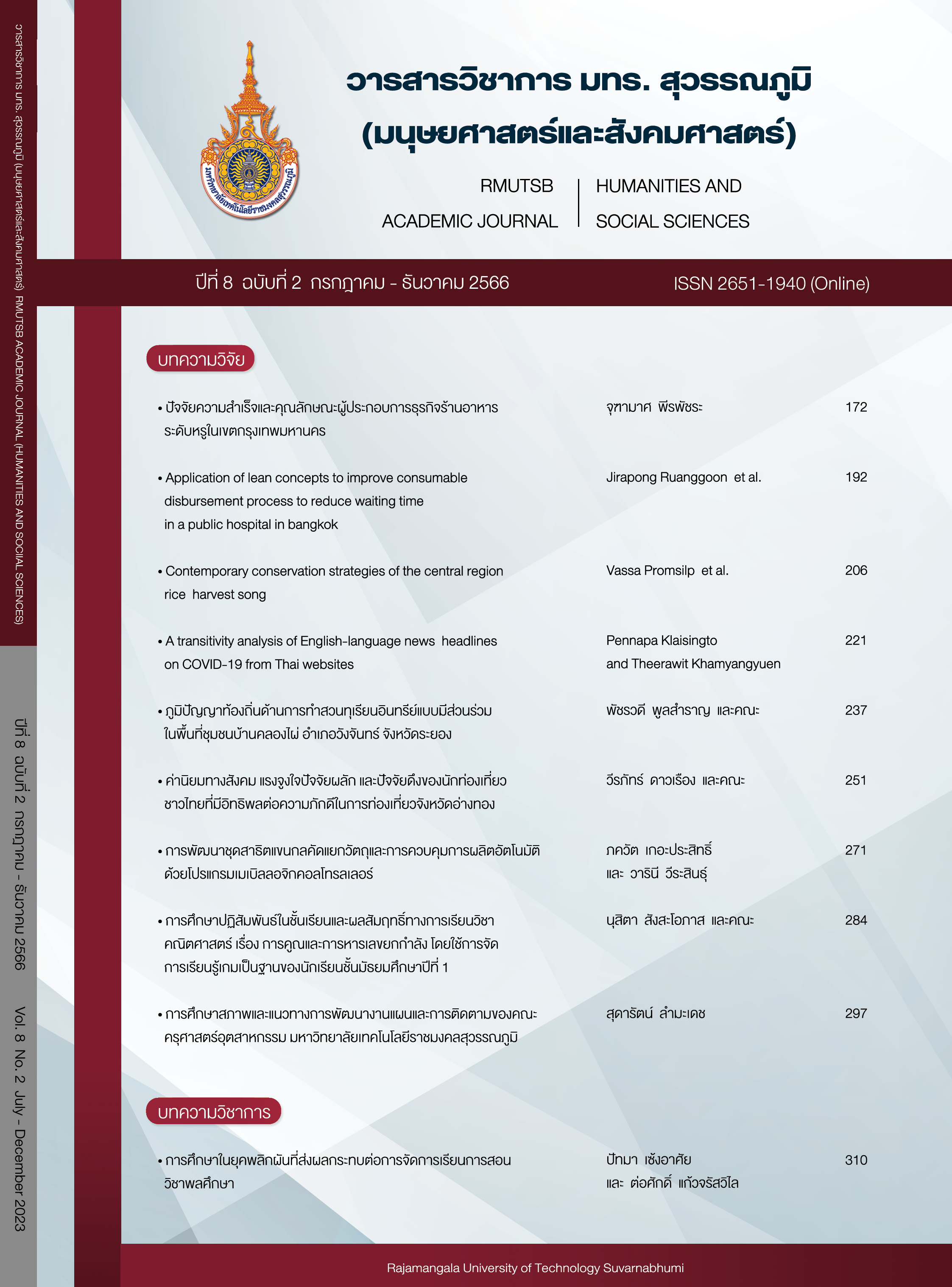
ปัจจัยความสำเร็จและคุณลักษณะผู้ประกอบการธุรกิจร้านอาหารระดับหรูในเขตกรุงเทพมหานคร
Article Sidebar
Main Article Content
บทคัดย่อ
ธุรกิจร้านอาหาร เป็นธุรกิจที่มีศักยภาพสูงเชื่อมโยงกับการเติบโตของอุตสาหกรรมการท่องเที่ยว ในขณะที่ร้านอาหารไทยระดับหรูยังประสบประเด็นท้าทายด้านการฟื้นตัวทางธุรกิจ งานวิจัยนี้เป็นการวิจัยเชิงคุณภาพ ด้วยวิธีปรากฏการณ์วิทยา มุ่งศึกษาข้อมูลการดำเนินธุรกิจร้านอาหาร ปัจจัยความสำเร็จ และคุณลักษณะผู้ประกอบการที่ประสบความสำเร็จในธุรกิจร้านอาหารระดับหรูในเขตกรุงเทพมหานคร ผู้ให้ข้อมูลหลัก คือ เจ้าของหรือผู้ได้รับมอบหมายในการบริหารร้านอาหาร ที่เป็นธุรกิจขนาดกลางและขนาดย่อมประเภทร้านอาหารระดับหรู จำนวน 10 คน ที่มีประสบการณ์ในการบริหารไม่ต่ำกว่า 5 ปี ซึ่งได้จากการสุ่มตัวอย่างแบบลูกโซ่ เก็บรวบรวมข้อมูลโดยการสัมภาษณ์เชิงลึก ตรวจสอบข้อมูลแบบสามเส้า วิเคราะห์โดยการแปลความและตีความข้อมูล ผลการวิจัยพบว่า ปัจจัยความสำเร็จของธุรกิจร้านอาหารระดับหรูในเขตกรุงเทพมหานครมี 7 ด้าน ได้แก่ รูปแบบร้านอาหาร คุณภาพอาหารและบริการที่เป็นเลิศ การตลาดและประชาสัมพันธ์ จริยธรรมทางธุรกิจ สิ่งแวดล้อมทางกายภาพ การบริหารองค์กร และเครือข่ายพันธมิตรทางธุรกิจ สำหรับคุณลักษณะผู้ประกอบการที่ประสบความสำเร็จมี 3 ด้าน ได้แก่ ด้านความรู้ โดยต้องมีความรู้เกี่ยวกับอาหาร การประกอบธุรกิจ เทคโนโลยี ความรู้เกี่ยวกับโลกและการเปลี่ยนแปลง ด้านทักษะ เกี่ยวกับทักษะการกำหนดแนวคิดและรูปแบบร้านอาหาร ทักษะการกำหนดกลยุทธ์ ทักษะการบริหารจัดการ และด้านคุณลักษณะ ได้แก่ มีความเป็นนวัตกรรม มุ่งมั่นในความสำเร็จ มีความสามารถในการแข่งขัน กล้าเผชิญกับความเสี่ยง และซื่อสัตย์
Article Details

อนุญาตภายใต้เงื่อนไข Creative Commons Attribution-NonCommercial-NoDerivatives 4.0 International License.
เอกสารอ้างอิง
Adhikari, B. (2020). Characteristics of successful migrant restaurant entrepreneurs in Finland. Joensuu, Finland: University of Eastern Finland.
Agmapisarn, C., & Julbanyong, B. (2019). Successful factors of Thai restaurant under the Michelin Star Program. Journal of Liberal Arts, Thammasat University, 19(2), 53-82. (in Thai)
Alhelalat, A. J., Habiballah, A. M., & Twaissi, M. N. (2017). The impact of personal and functional aspects of restaurant employee service behaviour on customer satisfaction. International Journal of Hospitality Management, 66, 46-53.
Alieliwa, R. (2006). A study of customer loyalty and the image of the fine dining restaurant (Master’s thesis). Oklahoma State University, Oklahoma.
Bangmo, S. (2015). Organization and management (7th ed.). Bangkok: Wittayapat. (in Thai)
Batat, W. (2022). Consumers’ perceptions of food ethics in luxury dining. Journal of Services Marketing, 36(5), 754-766.
Bharwani, S., & Talib, P. (2017). Competencies of hotel general managers: a conceptual framework. International Journal of Contemporary Hospitality Management, 29(1), 393-418.
Chantavanic, S. (2011). Data analysis in qualitative research (10th ed.). Bangkok: Chulalongkorn University Press. (in Thai)
Chewwasung, K. (2020). Model of customer experience management in Thai full-service restaurant (Doctoral dissertation). National Institute of Development Administration, Bangkok.
Department of Business Development. (2022). Business analysis report. Retrieved January 5, 2023, from https://www.dbd.go.th/download/article/article_20221025094101.pdf (in Thai)
Heonsawang, P., & Jewjinda, C. (2020). Success factors of operating a Thai restaurant business in the United States. Journal of Administrative and Management Innovation, 8(3), 106-115. (in Thai)
Heung-Gyu, S., Moo-Ho, S., & Yeonhee, C. (2015). Environmental factors on the entrepreneurship of successful restaurant establishment. International Journal of Tourism Sciences, 15(3-4), 96-109.
Jeong, M., Kim, K., Ma, F., & DiPietro, R. (2022). Key factors driving customers’ restaurant dining behavior during the COVID-19 pandemic. International Journal of Contemporary Hospitality Management, 34(2), 836-858.
Jin, N., Goh, B., Huffman, L., & Yuan, J. J. (2015). Predictors and outcomes of perceived image of restaurant innovativeness in fine-dining restaurants. Journal of Hospitality Marketing & Management, 24(5), 457-485.
Kasikorn Research Center. (2022). The restaurant business in 2022 is expected to turn around and recover 5.0 - 5.9. Retrieved February 2, 2023, form https://www.kasikornresearch.com/th/analysis/k-econ/business/Pages/restaurant-z3299.aspx?fbclid=IwAR0k6Jw9dEK_HxZk8hu-OsrjbRQi0ESBhz4-s3bn9pUWnISeGkVA61Y3P78 (in Thai)
Khan, M. A. (2020). Technological disruptions in restaurant services: Impact of innovations and delivery services. Journal of Hospitality & Tourism Research, 44(5), 715-732.
Kılıçhan, R., Karamustafa, K., & Birdir, K. (2022). Gastronomic trends and tourists’ food preferences: scale development and validation. International Journal of Contemporary Hospitality Management, 34(1), 201-230.
Langdridge, D. (2007). Phenomenological psychology: Theory, research and method. London: Pearson.
Lim, W. M., Aggarwal, A., & Dandotiya, R. (2022). Marketing luxury services beyond affluence in the new normal: Insights from fine dining during the coronavirus pandemic. Journal of Retailing and Consumer Services, 66, 102936.
Lincharearn, A. (2011). Qualitative data analysis technigques. Journal of Educational Measurement Mahasarakham University, 17(1), 17-29. (in Thai)
Madeira, A., Palrão, T., & Mendes, A. S. (2021). The impact of pandemic crisis on the restaurant business. Sustainability, 13(1), 40.
Mahasingha, C., Surannarak, J., & Charoenthanmanon, W. (2020). Success factors of medium-siged chain restaurant entrepreneurs in Bangkok Metropolitan Region.Journal of Business Administration and Social Science Ramkhamhaeng University, 3(3), 81-99. (in Thai)
Mai, N. K., Do, T. T., & Ho Nguyen, D. T. (2022). The impact of leadership competences, organizational learning and organizational innovation on business performance. Business Process Management Journal, 28(5/6), 1391-1411.
Martín-Martín, D., García, M. J., & Romero, I. (2022). Determinants of digital transformation in the restaurant industry. Amfiteatru Economic, 24(60), 430-446.
Michelin Travel Partner. (2021). The Michelin guide 2021. China: Michelin. (in Thai)
Ministry of Commerce. (2009). Restaurant/restaurant business. Retrieved February 1, 2023, form www.dbd.go.th/download/data_srevice/2sep.doc (in Thai)
Ministry of Industry. (2017). The achievement in implementation of the Government Policy and Industrial strategy fiscal year 2016. Bangkok: Ministry of Industry. (in Thai)
Namsao, V., & Ruanggoon, J. (2021) Social entrepreneurship: A case study of Yimsoo Café, a coffee shop to create job opportunities
for person with disabilities. RMUTSB Academic Journal (Humanities and Social Science), 6(1), 1-18. (in Thai)
Panawong, C. (2020). Qualitative research methods: from concepts, theory to practice (2nd ed.). Phitsanulok: Naresuan University Publishing House. (in Thai)
Panchapakesan, P., Amin, M., & Herjanto, H. (2022). How luxury restaurants will enhance the concept of guest delight. Journal of Hospitality and Tourism Insights, 5(2), 311-330.
Pitjatturat, P., Ruanguttamanun, C., & Wongkhae, K. (2021). Role of entrepreneurial marketing orientation on new product development performance of food retailers: Michelin guide restaurants in Thailand. Journal of Distribution Science, 19(8), 69-80.
Podhisita, C. (2021). Science and art of qualitative research (9th ed.). Bangkok: Amarin. (in Thai)
Poopatanapong, K., & Jearrajinda, N. (2020). The impact of technology development on employee performance. Rajapark Journal, 14(34), 86-100. (in Thai)
Sanon, W., Suantong, K., & Kongprem, N. (2020). The study of local healthy food from identity of community-based tourism for healthy food tourism destination in western Thailand. RMUTSB Academic Journal (Humanities and Social Science), 5(2), 179-195. (in Thai)
Shahzadi, M., Malik, S. A., Ahmad, M., & Shabbir, A. (2018). Perceptions of fine dining restaurants in Pakistan: What influences customer satisfaction and behavioral intentions? International Journal of Quality & Reliability Management, 35(3), 635-655.
Sutheewasinnon, P., & Pasunon, P. (2016). Sampling strategies for qualitative research. Parichat Journal Thaksin University, 29(2), 31-48. (in Thai)
Thammasane, S. (2021). The management model for restaurant business entrepreneurs in new normal age. Journal of Social Science and Buddhistic Anthropology, 6(7), 498-512. (in Thai)
Tourism Authority of Thailand. (2021). Gastronomy tourism. Retrieved February 13, 2023, form https://tourismproduct.tourismthailand.org/2022/10/12/gastronomy-tourism-th-en/ (in Thai)
Verevka, T. V. (2019). Development of industry 4.0 in the hotel and restaurant business. IBIMA Business Review, 2019, 324071.
Vo-Thanh, T., Zaman, M., Thai, T. D-H., Hasan, R., & Senbeto, D. L. (2022). Perceived customer journey innovativeness and customer satisfaction: a mixed-method approach. Annals of Operations Research, 2022, https://doi.org/10.1007/s10479-022-05079-3
Walaiwarangkun, P. (2020). Fine dining restaurant: Difficult business during the COVID-19 crisis. Retrieved February 23, 2023, form https://www.prachachat.net/d-life/news-443934 (in Thai)
Yasami, M., Phetvaroon, K., & Zhu, H. (2022). International tourists’ choices and satisfaction of small restaurants in Thailand: the influence of food safety indicators. Journal of Foodservice Business Research, 25(5), 499-532.
