
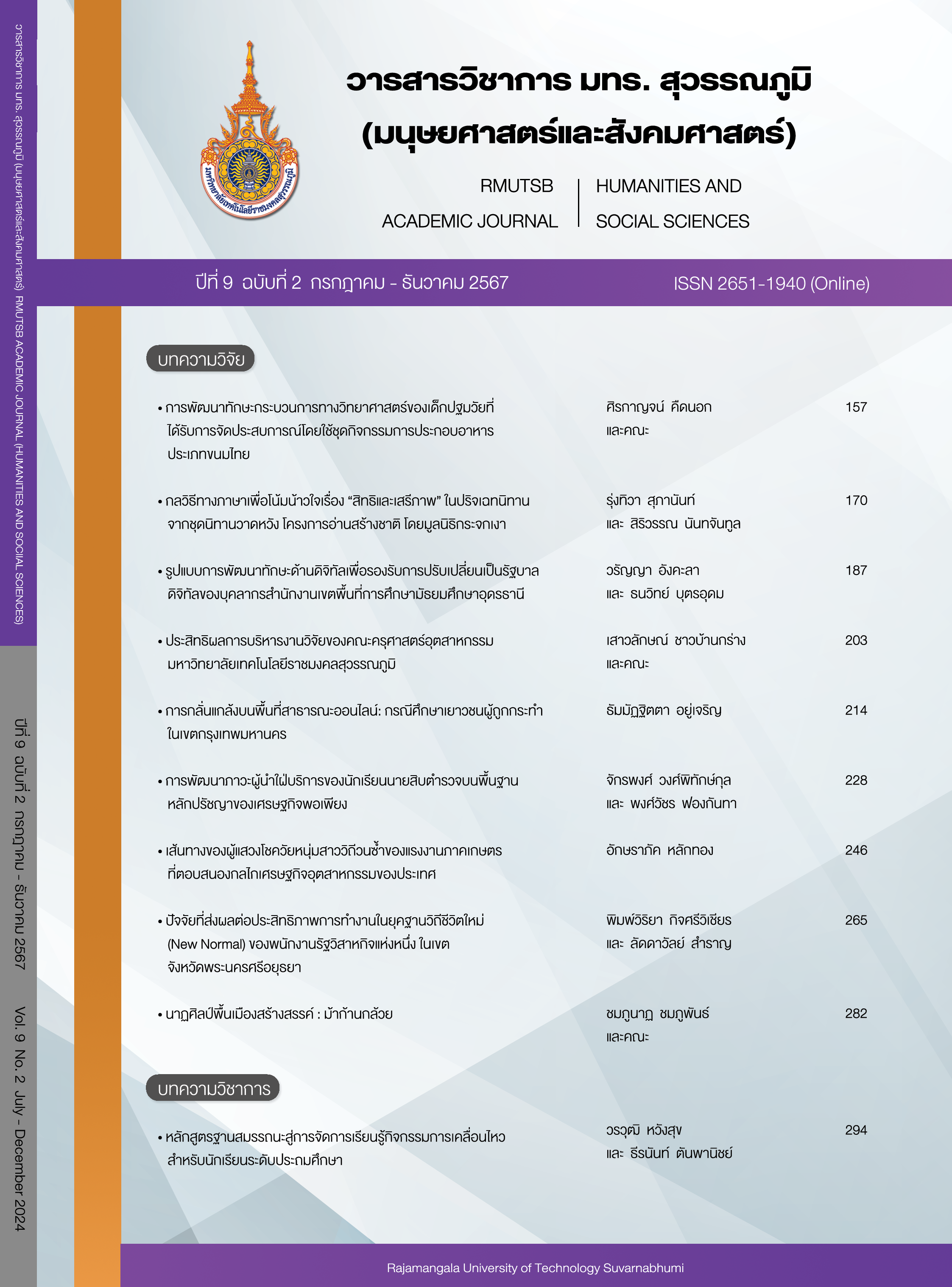
เส้นทางของผู้แสวงโชควัยหนุ่มสาววิถีวนซ้ำของแรงงานภาคเกษตรที่ตอบสนองกลไกเศรษฐกิจอุตสาหกรรมของประเทศ
Article Sidebar
Main Article Content
บทคัดย่อ
ทิศทางการพัฒนาของประเทศให้ความสำคัญกับการเติบโตของภาคเศรษฐกิจอุตสาหกรรมมาอย่างต่อเนื่อง ทำให้การย้ายถิ่นของประชากรวัยแรงงานเข้าสู่เขตอุตสาหกรรมเป็นปรากฏการณ์หนึ่งของแบบแผนชีวิตผู้คน จากพื้นที่ชนบทสู่เขตเศรษฐกิจที่มีความเจริญมากกว่า เป็นวงจรชีวิตของแรงงานภาคเกษตรที่หลั่งไหลเข้าไปเติมเต็มการพัฒนาภาคอุตสาหกรรมของประเทศ การศึกษานี้มีจุดประสงค์เพื่vสะท้อนชีวิตครอบครัวผู้ย้ายถิ่นที่เข้าไปทำงานในนิคมอุตสาหกรรมภาคตะวันออก และเพื่อถอดบทเรียนปรากฏการณ์ดังกล่าว ใช้วิธีการศึกษาแบบผสมผสาน (เก็บข้อมูลระหว่าง พ.ศ. 2564-2565) โดยปีที่ 1 เป็นการวิจัยเชิงปริมาณเพื่อสำรวจโครงสร้างครอบครัวและบริบททางสังคมของผู้ย้ายถิ่น ใช้แบบสอบถามที่สร้างขึ้นในการเก็บข้อมูลจากตัวอย่าง รวมทั้งสิ้น 503 ครัวเรือน ส่วนปีที่ 2 เป็นการศึกษาเชิงคุณภาพ ใช้การสัมภาษณ์เชิงลึก โดยเก็บข้อมูลจากการคัดเลือกกลุ่มตัวอย่าง ปีที่ 1 ที่สะดวกและยินดีให้ข้อมูลอีกครั้ง มีผู้เข้าร่วมโครงการทั้งสิ้น 17 ครัวเรือน ผลการศึกษาพบว่า แรงงานย้ายถิ่นที่เข้ามาทำงานในนิคมอุตสาหกรรมฯ ส่วนใหญ่มาจากภาคตะวันออกเฉียงเหนือ มีสถานภาพสมรสหรือมีครอบครัวแล้ว การดูแลครอบครัวยังคงตกเป็นภาระของแต่ละคนที่ต้องบริหารจัดการกันเองตามบริบทเงื่อนไขชีวิตที่แตกต่างกันไป บางครอบครัวส่งลูกกลับไปให้ปู่ย่าตายายเลี้ยงที่ต่างจังหวัด บางครอบครัวเลี้ยงดูกันเองและจ้างคนอื่นดูแลช่วงกลางวัน การย้ายถิ่นเป็นเหมือนวงจรชีวิตของผู้คนวัยแรงงานต่างจังหวัดที่มีความหวังด้านอาชีพการงานและการมีรายได้ที่ดีกว่าเดิม วิถีการย้ายถิ่นดังกล่าวได้ถูกผลิตซ้ำจากรุ่นสู่รุ่น ทำให้ภาคเกษตรต้องสูญเสียกำลังแรงงานวัยหนุ่มสาวรุ่นแล้วรุ่นเล่า ขณะที่ภาคอุตสาหกรรมจำเป็นต้องรับทรัพยากรมนุษย์ที่มีคุณสมบัติไม่สอดคล้องกับความต้องการในการพัฒนาอย่างแท้จริงข้อเสนอแนะชี้ให้มองการพัฒนาอย่างเป็นองค์รวมและหลากหลายมิติ รวมทั้งสร้างโอกาสและทางเลือกให้กับคนรุ่นใหม่อย่างมีคุณภาพ
Article Details

อนุญาตภายใต้เงื่อนไข Creative Commons Attribution-NonCommercial-NoDerivatives 4.0 International License.
เอกสารอ้างอิง
Amare, M., Hohfeld, L., Jitsuchon, S., & Waibel, H. (2012). Rural-urban migration and employment quality: A case study from Thailand (research report). Phillippines: Asian Development Bank.
Boonkaew, T., Suwannachat, W., & Praneetawatakul, S. (2017). The effects of economic transformation on total factor productivity in Thailand. A Proceedings of The 14th National Kasetsart University Kamphaeng Saen Conference (pp.1565-1573). Nakhon Prathom: Kasetsart University. (in Thai)
Chalamwong, Y. (2015). AEC and agricultural workers. Retrieved 22 September 2020, from https://tdri.or.th/2015/04/aec-and-agricultural-workers/ (in Thai)
Chamratrithirong, A. (2007). Research on internal migration in Thailand: The state of knowledge. Journal of Population and Social Studies, 16(1), 1-20.
Chirinang, P. (2016). Guidelines for improving industrial workers’ quality of life: A case study of Banglamung District, Chonburi Province. Dhonburi Rajabhat University Journal, 10(1), 96-109. (in Thai)
Filmer, D., & Pritchett, L.H. (2001). Estimating wealth effects without expediture data-or tears: An application to educational enrollments in states of India. Demography, 38(1), 115-132.
Jampaklay, A. Vapattanawong, P., Tangchonlatip, K., Richter, K., Ponpai, N., & Hayeeteh, C. (2012). Children Living apart from Parents due to Internal Migration (CLAIM). Nakhon Pathom: Institute for Population and Social Research, Mahidol University.
Khlungkorn, J. (2018). The satisfaction of people in the industrial estate area. A case of map Ta Phut Industrial Estate. Journal of Nakhonratchasima College, 12(1), 245-257. (in Thai)
Kimlengchiu, K., & Srisilaruk, R. (2022). Strategic human resource management in the new normal of the manufacturing industrial enterprises in the Chonburi Industrial Estate. RMUTSB Academic Journal (Humanities and Social Sciences), 7(2), 225-248. (in Thai)
Naksin, S. (2016). The impacts of Rayong Eastern Seaboard industrial estate on Pluak Daeng sub-district community (Master’s thesis). Burapha University, Chonburi. (in Thai)
National Statistical Office. (2019). The 2018 migration survey. Bangkok: National Statistical Office.
Peek, C., Imaem, W., & Tangtanarat, R. (2015). The state of Thailand’s population 2015: Features of Thai families in the era of low fertility and longevity (research report). Bangkok: the United Nations Population Fund Thailand and the Office of the National Economic and Social Development Board. (in Thai)
Phasuk, S. (2015). Behavior of labor migration in Thailand: Can migration explain the wage gap between the agricultural and the non-agricultural sectors: Final report (research report). Bangkok: Thailand Research Fund. (in Thai)
Pholphirul, P. (2012). Labour migration and the economic sustainability in Thailand. Journal of Current Southeast Asian Affairs, 31(3), 59-83.
Piotrowski, M., & Tong, Y. (2010). Economie and non-economic determinants of return migration: Evidence from rural Thailand. Population (English Edition), 65(2), 333-348.
Pratumphithak, S. (2018). The impact on the community caused by the MIE project developed coastal areas of the eastern region: the case of Map Ta Phut Municipality in Muang Rayong. Pathumthani University Academic Journal, 10(2), 82-89. (in Thai)
Ratniyom, A. (2017). Migration on the path of Thailand industrial development. Economics and Public Policy Journal, 8(16), 67-83. (in Thai)
Samutachak, B., Khamsuwan, K., & Nitnara, P. (2019). Vulnerable family: When societal changes harm Thai families and leave many behind. Nakhon Pathom: Institute for Population and Social Research, Mahidol University. (in Thai)
Social Security Office. (2022). Number and rate of employees per 1,000 being in danger. Retrieved 7 September 2023, from https://www.sso.go.th/wpr/main/privilege/ข้อมูลสถิติกองทุนเงินทดแทน_sub_category_list-label_1_169_744 (in Thai)
Vapattanawong, P. (2008). Consistency between socioeconomic status indices constructed by principal component analysis and DiHOPIT model. NIDA Development Journal, 48(3), 125-140. (in Thai)
World Economic Forum. (2017). Migration and Its impact on cities. Retrieved 20 October 2020, from https://www3.weforum.org/docs/Migration_Impact_Cities_report_2017_HR.pdf
Yamane, T. (1973). Statistics: An introduction statistics (2nd ed.). New York: Harper & Row.
