
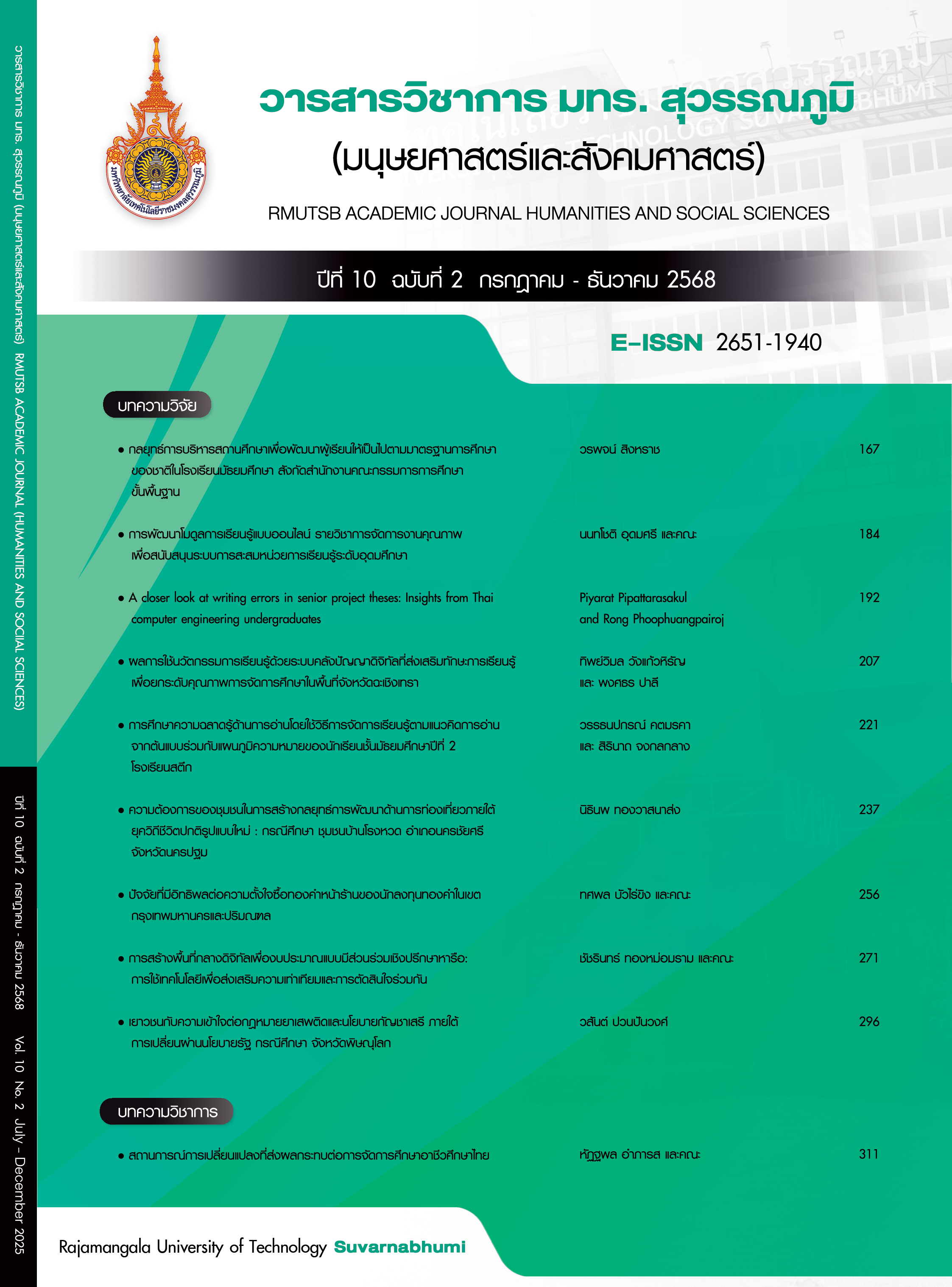
การศึกษาความฉลาดรู้ด้านการอ่านโดยใช้วิธีการจัดการเรียนรู้ตามแนวคิดการอ่าน จากต้นแบบร่วมกับแผนภูมิความหมายของนักเรียนชั้นมัธยมศึกษาปีที่ 2 โรงเรียนสตึก
Article Sidebar
Main Article Content
บทคัดย่อ
การวิจัยในครั้งนี้มีวัตถุประสงค์เพื่อ 1) เปรียบเทียบความฉลาดรู้ด้านการอ่านของผู้เรียนชั้นมัธยมศึกษาปีที่ 2 จากการจัดการเรียนรู้ตามแนวคิดการอ่านจากต้นแบบร่วมกับแผนภูมิความหมายก่อนและหลังเรียน 2) เปรียบเทียบความฉลาดรู้ด้านการอ่านกับเกณฑ์ร้อยละ 70 3) ศึกษาสภาพการจัดการเรียนรู้ของผู้เรียนชั้นมัธยมศึกษาปีที่ 2 จากการจัดการเรียนรู้ตามแนวคิดการอ่านจากต้นแบบร่วมกับแผนภูมิความหมาย กลุ่มตัวอย่างที่ใช้ในการวิจัย ได้แก่ ผู้เรียนชั้นมัธยมศึกษาปีที่ 2/11 จำนวน 32 คน ภาคเรียนที่ 2 ปีการศึกษา 2567 โรงเรียนสตึก สำนักงานเขตพื้นที่การศึกษามัธยมศึกษาบุรีรัมย์ กลุ่มตัวอย่างได้มาโดยการสุ่มแบบกลุ่ม เครื่องมือที่ใช้ในการวิจัย ได้แก่ แผนการจัดการเรียนรู้ตามแนวคิดการอ่านจากต้นแบบร่วมกับแผนภูมิความหมาย จำนวน 6 แผน แผนละ 2 ชั่วโมง เครื่องมือที่ใช้ในการเก็บรวบรวมข้อมูล ได้แก่ แบบวัดความฉลาดรู้ด้านการอ่าน และแบบสัมภาษณ์แบบมีโครงสร้างสภาพการจัดการเรียนรู้ วิเคราะห์ข้อมูลโดยค่าเฉลี่ย ร้อยละ ส่วนเบี่ยงเบนมาตรฐาน และสถิติทดสอบที ผลการวิจัยพบว่า 1) ความฉลาดรู้ด้านการอ่านของผู้เรียนชั้นมัธยมศึกษาปีที่ 2 จากการจัดการเรียนรู้ตามแนวคิดการอ่านจากต้นแบบร่วมกับแผนภูมิความหมายหลังเรียนสูงกว่าก่อนเรียนอย่างมีนัยสำคัญทางสถิติที่ระดับ .05 2) ความฉลาดรู้ด้านการอ่านสูงกว่าเกณฑ์ร้อยละ 70 อย่างมีนัยสำคัญทางสถิติที่ระดับ .05 3) สภาพการจัดการเรียนรู้ พบว่า มีการจัดโต๊ะแบบประชุมเพื่อส่งเสริมปฏิสัมพันธ์ระหว่างผู้เรียน ต้นแบบที่เลือกมีคุณลักษณะที่เป็นกันเอง เป็นมิตร และมีวิธีการที่ทำให้ผู้เรียนประสบความสำเร็จ ส่งผลให้ผู้เรียนมีปฏิสัมพันธ์ที่ดี มีความกระตือรือร้นในการเรียนรู้ และแสดงความคิดที่เปิดกว้างมากขึ้น โดยผู้เรียนกล้าตั้งคำถามและแสดงความคิดเห็นมากขึ้น
Article Details

อนุญาตภายใต้เงื่อนไข Creative Commons Attribution-NonCommercial-NoDerivatives 4.0 International License.
เอกสารอ้างอิง
Bandura, A. (1986). Social foundations of thought and action: A social cognitive theory. Prentice-Hall.
Brooks, D. C. (2012). Space and consequences: The impact of different formal learning spaces on instructor and student behavior. Journal of Learning Spaces, 1(2), 1-12.
Fisher, K. (2005). Linking pedagogy and space: Proposed planning principles. Department of Education and Training, Victoria. https://www.education.vic.gov.au/Documents/school/principals/infrastructure/pedagogyspace.pdf
Heimlich, J. E., & Pittelman, S. D. (1986). Sematic mapping: Classroom applications. International Reading Association.
Kaewkangwan, S. (2002). Thai language learning through semantic mapping. Chulalongkorn University Press. (in Thai)
Khanamkaew, D. (2019). Need of left-handed students about management the classroom atmosphere and supporting the study media: Case study of major community development in Faculty of Humanities and Social Sciences of Nakhon Si Thammarat Rajabhat University. Journal of Educational Innovation and Research, 3(2), 79-98. https://so03.tci-thaijo.org/index.php/jeir/article/view/247302/166807 (in Thai)
Lowery, D. C. (2010). A comparison of the effects of instruction using traditional methods to instruction using reading apprenticeship [Doctoral dissertation, Mississippi State University]. ProQuest Dissertations Publishing. https://www.proquest.com/docview/123456789
Mehdian, N. (2009). Teacher’s role in the reading apprenticeship framework: Aid by the side or sage by the stage. English Languge Teaching, 2(1), 3-12.
Ministry of Education. (2008). Indicators and core curriculum of basic education in the Thai language learning area according to the Basic Education Core Curriculum B.E. 2551 (A.D. 2008). Cooperative League of Thailand Press. (in Thai)
Nanta, C. (2020). The use of semantic mapping activities to enhance reading, writing, and vocabulary skills of Mathayomsuksa 1 students. Yala Rajabhat University Journal, 15(2), 118-190. https://so04.tci-thaijo.org/index.php/yru_human/article/view/243815/165756 (in Thai)
National Economic and Social Development Council. (2022). The 13th National Economic and Social Development Plan (2023–2027). National Economic and Social Development Council. (in Thai)
Office of the Basic Education Commission, & Institute for the Promotion of Teaching Science and Technology. (2024). Reading literacy development set, Book 1: Handbook for using the reading literacy development set. Institute for the Promotion of Teaching Science and Technology. https://d2ieq.ipst.ac.th/#docs (in Thai)
Office of the Education Council. (2008). The development of a national educational standard and learning evaluation criteria. Office of the Education Council, Ministry of Education. (in Thai)
Office of the Private Education Commission. (1988). Self-training manual. Srimuang Printing. (in Thai)
Pansuppswat, T., & Songserm, U. (2024). The development of an English interactive approach and collaborative learning instructional model to enhance reading comprehension ability. Silpakorn University e-Journal (Social Sciences, Humanities, and Arts), 44(2), 12-25. https://so05.tci-thaijo.org/index.php/sujthai/article/view/260565/182004 (in Thai)
Phanchamnan, A. (2024). Personality psychology for the leader. Journal of MCU Humanities Review, 10(1), 385-400. https://so03.tci-thaijo.org/index.php/human/article/view/274567/183675 (in Thai)
Schoenbach, R., Greenleaf, C., & Murphy, L. (2012). Reading for understanding: How reading apprenticeship improves disciplinary learning in secondary and college classrooms. Jossey-Bass.
Sinsanguan, S. (2022). The development of English reading comprehension using semantic mapping and cooperative learning for eleventh grade students. Academic Journal of Mahamakut Buddhist University Roi Et Campus, 11(1), 273-283. https://so01.tci-thaijo.org/index.php/AJMBU/article/view/246719/169978 (in Thai)
Sinatra, R., Stahl-Gemake, J., & Morgan, N. W. (1986). Using sematic mapping after reading to organize and write original discourse. Journal of Reading, 30(1), 4-13. https://eric.ed.gov/?id=EJ339948
Strangman, N., Vue, G., Hall, T., & Meyer, A. (2004). Graphic organizers and implications for universal design for learning: Curriculum enhancement report. National Center on Accessing the General Curriculum (NCAC). http://www.inclusion-ny.org/files/UDLGraphicOrganizers.pdf
Setthaphong, T. (2016). The development of an instructional model based on the reading apprenticeship approach combined with semantic mapping strategies to enhance analytical reading ability of higher education students [Doctoral dissertation, Chulalongkorn University]. Digital Object Identifier. https://doi.nrct.go.th/ListDoi/listDetail/10.14457%2FCU.the.2016.373 (in Thai)
Setthaphong, T., & Ekwanang, W. (2019). Research and development of reading literacy based on PISA using the reading apprenticeship approach among lower secondary school student. Thailand Research Fund. https://digital.library.tu.ac.th/tu_dc/frontend/Info/item/dc:166522 (in Thai)
Thongjeen, S. (2015). Instructional design and learning management. Bueng Kan Education Center. (in Thai)
Uporamai, P. (1980). Instructional system. Sukhothai Thammathirat Open University. (in Thai)
Vygotsky, L. S. (1978). Mind in society: development of higher psychological processes (M. Cole, V. John-Steiner, S. Scribner, & E. Souberman, Eds.). Harvard University Press. https://doi.org/10.2307/j.ctvjf9vz4
Wannarka, R., & Ruhl, K. (2008). Seating arrangements that promote positive academic and behavioural outcomes: A review of empirical research. Support for Learning, 23(2), 89-93. https://eric.ed.gov/?id=EJ796120
Woolner, P., Hall, E., Higgins, S., & Wall, K. (2007). Exploring the impact of the school environment on learning: A review of the literature. International Journal of Educational Research, 46(4), 224-240. https://doi.org/10.1016/j.ijer.2007.09.006
