
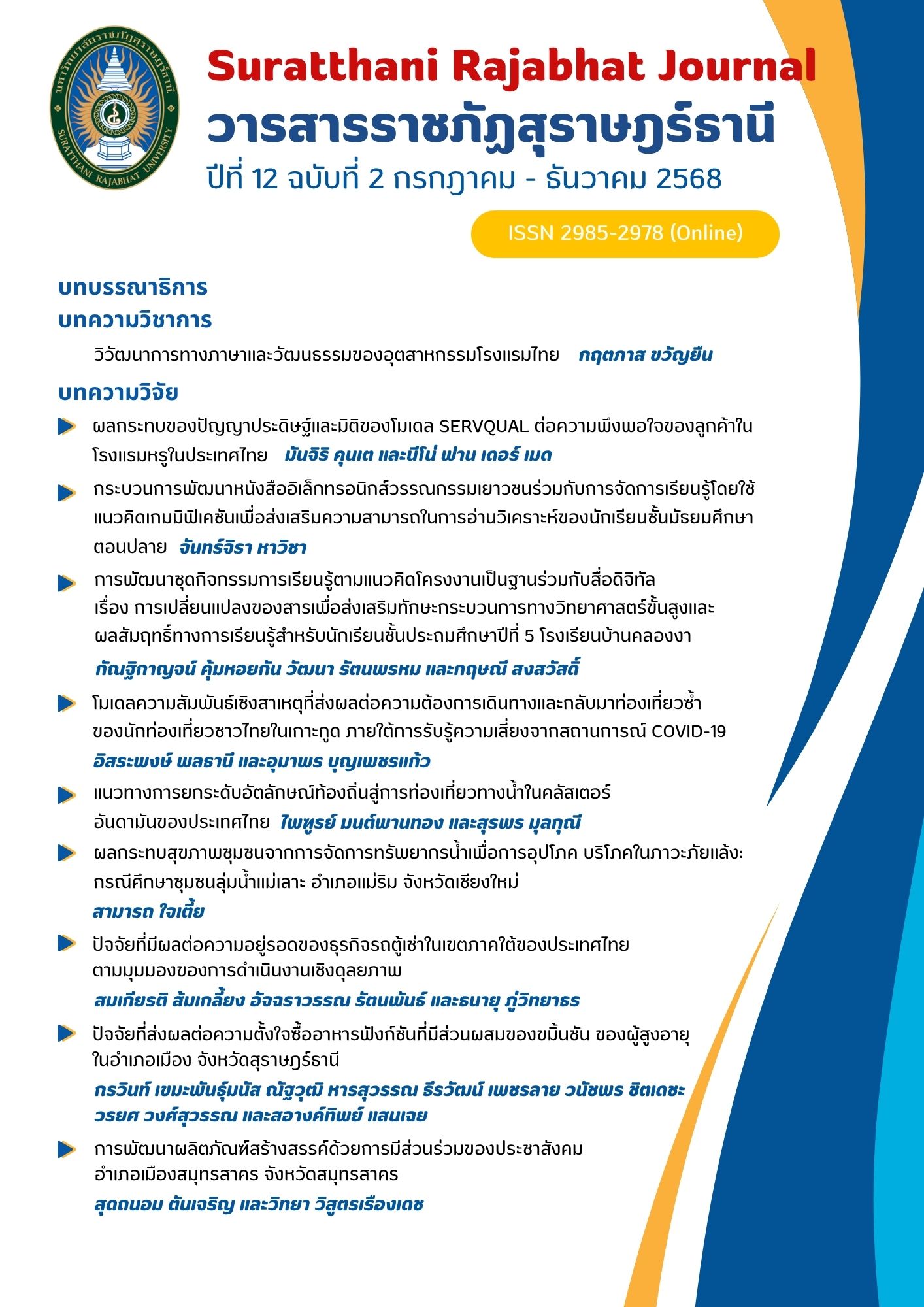
Causal Model Relationships Affecting Thai Tourists' Desire to Travel and Revisit Ko Kut in the Context of Perceived Risks from the COVID-19 Situation
Article Sidebar
Main Article Content
Abstract
The objective of this research was to develop and examine the causal relationships model influencing Thai tourists’ intention to travel and revisit to Koh Kood under the perceived risks from the COVID-19 situation. This study employed a quantitative research design. Data were collected randomly from a sample of 401 Thai tourists who had traveled to Koh Kood, Trat Province, and were analysed using MIMIC model.
The results revealed that the causal model developed based on the hypothesis was consistent with the empirical data. The relative chi-squared value (CMIN/DF) was 1.94, the goodness-of-fit index (GFI) was 0.93, and the comparative fit index (CFI) was 0.96, the root mean square error of approximation (RMSEA) was 0.04, and the normed fit Index (NFI) was 0.92. The findings revealed that tourists’ willingness to travel and their intention to revisit after they were aware of the risks associated with traveling were statistically significant at the 0.05 level. Factors influencing perceived risk included pre-travel impression, travel intentions, and self-awareness of travel-related risks, with positive path coefficients (β) of 0.66, 0.25, and 0.21, respectively. Together, these three factors explained 97% of the variance in perceived travel risk (R² = 0.97). The findings of this study can serve as a practical guideline for entrepreneurs or stakeholders in the area to enhance service delivery, as well as to prepare through the formulation of policies and plans aimed at raising awareness of travel-related risk that tourists may encounter during their travels.
Article Details

This work is licensed under a Creative Commons Attribution-NonCommercial-NoDerivatives 4.0 International License.
References
Arbuckle, J. L. (2019). IBM SPSS Amos 20 user’s guide. New York: IBM.
Abraham, V., Bremser, K., Carreno, M., Crowley, L., & Moreno, M. (2021). Exploring the consequences of COVID-19 on tourist behaviors: perceived travel risk, animosity and intentions to travel. Tourism Management, 76(4), 701-717. https://doi.org/10.1016/j.tourman.2020.103959
Abraham, V., Bremser, K., Carreno, M., Crowley-Cyr, L., & Moreno, M. (2023). Exploring the consequences of COVID-19 on tourist behaviors: Perceived travel risk, animosity, and intentions to travel. Journal of Travel Research, 62(1), 22-36. https://doi.org/10.1177/0047287522108431
Byrne, B. M. (2010). Structural equation modeling with AMOS: Basic concepts, applications, and programming (2nd ed.). Routledge.
Cahyanto, I., Wiblishauser, M., Pennington-Gray, L., & Schroeder, A. (2016). The dynamics of travel avoidance: The case of Ebola in the US. Tourism Management Perspectives, 20, 195-203. https://doi.org/10.1016/j.tmp.2016.08.007
Chin, C.-H., Chin, C.L. & Wong, W.P.-M. (2018). The implementation of green marketing tools in rural tourism: the readiness of tourists, Journal of Hospitality Marketing & Management, 27(3), 261-280. https://doi.org/10.1080/19368623.2017.1359723
Cooper, M. (2005). Japanese tourism and the SARS epidemic of 2003. Journal of Travel & Tourism Marketing, 19(2-3), 117-131. https://doi.org/10.1300/J073v19n02_08
Dolnicar, S. (2005). Understanding barriers to leisure travel: Tourist fears as a marketing basis. Journal of Vacation Marketing, 11(3), 197-208. https://doi.org/10.1177/1356766705052342
Dowling, G. R., & Staelin, R. (1994). A model of perceived risk and intended risk-handling activity. Journal of Consumer Research, 21(1), 119. https://doi.org/10.1086/209380
Economic, Tourism and Sports Division. (2022). Tourism Economy of Thailand, Quarter 1 of the year 2022 and the trend of 2023. https://secretary.mots.go.th/ewtadmin/ewt/policy/download/InfoTorismEconomicReport
Floyd, M. F., Gibson, H., Pennington-Gray, L., & Thapa, B. (2004). The effect of risk perceptions on intentions to travel in the aftermath of September 11, 2001. Journal of Travel & Tourism Marketing, 15(2-3), 19-38. https://doi.org/10.1300/J073v15n02_02
Hair, J. F., Black, W. C., Babin, B. J., Anderson, R. E., & Tatham, R. L. (2010). Multivariate data analysis: A global perspective (7th ed.). Pearson.
Hajibaba, H., Gretzel, U., Leisch, F., & Dolnicar, S. (2015). Crisis-resistant tourists. Annals of Tourism Research, 53, 46-60. https://doi.org/10.1016/j.annals.2015.02.011
Huang, Y., Zhang, M., Gursoy, D., & Shi, S. (2020). An examination of interactive effects of employees’ warmth and competence and service failure types on customer’s service recovery cooperation intention. International Journal of Contemporary Hospitality Management, 32(7), 2429-2451. https://doi.org/10.1108/IJCHM-09-2018-0636
Jackson, M. (2019). Utilizing attribution theory to develop new insights into tourism experiences. Journal of Hospitality and Tourism Management, 38, 176-183. https://doi.org/10.1016/j.jhtm.2018.04.007
Joreskog, K.G. & Sorbom, D. (1996).LISREL 8 : User’s reference guide. Chicago, IL: Scientific Software International
Kline, R.B. (2011). Principles and Practice of Structural Equation Modeling. New York: Guilford Press.
Lam, T., & Hsu, C. (2006). Predicting behavioral intention of choosing a travel destination. Tourism Management, 27(4), 589-599. https://doi.org/10.1016/j.tourman.2005.06.002
Nunnally, J.C., & Bernstein, I.H. (1994). The assessment of reliability. In Psychometric theory (3rd ed., pp. 248-292). New York: McGraw-Hill.
Office of the National Economic and Social Development Board. (2019). National Economic and Social Development Plan, No. 12 (2017-2021). Bangkok.
Rittichainuwat, B.N., & Chakraborty, G. (2009). Perceived travel risks regarding terrorism and disease: The case of Thailand. Tourism Management, 30(3), 410 - 418. https://doi.org/10.1016/j.tourman.2008.08.001
Schumacker, R. E. & Lomax, R. G. (2010).Structural Equation Modeling. (3th ed.). New York: Routledge.
Sonmez, S.F., & Graefe, A.R. (1998). Influence of terrorism risk on foreign tourism decisions. Annals of Tourism Research, 25(1), 112 - 144. https://doi.org/10.1108/TR-03-2019-0043
Sonmez, S., & Tasci, A.D.A. (2019). Characteristics and behaviors of anti-gun and pro-gun travelers. Tourism Review, 75(2), 347-368. https://doi.org/10.1108/TR-03-2019-0043
Sonnichsen, B. (2020, October 28). Gesundheitsminister Spahn zu Herbst- und Winterurlaub: ‘Schönheit Deutschlands genießen’ [Television broadcast]. ARD. www.tagesschau.de/inland/spahnurlaub-coronavirus-101.html
Su, L., Lian, Q., & Huang, Y. (2020). How do tourists' attribution of destination social responsibility motives impact trust and intention to visit? The moderating role of destination reputation. Tourism Management, 77, 346-361.https://doi.org/10.1108/TR-03-2019-0098
Seddighi, H.R., & Theocharous, A.L. (2002). A model of tourism destination choice: A theoretical and empirical analysis. Tourism Management, 23(5), 475-487. https://doi.org/10.1108/TR-03-2019-028
Wilder-Smith, A. (2006). The severe acute respiratory syndrome: Impact on travel and tourism. Travel Medicine and Infectious Disease, 4(2), 53-60. https://doi.org/10.1108/TR-03-2019-0118
