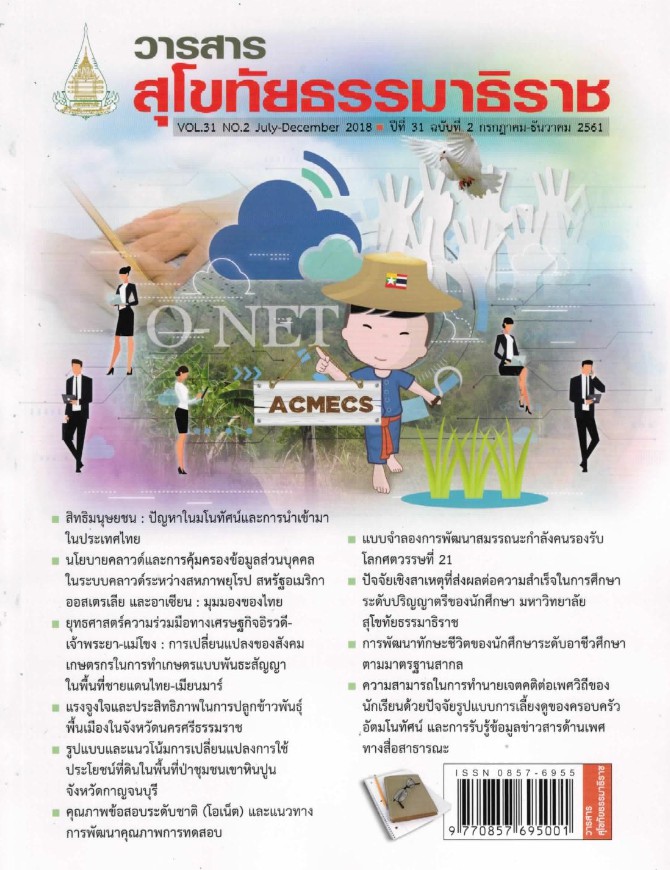
Analysis of the Ordinary National Educational Test Items (O-NET) and Guidelines on the Development of Test Quality
Keywords:
Ordinary National Educational Test, Test quality, Item analysisAbstract
The objectives of this research were : 1) to analyze the quality of the Ordinary National Education Test (O-NET) items in Thai language subject, Social studies, Religion and Culture subject, English language subject, Mathematics subject, and Sciences subject administered from academic year 2011 (B.E. 2554) to 2015 (B.E. 2558) ; and 2) to provide a guideline on the development of item quality. Data were the O-NET item response from students of Grade 6 (Prathomsuksa 6), Grade 9 (Matthayomsuksa 3) and Grade 12 (Matthayomsuksa 6). Data were analyzed through the classical test theory and the item response theory. Qualitative data analysis was used to produce the guideline on the development of item quality. This research revealed that : 1) the majority of O-NET items, analyzed through the classical test theory and the item response theory, met the difficulty criteria and discrimination criteria. Guessing values from the item response theory were quite low. The reliability coefficients ranged from 0.6 to 0.8 and were acceptable. Yet, there were still low reliability coefficients in certain cases. The Thai language subject in 2014 (B.E. 2557) for Prathosuksa 6 (Grade 6) had the reliability coefficient of 0.51 while for Matthayomsuksa 3 (Grade 9) it had the reliability coefficients of 0.37. The tests did not have large amount of items. Therefore, based on this finding, it was concluded that O-NET items had fair quality. To develop item quality, it is needs to increase test length; and 2) according to the proposed roadmap on the development of item quality, there should be determining the item structure that covers standards in the curriculum, developing the items closely relevant to the determined item structure, developing the parallel tests in each year, examining the alignment between the items and the standards in the Basic Education Core Curriculum by using the alignment evaluation method, and equating the test scores across years.
References
Ebel, R. L., & Frisbie, D. A. (1986). Essentials of Educational Measurement. (4th ed.). Englewood Cliffs, New Jersey: Prentice-Hall
OECD. (2012). PISA 2012 Technical Report. Organization for Economic Co-operation and Development.
Webb, N. L. (1997). Research Monograph No.8. Criteria for Aligning of Expectations and Assessments in Mathematics and Science Education. Retrieved June 19th, 2012, from http://facstaff.wceruw.org/normw/WEBBMonograph6criteria.pdf.
-------------. (1999). Research Monograph No.18. Alignment of Science and Mathematics Standards and Assessments in Four States. Washington, DC: Council of Chief State School Officers.
Downloads
Published
How to Cite
Issue
Section
License
บทความที่ได้รับการตีพิมพ์เป็นลิขสิทธิ์ของวารสารมหาวิทยาลัยสุโขทัยธรรมาธิราช
ข้อความที่ปรากฏในบทความแต่ละเรื่องในวารสารวิชาการเล่มนี้เป็นความคิดเห็นส่วนตัวของผู้เขียนแต่ละท่านไม่เกี่ยวข้องกับมหาวิทยาลัยสุโขทัยธรรมาธิราช และคณาจารย์ท่านอื่นๆในมหาวิทยาลัยฯ แต่อย่างใด ความรับผิดชอบองค์ประกอบทั้งหมดของบทความแต่ละเรื่องเป็นของผู้เขียนแต่ละท่าน หากมีความผิดพลาดใดๆ ผู้เขียนแต่ละท่านจะรับผิดชอบบทความของตนเองแต่ผู้เดียว
ห้ามนำข้อความทั้งหมด หรือบางส่วนไปพิมพ์ซ้ำ เว้นแต่จะได้รับอนุญาตจากกองบรรณาธิการวารสาร

