The influence of the family on the prevention of new drinkers in teenagers
Keywords:
Alcohol consumption, Teenagers, FamilyAbstract
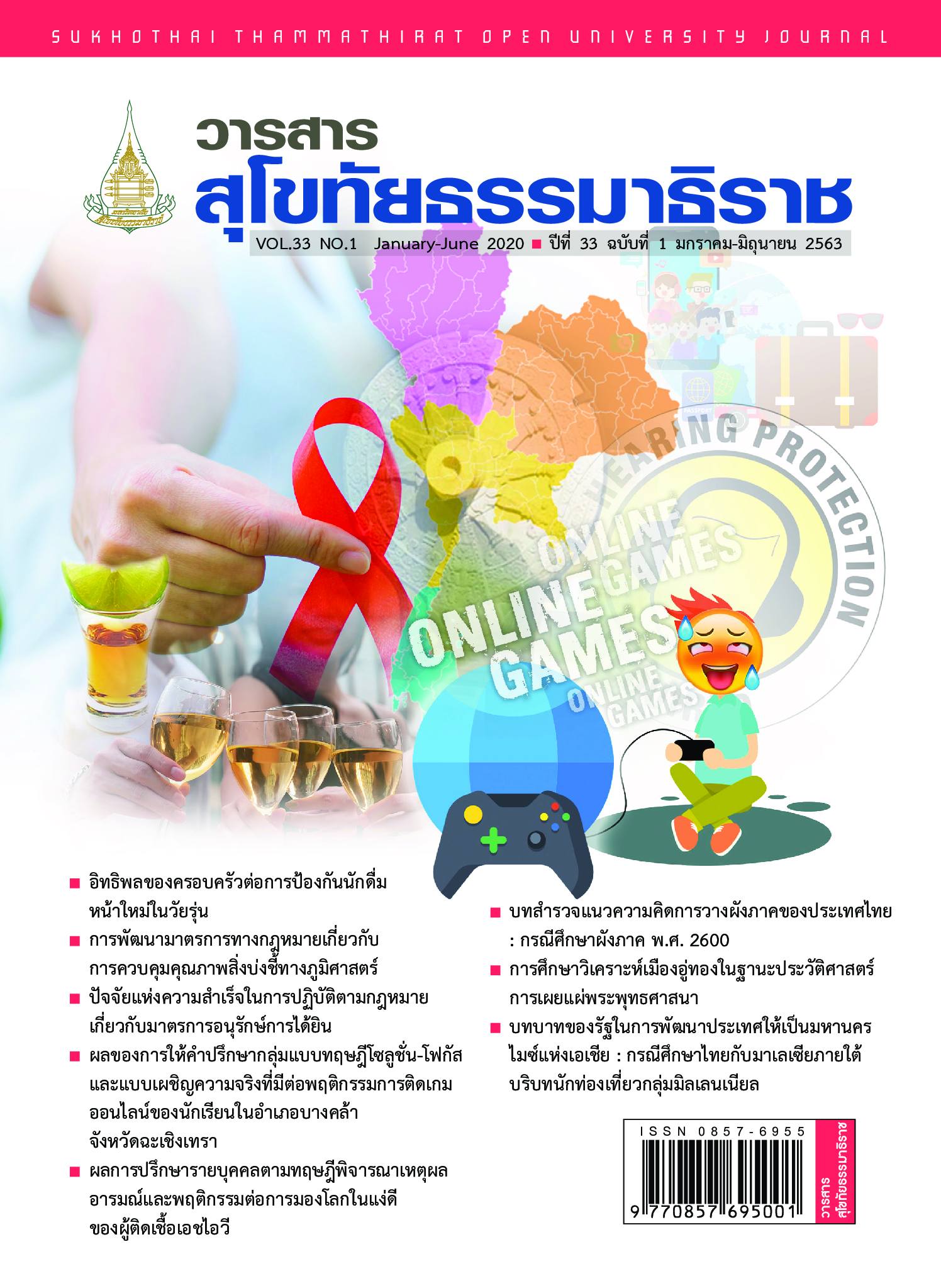
Alcohol consumption is one of the risk factors leading to premature death. Despite the national policy prohibiting the sale of alcohol to people aged less than 20 years old, but the incidence of new drinkers in teenagers aged 15-19 years old are also high (13.94%) (CAS, 2019) compared to other age groups. Considered as an important public health problem in the country. From such problems, both the public and private sectors have realized the importance of the problem, has issued a policy together with a campaign to jointly solve problems from various factors that are related to alcohol drinking behavior in teenagers such as gender, age, grade point average, other drug use, subjective norm from friends. In addition to these factors, family context such as alcohol drinking behavior and acceptance of alcoholic beverages of family members, that is one of the factors that is important to the behavior of alcohol drinking in teenagers. Because the family institution is the main institution to instill values, attitudes, beliefs, behaviors, cultures and social roles for children. The behavioral expression should, therefore, start from having a role model and having a good family relationship in order to strengthen the family institution, as a protective barrier and as the main institution to prevent various risk behaviors that may occur with children in the future.
References
Aussanangkornchai, S. (2004). Alcohol: Caring for patients with alcohol dependence problems in general practice, 20(9), 701-708. (in Thai)
Autsaha, J. (2016). Articles of important situations, alcohol control. Retrieved August 15, 2019, from Chulalongkorn University: https://www.nurs.chula.ac.th/th/content_page/download/275/299/15.html (in Thai)
Bausorn, R., & Punnathikul, R. (2012). Alcohol Consumption Behavior of Bachelor's Degree Students in Bangkok University. Ramathibodi Nursing Journal, 18(2), 259-71. Retrieved August 1, 2019, from Web site: https://www.tci-thaijo.org/index.php/RNJ/article/view/8981 (in Thai)
Bureau of Non Communicable Disease. (2015). Report on the Survey of Non-communicable Disease and Injury Behavior Survey 2015 (Health Zone Level). Retrieved August 1, 2019, from Bureau of Non Communicable Disease Web site: http://www.thaincd.com/2016/news/hot-news-detail.php?id=10517&gid=16 (in Thai)
Center for Alcohol Studies. (2019). Situation report alcoholic beverage consumption in Thai society for the year 2017. Bangkok: Sahamitkanpim (1992); 51-64. (in Thai)
Chansaeng, S., Ketrat, K., Nan-udon, R., Komolmalai, W., Soonthorn, S., & Sutheeprasert, T. (2018). Factors relating to alcohol consumption behaviors among secondary school male students in Nonthaburi province. Community Health Development Academy Khon Kaen University. 6(2): 197-213 (in Thai)
Chirapradispol, R. (2018). Prevalence and factors associated with new students drinker in Bangkok Metropolitan high schools. Journal of Public Health Nursing, 32(2), 155-171. (in Thai)
Green, L.W., & Kreuter, M.W. (1999). Health promotion planning an educational and ecological approach. (3rd ed.). California: Mayfield;.
Hamechayat, A., & Yodnil, S. (2012). Factors Related to Alcohol Drinking among Female Students in High School Khao Kitchakut District Chantaburi Province. Journal of Education and Social Development, 8: 115-128. (in Thai)
Junaim, S. (1999). Developmental Psychology. Bangkok:Thaiwattanapanich. (5th ed.). (in Thai)
Kheaw-on, M., Sangon, S., & Nintachan, P. (2016). Factors relating to drinking behavior in Navy non commissioned officer students. The Journal of Psychiatric Nursing and Mental Health, 30(3), 36-51. (in Thai)
National Institute on Alcohol Abuse and Alcoholism [NIAAA]. (2003). Assessing alcoholic problems: a guide for clinicians and researchers. Betheda: Nation Institutes of Health Publication.
Phupaibul, R. (2004). Health promotion in youth with participation. Bangkok: Ltd.Noble. (in Thai)
Powwattana, A. (2011). Health Promotion and Disease Prevention in Communities: Application of Concepts and Theories in Practice. Bangkok: Klangnanawithaya.; 162-189. (in Thai)
Putnam, R.D. (1993). Making Democracy Work: Civic Traditions in Modern Italy. Princeton: Princeton University Press.
Siripong, W., & Aphisamacharayothin, P. (2018). PRECEDE Framework analysis that related to alcoholic drinking behaviors of bachelor degree female students in a university, Phitsanulok Province. Thaksin University Library Journal, 7(2018), 91-110 Retrieved August 1, 2019, from Thaksin University Web site: file:///C:/Users/User/Downloads/Documents/113-47474781-1-PB.pdf (in Thai)
Thepnhu, J. (1997). Factors influencing alcohol drinking among upper secondary school students in Phatthalung Province. Faculty of Graduate Studies, Mahidol University. (in Thai)
Urberg, K., Goldstein, M.S., Toro, P.A., et al. (2005). Supportive relationships as a moderator of effects of parent and peer dinking on adolescent drinking. J Res Adolesc.; 15(1): 1-19.
World Health Organization. (2018). Global status report on alcohol and health 2018. Retrieved August 1, 2019, from Geneva: World Health Organization Web site: https://www.who.int/substance_abuse/publications/global_alcohol_report/gsr_2018/ en/
Downloads
Published
How to Cite
Issue
Section
License
บทความที่ได้รับการตีพิมพ์เป็นลิขสิทธิ์ของวารสารมหาวิทยาลัยสุโขทัยธรรมาธิราช
ข้อความที่ปรากฏในบทความแต่ละเรื่องในวารสารวิชาการเล่มนี้เป็นความคิดเห็นส่วนตัวของผู้เขียนแต่ละท่านไม่เกี่ยวข้องกับมหาวิทยาลัยสุโขทัยธรรมาธิราช และคณาจารย์ท่านอื่นๆในมหาวิทยาลัยฯ แต่อย่างใด ความรับผิดชอบองค์ประกอบทั้งหมดของบทความแต่ละเรื่องเป็นของผู้เขียนแต่ละท่าน หากมีความผิดพลาดใดๆ ผู้เขียนแต่ละท่านจะรับผิดชอบบทความของตนเองแต่ผู้เดียว
ห้ามนำข้อความทั้งหมด หรือบางส่วนไปพิมพ์ซ้ำ เว้นแต่จะได้รับอนุญาตจากกองบรรณาธิการวารสาร

