
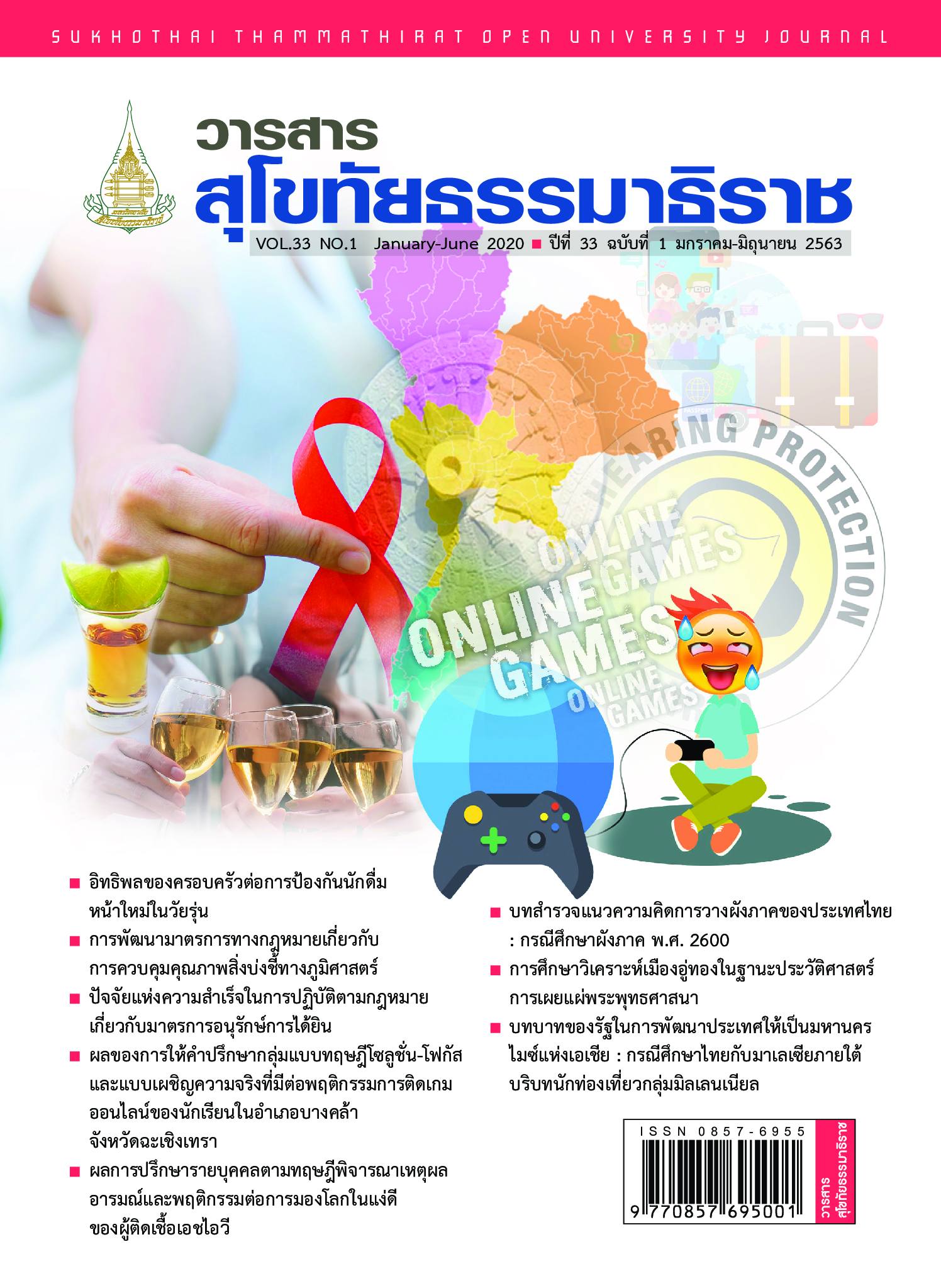
Results of Solution-Focused Brief Therapy in Groups and Reality Therapy Groups Affecting the Online Game Playing Behavior of the Students in Bangkhla District, Chachoengsao Province
Keywords:
Solution-Focused Brief Therapy in Groups /Groups and Reality /Online GameAbstract
This research aimed at surveying the online game playing behavior of the students in Bangkhla District, Chachoengsao Province, creating the model of Solution-Focused Brief Therapy in Groups associated with Reality Therapy Groups affecting the behavior of playing online games, and studying the results of Solution-Focused Brief Therapy in Groups and Reality Therapy Groups affecting the online game playing behavior. The research population consisted of 4,613 students who enrolled in 1st and 2nd semester of Year 2016 in Bangkhla District, Chachoengsao Province. Questionnaires to survey the students' behavior of playing online games were used. The sample group was selected by the purposive sampling, comprising of 385 students, which was calculated by Taro Yamane formula. The Game Addiction Screening Test (GAST) for children and teenagers was used for collecting data. In this research, an experimental group of nine students was conducted using Solution-Focused Brief Therapy in Groups and Reality Therapy Groups affecting the online game playing behavior of the students at Bangkhla Phitthayakhom School. Statistics used in this research were min, max, mean, standard deviation, and One-way ANOVA.
The research results were:
- In terms of the online game playing behavior of 385 students in Bangkhla District, Chachoengsao Province, according to the Game Addiction Screening Test (GAST) for children and teenagers, it showed that 211 male students had total score lower than 24 so they were be classified in normal group and no violence of problems were found from playing online games. While 174 female students had the total score lower than 16 so they were classified in normal group and no violence of problems were found from playing online games.
- In terms of game addiction of the students before and after the experiment and monitoring period, it showed that the results before experiment were different from the results after experiment with the statistical significance of 0.5. After the experiment, the level of game addiction was lower and no differences were found between after the experiment and the monitoring period.
References
Anantakoon, T., Krisanan, W., Chaisakda, S., & Thuwasetthakun, C. (2547). Thai Children and Teenagers on the Internet, the Creative and Dangerous Perspective. Factors Related to Behavior and Playing Computer Games of Secondary School Students in Bangkok. Bangkok : National Electronics and Computer Technology Center.(in Thai)
Anderson, H., & Goolishiam, H. (1992).The Client is the Expert : A Not-knowing Approcach Therapy.In S. McNamee & K.J. Gergen (Eds.) Therapy as Social Construction (pp.25-39).Newbury Park, CA:Sage.
Bertolino. (2010). Collaborative, Competency-based Counseling and Therapy. Boston: Allyn & Bacon.
Bubenzer, D.L., & West, J.D. (1993). William Hudson O’Hanlon: On Seeking Possibilities and Solutions in Therapy. The Family Journal: Counseling and Therapy for Couples and Families, 1(4), 365-379.
Charleswort, J.R., & Jackson, M. (2004). Solution-focused Brief Counseling : An Approach for Professional School Counselors. In B.T. Erford (Ed.), Professional School Counseling:A Handbook of Theories, Program & Practice. p.p. 139–148. Austin, TX: CAPS Press.
Charoenrat, T., Chalerm, W., Tansiri, A., Sirathatnararot, T., Kulnaphadon, T., Pongmode V., & Athipanchapong, T. (2556). The research project to develop a spatial management network to analyze the situation and drive the development of quality of life for children and youth in the eastern region. Bangkok: Thailand Research Fund.(in Thai)
Corey, M.S., Corey, G. & Corey, C. (2004). Groups Process and Practice. (3rd ed.) CA: Brooks/Cole. Cengage Learning.
Corey, M.S., Corey, G. & Corey, C. (2012). Groups Process and Practice. (9th ed.) CA: Brooks/Cole. Cengage Learning.
Daosumang, N. (2549). The Factors Related to Computer Game Playing Behavior of Secondary School Students in Bangkok. A Thesis for the Degree of Master of Program in Home Economics Education. Kasetsart University.(in Thai)
De Jong, P., & Berg, I.K. (2002). Interviewing for Solutions. (2nd ed.) Pacific Grove, CA: Brooks/cole.
De Shazer, S. (1988). Clues: Investigating Solutions in Brief Therapy. New York : W.W. Norton & Company.
Hoff, L.A. (1995). People in Crisis: Understanding and Helping (4th ed.). San Francisco: Jossey-Bass.
Horchareon, A. (2557). The Relationship between Self-control and Online Gaming Behavior of Junior High School Students. Independent Research: Master of Education of Educational Psychology and Guidance Program. Chiang Mai University. http://laptemilk.exteen.com/(online), 2013 (Retrieved January 2015).(in Thai)
Jacobs, E., Masson, L., & Harvill, L. (2002). Group Counseling Strategies and Skills. (4th ed.) CA: Brook/Cole.
Kale, D., & Little, S. (2005). Edge Generation in Developing Countries: A Theoretical for Exploring Dynamic Learning in High-technology Firms in The Electronic Journal of Knowledge Management 3(2):87-96. [Online]. Available from: http://www.ejkm.com. [10 July 2014].
Karen, R., & Andrew, S. (2002). The Resilience Factors: Seven Key to Finding Your Inner Strength and Overcoming Life’s Hurdles. Three Rivers Press, An Imprint of the Crown Publishing Group, A division of Random House, Inc., New York.
Kelman, H.C. (1963). The Role of the Group in the Education of Therapeutic Change. International Journal of Group Psychotherapy. Vol.13.
Laptemilk. Knowledge About the Game. http://laptemilk.exteen.com/(online), 2013 (Retrieved January 2015)
Mahajarearn, J. (2547). The Study Behavior and Impact of Online Game Media Exposure of High School Students in Mueang District Nakhon Pathom Province. Bangkok : A Thesis for the Degree of Master. Faculty of Journalism and Mass Communication. Thammasat University.(in Thai)
Metcalf, L. (1998). Solution-focused Group Therapy : Ideas for Groups in Private Practice,Schools, Agencies, and Treatment Program. New York: Free Press.
Murphy, J.J. (2008). Solution-focused Counseling in Schools. Alexandria, VA: American Counseling Association
Nakornthap, A. (2545). Educational Management by Family: Home School. Bangkok: Office of the National Education Commission.(in Thai)
O’Hanlon, W.H., & Weiner-Devis, M. (2003). In Search of Solutions: A New Direction in Psychotherapy. New York: Norton.
Piamyoosuk, T. (2549). Behavior Patterns for Playing Online Games of Children and Adolescents. Bangkok: A Thesis for the Degree of Master. Faculty of Journalism and Mass Communication. Thammasat University.(in Thai)
Sennan, T. (2549). The Behavior and Effects of Addiction to Online Games of Group Game Players at the Student. Chulalongkorn University.(in Thai)
Siriyurasak, U. (2547). Children Television Advertisements: The Collection of Academic Articles about the Impact that Children Receive from the Media and Guidelines for Management. Bangkok: Children for Development Foundation.(in Thai)
Sklare, G.B. (2005). Brief Counseling that Works: A Solution-focused Approach for School counselors and Administrators. Thousand Oaks, California: Corwin Press & The American School Counselor Association.
Tophan, P. (2550). The Important Factors that Influence the Motivation of Teenagers in Playing Online Games. Bangkok: Ramkhamhaeng University.(in Thai)
Walter, J.L., & Peller, J.E. (1992). Becoming Solution-focused in Therapy. New York : Brunner/Mazel, INC.
Wisetsin, T. (2551). The Online Game Exposure Behavior and Opinions of Secondary School Students in Bangkok Towards Violence in Online Games. Bangkok: A Thesis for the Degree of Master. Faculty of Journalism and Mass Communication. Thammasat University.(in Thai)
Wubbolding, R.E. (2000). Reality Therapy for the 21st century. Muncie, IN: Accelerated Development (Taylor & Francis group).
Downloads
Published
How to Cite
Issue
Section
License
บทความที่ได้รับการตีพิมพ์เป็นลิขสิทธิ์ของวารสารมหาวิทยาลัยสุโขทัยธรรมาธิราช
ข้อความที่ปรากฏในบทความแต่ละเรื่องในวารสารวิชาการเล่มนี้เป็นความคิดเห็นส่วนตัวของผู้เขียนแต่ละท่านไม่เกี่ยวข้องกับมหาวิทยาลัยสุโขทัยธรรมาธิราช และคณาจารย์ท่านอื่นๆในมหาวิทยาลัยฯ แต่อย่างใด ความรับผิดชอบองค์ประกอบทั้งหมดของบทความแต่ละเรื่องเป็นของผู้เขียนแต่ละท่าน หากมีความผิดพลาดใดๆ ผู้เขียนแต่ละท่านจะรับผิดชอบบทความของตนเองแต่ผู้เดียว
ห้ามนำข้อความทั้งหมด หรือบางส่วนไปพิมพ์ซ้ำ เว้นแต่จะได้รับอนุญาตจากกองบรรณาธิการวารสาร

