
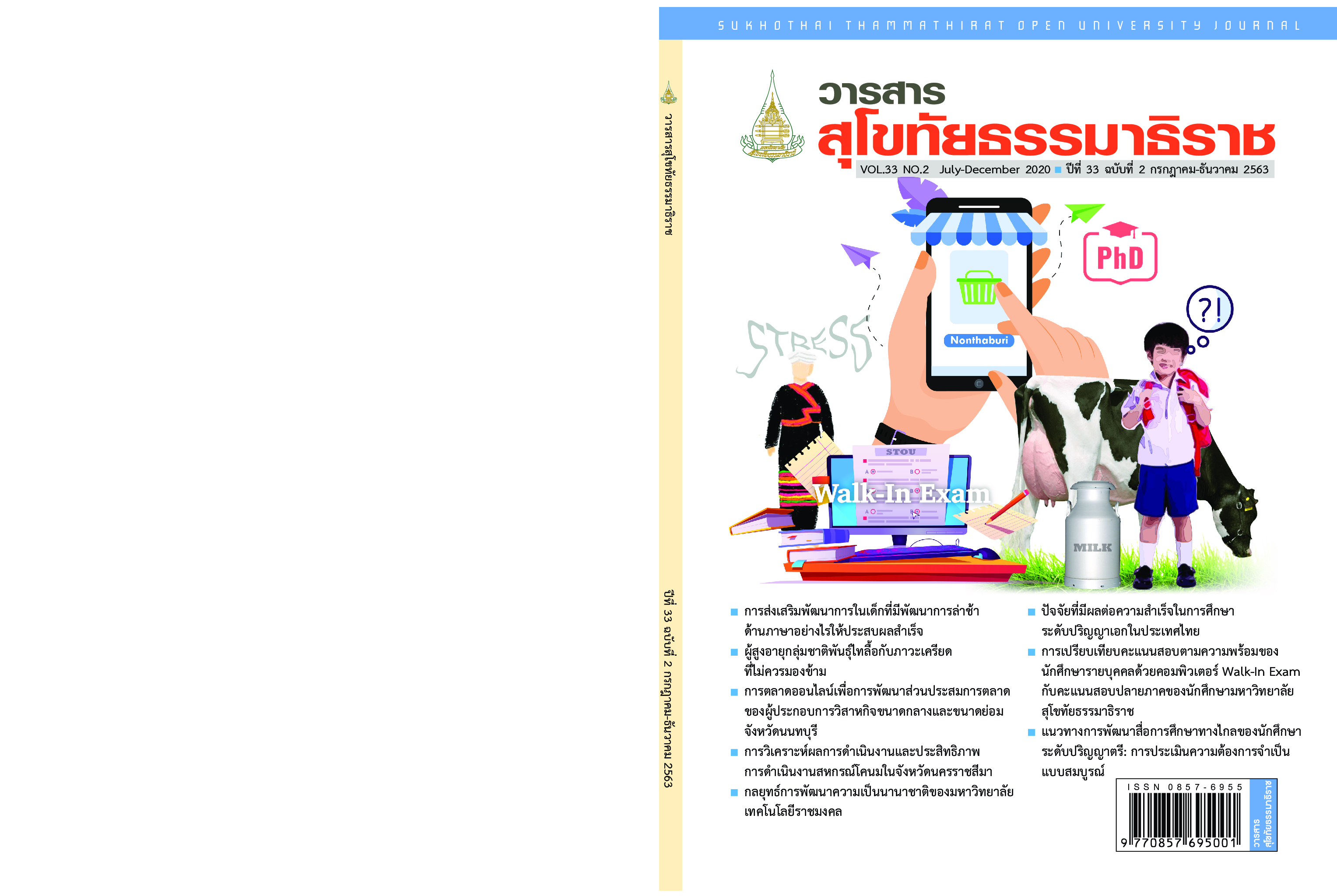
A study of score between Walk-in examination scores and final examination scores of Sukhothai Thammathirat Open University’s student.
Keywords:
Computer based examination., Average scores, Effect size., Walk-In examinationAbstract
Abstract
This research was aimed to 1) compare the number of students who passed the final examination between passed the Walk-in examination group and final examination only group. 2) compare the average score between the Walk-in examination scores and the final examination scores of those who passed the Walk-in examination. This research uses secondary data from 8 semesters and the data consisting of data for students who failing in Walk-in examination and take the final examination 9,374 records and data for students who take final examination only 312,152 records. The research instruments included the form of recording test scores of students who passed the Walk-in examination and taking the final examination in the amount of 9,374 sets, and the form of the test scores of students who took the final examination only 312,152 sets.
The research results show the following findings. 1) Walk-in examination test has more average difficulty than final examination test in 50 subjects and almost every semester. This means that the final examination test is harder than the Walk-in examination test. 2) Students who pass the Walk-in examination can pass the examination more than students who took the final examination only in 41 subjects (82%) and lower than the students who only take the final exam in 9 subjects (18%) and 3) only students who pass the Walk-in examination when going to the final examination can get the average scores more than the average scores from the Walk-in examination, with the effect size is a plus of 40 subjects (80 percent) and the average score from the final examination is less than the average score from the Walk-in examination. Effect size is negative 10 sets of subjects (20 percent).
Keywords: Computer based Examination. Item Difficulty. Effect size. Average Scores.
References
Chirawatkul, A. (2013). “Using effect size to present the different of education intervention.”Journal of Health Science Health Technical Office, Ministry of Health, 22(6), (November–December). (in Thai)
Juimoungsri, S., & Wijitwanna, S. (2019). Factors Affecting Test Scores of STOU Students Who Take Walk-in Examination via Computer. (in Thai)
Kerdpramot, P. (2001). The results of formative testing through internet conducted on MattayomSuksa 3 students. Master of Education Degree in Educational Measurement. Srinakharinwirot University. (in Thai)
Khaosaard, P. (1998). A development of the computerized formative testing process in English subject with diagnostic feedback. Degree of Master of Education in Educational Measurement and Evaluation. Department of Educational Research. Chulalongkorn University. (in Thai)
Downloads
Published
How to Cite
Issue
Section
License
บทความที่ได้รับการตีพิมพ์เป็นลิขสิทธิ์ของวารสารมหาวิทยาลัยสุโขทัยธรรมาธิราช
ข้อความที่ปรากฏในบทความแต่ละเรื่องในวารสารวิชาการเล่มนี้เป็นความคิดเห็นส่วนตัวของผู้เขียนแต่ละท่านไม่เกี่ยวข้องกับมหาวิทยาลัยสุโขทัยธรรมาธิราช และคณาจารย์ท่านอื่นๆในมหาวิทยาลัยฯ แต่อย่างใด ความรับผิดชอบองค์ประกอบทั้งหมดของบทความแต่ละเรื่องเป็นของผู้เขียนแต่ละท่าน หากมีความผิดพลาดใดๆ ผู้เขียนแต่ละท่านจะรับผิดชอบบทความของตนเองแต่ผู้เดียว
ห้ามนำข้อความทั้งหมด หรือบางส่วนไปพิมพ์ซ้ำ เว้นแต่จะได้รับอนุญาตจากกองบรรณาธิการวารสาร

