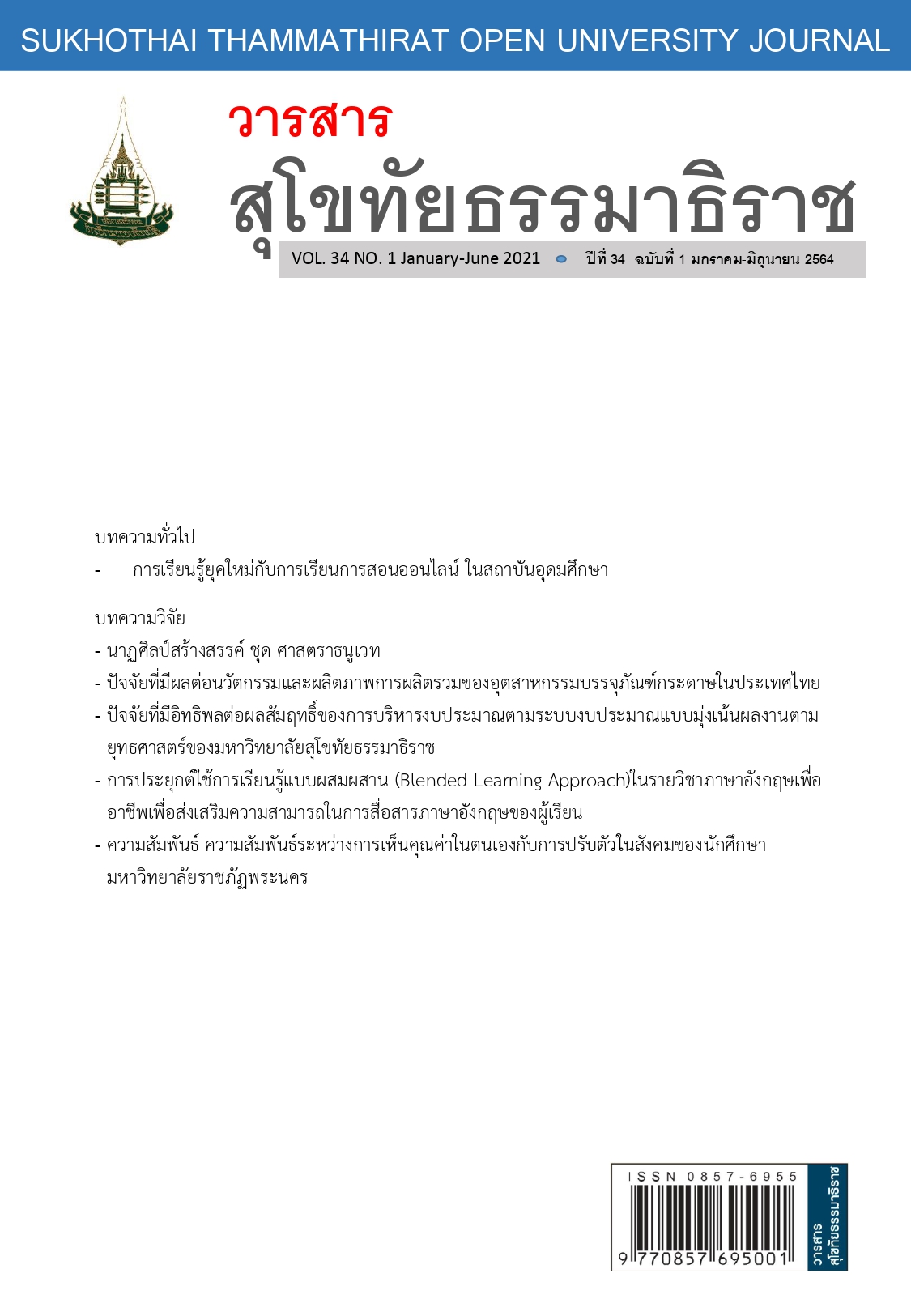
Application of Blended Learning Approach in English for Career Course to Enhance Learners' English Communicative Ability
Keywords:
Blended learning, English for career, communication efficiency in EnglishAbstract
This research aimed to 1) apply blended learning approach in teaching and leaning English for career course. 2) develop the communicative ability and English language skills of students in English for career course. 3) explore students’ satisfaction towards learning with blended learning approach. The sample group was 32 of 2nd year students from Industrial Management division in Faculty of Business Administration, Rajamangala University of Technology Rattanakosin and was selected by purposive sampling. The experiment was done by having students taking pretest and posttest in English for office staff and attending class in English for careers for 10 times in totaling 30 hours.
The research instruments included 1) the English for career course which consisted of lesson plans, blended teaching and learning activities, and course materials. 2)pretest and posttest to measure English communication abilities in English for career as an office staff. 3) a satisfaction questionnaire on the application of blended learning approach in this course. Data analysis was conducted using t-test and effect size scores to compare English communication ability of sample students both before and after studying. Mean and standard deviation in finding the satisfactions of students towards the model of blended learning in English for communication class which was created.
The results of the study were as follow:
1) The ability to communicate in English of students in sample group increased with statistical significance level of 0.05 and with the difference of 5.11.
2) The sample group had good satisfactions on the Blended learning curriculum model which was created.
References
Allwright, R. (1983). “Language Learning Through Communicative Practice.”Communicative Approach to Language Teaching. Oxford: Oxford UniversityPress.
Brown, H. (2000). Principle of Language Teaching and Learning. 4thEd. New York:AddisonWesley Longman, Inc.
Bitter, S. and Frankl, G. (2012). Evaluation of blended learning courses: The assessment of the e-tutors. Proceeding of International conference on interactive collaboration learning. p.p. 1-6.
Bonk, C. and Graham, C. (2006). The handbook of blended learning environments: Global perspectives, local designs. San Francisco: Jossey‐Bass/Pfeiffer. p.p.5.
Brown, J.D. (1996). Testing in Language Program. New York: Prentice Hall Regents.
Chamberlain, M. and Reynolds. (2007). Blended Learning Initiatives in HigherEducation: Opportunities and Challenges. EdMedia & Innovative Learning 2007. (June 25, 2007) pp. 2397-2402.
Chaima, N. (2012).Development of integrated teaching and learning management model by application of information technology to develop higher thinking skills forstudents of physical educationinstitutions. Phetchabun Campus.Dissertation. Khon Kaen University.
Chanthep, W. & Thammametha, T. (2011).Development of integrated training model with Learning as a team to develop integrated, interdisciplinary teaching design competencies for teachers teach at the elementary school level. Silpakorn Research Journal, V.3, No.1. 2011, p.p. 135-149.
Grave, K. (2000). Designing Language Courses: A Guide for Teacher. Canada: Heinle & Heinle Publishers.
Hughes, G. (2008). Using blended learning to increase learner support and improve retention.London:Institute of Education.
Johnson, Keith.1982.Communication Syllabus Design and Methodology.Pergamon: Oxford.
Khaemmanee, T. (2005).Pedagogy: Knowledge for effective learning process.4thed.Bankok: Publisher of Chulalongkorn University.
Kunarak, K. (2002).Instructional Design.3th ed.Nakhon Pathom: Faculty of Education, Silpakorn University.
Kulthanan, P. et.al.(2011). Blended Learning.www.tci-thaijo.orgcited February 18, 2018.
Lee, S. (2008). Professors’ Perceptions and Needs on Blended e-learning.E-Learn: World Conference on E-learning in Corporate, Government, Healthcare and Higher Education (Oct. 15, 2007) pp. 1113-1126.
Lopez-Perez, M. et. al.(2013). The influence of the use of technology on student outcomes in a blended learning context. Education Technology Research and Development e-Journal.p.p. 625-638.
Mortera-Gutierrez, F. Fostering. (2007). Creativity in a Qualitative Research Course Using Black Board with a Blended Learning Approach: Best Practices. E-Learn: World Conference on E-learning in Corporate, Government, Healthcare and Higher Education (Oct. 15, 2007) pp. 1131-1136.
National Strategy Secretariat Office, National Strategy Plan, Office of the National Economic and Social Development, Bangkok, Thailand, p.23-32, 2018.
Precel, K. et al.(2009). Pedagogical and Design Aspects of a Blended Learning Course. The International Review of Research in Open and Distributed LearningVol. 10 No.2 (Apr. 2, 2009)
Richards, J C.; Rodgers, T S. (2001). Approaches and Methods in Language Teaching.2ndEd. Cambridge, New York: Cambridge University Press.
Savigon, S. (1983). Communicative Competence: Theory and Classroom Practice.Massachusettes: Addison –Wesley Publisher Co.
Sriamdee, P. (2013). The results of blended learning with information technology 2 problem solving activity on problemsolving ability and achievement. Learning of Mathayom Suksa 2 students at Sirindhorn Ratchavayalai School.Veridian E-Journal, V.6, No. 2. 2013, p.p. 582-596.
Tumthong, S. and Wanphirun, P. (2012).Development of a integrated training model using knowledge management techniques to develop competencies according to international professional skill standards.https://journal.oas.psu.ac.th cited. February 18, 2018.
Taba, Hilda. (1962). Curriculum Development: Theory and Practice.New York:Harcourts Brace & World.
Tyler, Ralph W. (1950). Basic Principle of Curriculum and Instruction. Chicago: University of Chicago Press.
Wanphirun, P. (2011).Blended learning from concept to practice.Journal of Vocational and Technical Education.V1. No.2 (Jul.-Dec.2011), p.p 43-49.
Wanphirun, P. and Nilsuk, P. (2013).The results of blended learning using cognitive tools to develop the critical thinking skills of graduate students.https://journal.oas.psu.ac.th. Cited February 18, 2018.
Widdowson, H. and Brumfit, C. (1981). Issues in Second Language Syllabus Design in the Second Language Classroom: Direction for the 1980’s. Oxford: Oxford University Press.
Downloads
Published
Versions
- 2022-05-02 (3)
- 2022-02-08 (2)
- 2021-09-12 (1)
How to Cite
Issue
Section
License
บทความที่ได้รับการตีพิมพ์เป็นลิขสิทธิ์ของวารสารมหาวิทยาลัยสุโขทัยธรรมาธิราช
ข้อความที่ปรากฏในบทความแต่ละเรื่องในวารสารวิชาการเล่มนี้เป็นความคิดเห็นส่วนตัวของผู้เขียนแต่ละท่านไม่เกี่ยวข้องกับมหาวิทยาลัยสุโขทัยธรรมาธิราช และคณาจารย์ท่านอื่นๆในมหาวิทยาลัยฯ แต่อย่างใด ความรับผิดชอบองค์ประกอบทั้งหมดของบทความแต่ละเรื่องเป็นของผู้เขียนแต่ละท่าน หากมีความผิดพลาดใดๆ ผู้เขียนแต่ละท่านจะรับผิดชอบบทความของตนเองแต่ผู้เดียว
ห้ามนำข้อความทั้งหมด หรือบางส่วนไปพิมพ์ซ้ำ เว้นแต่จะได้รับอนุญาตจากกองบรรณาธิการวารสาร
