
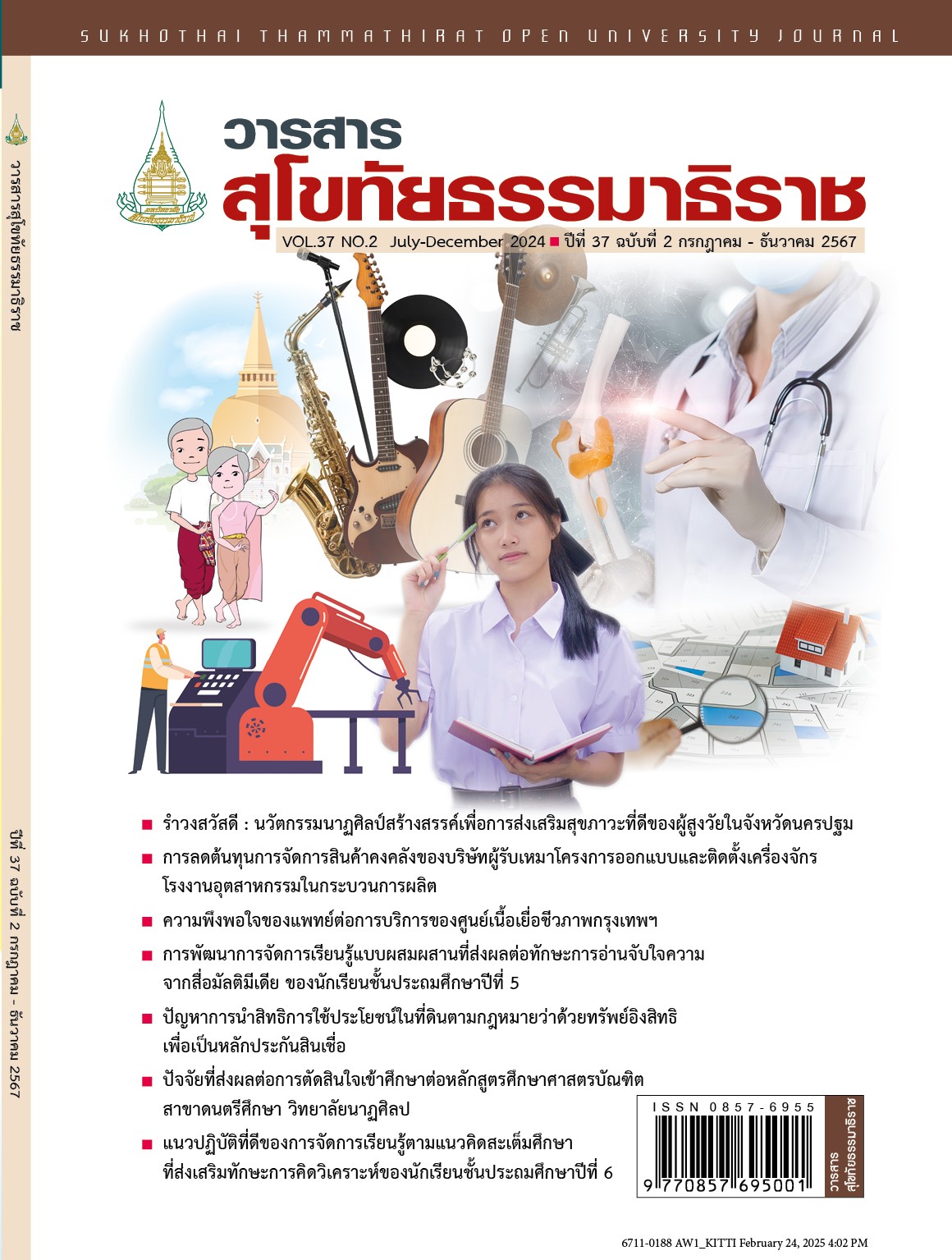
Inventory Cost Reduction of Sub-contractor Company for Designing and Installation Machines in Manufacturing Process
Keywords:
ABC analysis, Economic Order Quantity, inventory management model, Sub-contractor of design and installation machineryAbstract
This research is proposed to inventory cost reduction of sub-contractor company for designing and installation machines in manufacturing process. From the stock count data, it has been found that the company had 26 items of inventory with a total value of approximately 263,436 Baht. The problem of inventory value is higher than demand by about 71%. Moreover, the physical inventory is not categorized with the placement of the products is not the exact placement, which is not conducive to visual operation and then make it is difficult to find products and repeated purchases occur frequently. Therefore, the ABC analysis theory is applied to categorize inventory by product value condition. Thus, they can be separated into category A with total 7 products, category B product with 9 items, and category C with 10 products respectively. Product group A is selected by the highest product value criteria. Let it is analyzed and solved the problems by inventory management with mathematical model. Starting from the forecasting the demand of products per month, determination of minimum and maximum, purchase cycle times and suitable purchasing quantity compare with Economic Order Quantity (EOQ) theory. The model is created to analysis by applying formula in Microsoft Excel. The results of a study in product group A are found with non-turnover products of 6 items, which can be determined the suitable purchasing quantity by purchase cycle time rather than Economic Order Quantity (EOQ) theory because it is reduced risk to backlog inventory. In addition, new warehouse design principles have been applied to make the product tidy. Then products are stored in categories, the storage area is clearly divided, and assigned staff aisle to make it easy and quick to check the stock available in the warehouse. Finally, the products picking rate before the improvement is approximated 20 minutes and after improvement is approximated 5 minutes per picking or reduced by 75%.
References
Biami Mbakop Ariane Kevine. (January - Feburary 2018). The Effectiveness of ABC Cross Analysis on Products Allocation in the Warehouse (Case Study: CHOCOCAM Company Ltd Douala). International Journal of Novel Research in Interdisciplinary Studies, 5(1), 11-30.
Jean-Claude Munyaka Baraka. (July 2022). แนวคิดและการใช้งานการจัดการสินค้าคงคลังอย่างเป็นระบบ. South African Journal of Industrial Engineering, 33(2), 15-36.
Jutathip Leelathanapipat, Theerawat Chantuek. (January - April 2018). Professional inventory management. Academic journal Veridian E –Journal, Silpakorn University, 11(1), 226-229.
Krittanathip,Cha-um,Suwandee et al., (2012). The Reduction of Inventory and Warehouse Costs for Thai Traditional Wholesale Businesses of Consumer Products. Procedia-Social and Behavioral Sciences Symposium, 4th International Science, Social Science, Engineering and Energy Conference, 88, 142-148.
Napasorn Sakulpradit. (2017). Inventory management for producing and distributing factory of frozen products. Master of Engineering Independent study, Department of Industrial Development, Department of Industrial Engineering, Faculty of Engineering, Thammasat University.
Pathompong Homsri, Chakrabhand Kongthana. (July-December 2014). Development of inventory management system case study of installation and maintenance company of SME factory. Academic Journal of the Faculty of Industrial Technology, Lampang Rajabhat University, 7 (2), 42-56.
Pradit Puttikulborworn, Yongyuth Hemala. (2017). Inventory management to improve inventory management efficiency. Bachelor of Engineering Program, Management Engineering and Logistics, College of Technology Innovation and Engineering, DhurakijPundit University.
Rakesh Kumar. (2016). Economic Order Quantity (EOQ) Model. Global Journal of Finance and Economic Management, 5(1), 1-5.
S.Kavitha, A.Kandeepan, N.Narmadha. (October 2021). ABC Analysis, an Inventory Management Technique at a Manufacturing. International Journal of Operations Management and Services, 19(3), 167-170.
Siriluk kaewnual, Sakchai Rakkharn, Samroeng Netpu3. (2021). Inventory Management Case Study of Fire Protection Systems Company. Independent study Engineering Management, Master of Engineering, Kasem Bundit University.
Thanakamol Thongkon, Loponapat Tulayalak. (2019). Improving Warehouse Management Case Study: Water Tank Manufacturing and Distribution Plant. Bachelor of Engineering, Logistics Department, Department of Material Transfer Engineering and Logistics, Faculty of Engineering, King Mongkut's University of Technology North Bangkok.
Thiyada Chaimaikram. (2015). Optimizing Warehouse Management Case Study 2 warehouse Burana Bangkok Pubwarehouse Organization. Independent study, Master of Business Administration, Graduate School, Bangkok University.
Downloads
Published
How to Cite
Issue
Section
License
Copyright (c) 2025 Sukhothai Thammathirat Open University

This work is licensed under a Creative Commons Attribution-NonCommercial-NoDerivatives 4.0 International License.
บทความที่ได้รับการตีพิมพ์เป็นลิขสิทธิ์ของวารสารมหาวิทยาลัยสุโขทัยธรรมาธิราช
ข้อความที่ปรากฏในบทความแต่ละเรื่องในวารสารวิชาการเล่มนี้เป็นความคิดเห็นส่วนตัวของผู้เขียนแต่ละท่านไม่เกี่ยวข้องกับมหาวิทยาลัยสุโขทัยธรรมาธิราช และคณาจารย์ท่านอื่นๆในมหาวิทยาลัยฯ แต่อย่างใด ความรับผิดชอบองค์ประกอบทั้งหมดของบทความแต่ละเรื่องเป็นของผู้เขียนแต่ละท่าน หากมีความผิดพลาดใดๆ ผู้เขียนแต่ละท่านจะรับผิดชอบบทความของตนเองแต่ผู้เดียว
ห้ามนำข้อความทั้งหมด หรือบางส่วนไปพิมพ์ซ้ำ เว้นแต่จะได้รับอนุญาตจากกองบรรณาธิการวารสาร

