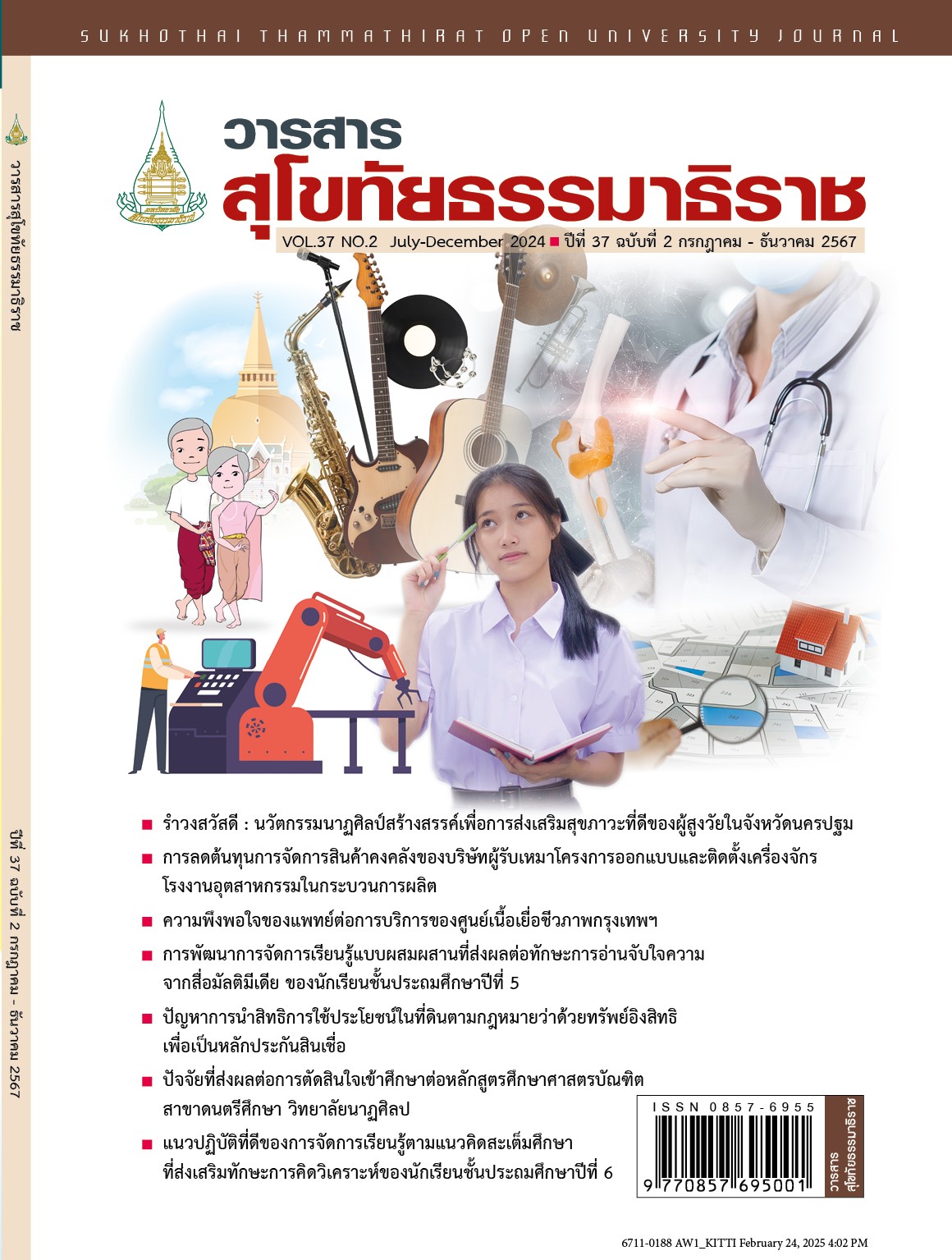
Development of Blended Learning Affecting on Reading Comprehension Skills Through Multimedia for 5th Grade Students.
Keywords:
Blended learning, Reading comprehensionAbstract
The purposes of this research were 1) to develop and f ind the eff iciency of a blended learning approach to enhance reading comprehension skills through multimedia to be eff icient according to the 80/80 criteria, 2) to compare the results of reading comprehension skills based on the blended learning approach through multimedia and traditional learning approach, and 3) to study satisfaction
on the blended learning approach on reading comprehension skills through multimedia. The sample
in this study was f ifth grade students (60 students from 2 classrooms) that enrolled in Thai Language subject at Srinakarinwirot University Prasarnmit Demonstration school (Elementary) in second semester of academic year 2022. A cluster sampling technique was used to select an experimental group of thirty students and a control group of thirty students in the study.
The research tools were included 1) a lesson plan based on blended learning approach on reading comprehension skills
through multimedia, 2) a reading comprehension test through multimedia, and 3) a questionnaire on satisfaction after learning though blended learning. The eff icacy determination E1/E2, mean ( ), Standard Deviation (SD) and t-test and paired t-test were used for data analysis. The results indicated that 1) the blended learning approach had the eff iciency of process (E1) 80.86 and the eff iciency of product (E2) 81.62 which complied to the def ined criteria of 80/80, 2) the students’ reading comprehension skills in the experimental group based on the blended learning were signif icantly higher than the students in the control group who received the traditional learningapproach, at a statistically signif icant level of .01. 3) the students’ satisfaction level in the experimentalgroup after learning with the blended learning approach on reading comprehension skills through multimedia was at the high level. (
= 4.41 , SD = .30)
References
Allan, B. (2007). Blended learning: Tools for teaching and training. Facet Publishing.
Anukulwet, et. al. (2008, July-December). Development of a teaching model for technical practice on the Internet for vocational students. SWU Journal of Educational Sciences, 9(2), 1-13. (in Thai)
Beach, P. (2017). Self-directed online learning: A theoretical model for understanding elementary teachers' online learning experiences. Teaching and Teacher Education, 61, 60-72.
Bonk, C. J., & Graham, C. R. (2012). The handbook of blended learning: Global perspectives, local designs. Wiley+ ORM.
Bruner, J. S. (1960). The process of education. Harvard University Press.
Bunson, R. (2020). Enhancing English Reading Comprehension Ability by Using Blended Learning for Prathomsuksa 6 Students. (M.Ed. in Curriculum and Instruction), Dhurakij Pundit University. (in Thai)
Carman, J. M. (2005). Blended learning design: Five key ingredients. Agilant Learning, 1(11), 1-10.
Chaivetsakul, D. (2018). Study of Analytical Thinking Ability and Scientific Attitude of The Sixth Grade Students Using a Blended Learning Approach Emphasizing On 5E Modified Learning Model. (M.Ed. in Educational Science & Learning Management, Graduate School, Srinakharinwirot University. (in Thai)
Chen, K. C., & Jang, S. J. (2010). Motivation in online learning: Testing a model of self-determination theory. Computers in human behavior, 26(4), 741-752.
Driscoll, M. (2002). Blended learning: Let’s get beyond the hype. E-learning, 1(4), 1-4.
Fimala, Y., Alwi, N. A., Miaz, Y., & Darmansyah, D. (2022). Blended learning LKPD development based on learning using nearpod applications for integrated learning in elementary school. Journal of Innovation in Educational and Cultural Research, 3(2), 97-105.
Isarapreeda, P. (1995). Essentials of educational psychology. Bangkok: Num printing letters. (in Thai)
Jenchit, C, P. (1995). Teaching and learning psychology. Bangkok: Ton or Grammy. (in Thai)
Joyce, B & Weil, M. (1985). Models of teaching. 2nd ed. New Delhi :Prentice–Hall.
Jutha, M. (2001). Application of psychology for learning. Bangkok: Aksarapipat. (in Thai)
Khaemmanee, T. (2009). Teaching science. (12th edition). Bangkok: Chulalongkorn University Press. (in Thai)
Khowtrakul, S. (1998). Educational psychology. Bangkok: Chulalongkorn University Press. (in Thai)
Kundu, A., Bej, T., & Nath Dey, K. (2021). Time to achieve: implementing blended learning routines in an Indian elementary classroom. Journal of Educational Technology Systems, 49(4), 405-431.
Laipat, T. (2018). Development of Blended Learning Model to Enhance the Twenty First Century Life Skills of Health Education Undergraduate Students. (Ph.D. in Educational Science and Learning Management, Graduate School, Srinakharinwirot University. (in Thai)
Macaruso, P., Wilkes, S., & Prescott, J. E. (2020). An investigation of blended learning to support reading instruction inelementary schools. Educational Technology Research and Development, 68(6), 2839-2852.
Mansetthawit, N. (1997). Language and thinking development. Bangkok: Odeon Store. (in Thai)
Moksri, P. (2017, April – June). The Development of a Blended Learning Model Using Team Project Technique to Develop Sixth Grade Students’ Critical Thinking. Journal of Education, Khon Kaen University Graduate Research, 11(2), 176–187. (in Thai)
National PISA Implementation Center. (2021). Results of PISA 2018 assessment of reading, mathematics and science. Institute for the Promotion of Teaching Science and Technology (IPST), Ministry of Education. (in Thai)
Naweekarn, S. (2002). Organizational behavior. Bangkok: Bannakij Publishing House 1991 Co., Ltd. (in Thai)
Nonnarong Wasnil, N. (2020, (January - June). Development of a Blended Learning Model for Learning in the Career and Technology Module 3 Information and Communication Technology of Grade 2 Students. Journal of Rangsit University: Teaching & Learning. 14(1), 66-81. (in Thai)
Panich, V. (2012). Learning culture for new students 21st Century. Bangkok: Sodsri-Saritwong Foundation. (in Thai)
Petsaengsri, S. (2012). Review article. Blended learning and application of Blended Learning and Its Applications. Journal of Industrial Education. 11(1), 1-5. (in Thai)
Phrueksawan, B. (2002). Guidelines for developing rapid reading and thinking. Bangkok: Thaiwattanapanich. (in Thai)
Pham Thi L & Nguyen Thi Hong M. (2023). Using Blended Learning in Improving Reading Comprehension Skills for Secondary Students. European Modern Studies Journal. 7(3),183-189 DOI:10.59573/emsj.7(3).2023.18
Pipatsri, P. (2020). The development of blended lerning on kidbright progrming for grade 9th students. (ME.d. in Education Technology), Graduate School, Burapha University. (in Thai)
Prasert, S. (2017). Blended Learning, this hour is the best. Magazine for developing knowledge and creativity to increase human capital potential through public learning processes.
Retrieved April, 2023 from https://www.okmd.or.th/knowledge/okmd-magazine/874/ (in Thai)
Rombot, O., Boeriswati, E., & Suparman, A. (2021). The Development of Blended Learning Model for Reading Comprehension Learning of BIPA Students in Grade V Elementary School. Ilkogretim Online, 20(5).
Rovai, A. P., & Jordan, H. M. (2004). Blended learning and sense of community: A comparative analysis with traditional and fully online graduate courses. International Review of Research in Open and Distributed Learning, 5(2), 1-13.
Savoy, A., Proctor, R. W., & Salvendy, G. (2009). Information retention from PowerPoint™ and traditional lectures. Computers & Education, 52(4), 858-867.
Sawadiwong, Wilaiwan. (2004). Developing critical reading skills of Grade 6 students based on the KWL Plus technique. (ME.d. in Curriculum and Supervision). Graduate School, Silpakorn University. (in Thai)
Şendağ, S., & Odabaşı, H. F. (2009). Effects of an online problem based learning course on content knowledge acquisition and critical thinking skills. Computers & education, 53(1), 132-141.
Singh, H., & Reed, C. (2001). A white paper: Achieving success with blended learning. Centra software, 1, 1- 11.
Srisang, P. (2009, January-December. Basic knowledge about educational institution curriculum development. Social Science Journal Srinakharinwirot University. 12, 291-103. (in Thai)
Tantiwitkoson, W. (2017). The Develop the Blended learning activity model using GRIS technique to enhance Thai reading competence. (M.Ed. in Educational Technology) , Graduate School, Silpakorn University. (in Thai)
Thungkanai, K. (2021). Blended learning in a new normal. Journal of Educational Studies, 15(1), 29-43. (in Thai)
Valiathan, P. (2002). Blended learning models. Learning circuits, 3(8), 50-59.
Yuangklang, S. (2017). The Development of Blended Learning System by Using Gamification Based Learning to Enhance the Mathematics Problem Solving Skills and Connection Skills to Real Life for Primary schools. (Ph.D. in Educational Technology and Communications), Mahasarakham University. (in Thai)
Downloads
Published
How to Cite
Issue
Section
License
Copyright (c) 2025 Sukhothai Thammathirat Open University

This work is licensed under a Creative Commons Attribution-NonCommercial-NoDerivatives 4.0 International License.
บทความที่ได้รับการตีพิมพ์เป็นลิขสิทธิ์ของวารสารมหาวิทยาลัยสุโขทัยธรรมาธิราช
ข้อความที่ปรากฏในบทความแต่ละเรื่องในวารสารวิชาการเล่มนี้เป็นความคิดเห็นส่วนตัวของผู้เขียนแต่ละท่านไม่เกี่ยวข้องกับมหาวิทยาลัยสุโขทัยธรรมาธิราช และคณาจารย์ท่านอื่นๆในมหาวิทยาลัยฯ แต่อย่างใด ความรับผิดชอบองค์ประกอบทั้งหมดของบทความแต่ละเรื่องเป็นของผู้เขียนแต่ละท่าน หากมีความผิดพลาดใดๆ ผู้เขียนแต่ละท่านจะรับผิดชอบบทความของตนเองแต่ผู้เดียว
ห้ามนำข้อความทั้งหมด หรือบางส่วนไปพิมพ์ซ้ำ เว้นแต่จะได้รับอนุญาตจากกองบรรณาธิการวารสาร

