
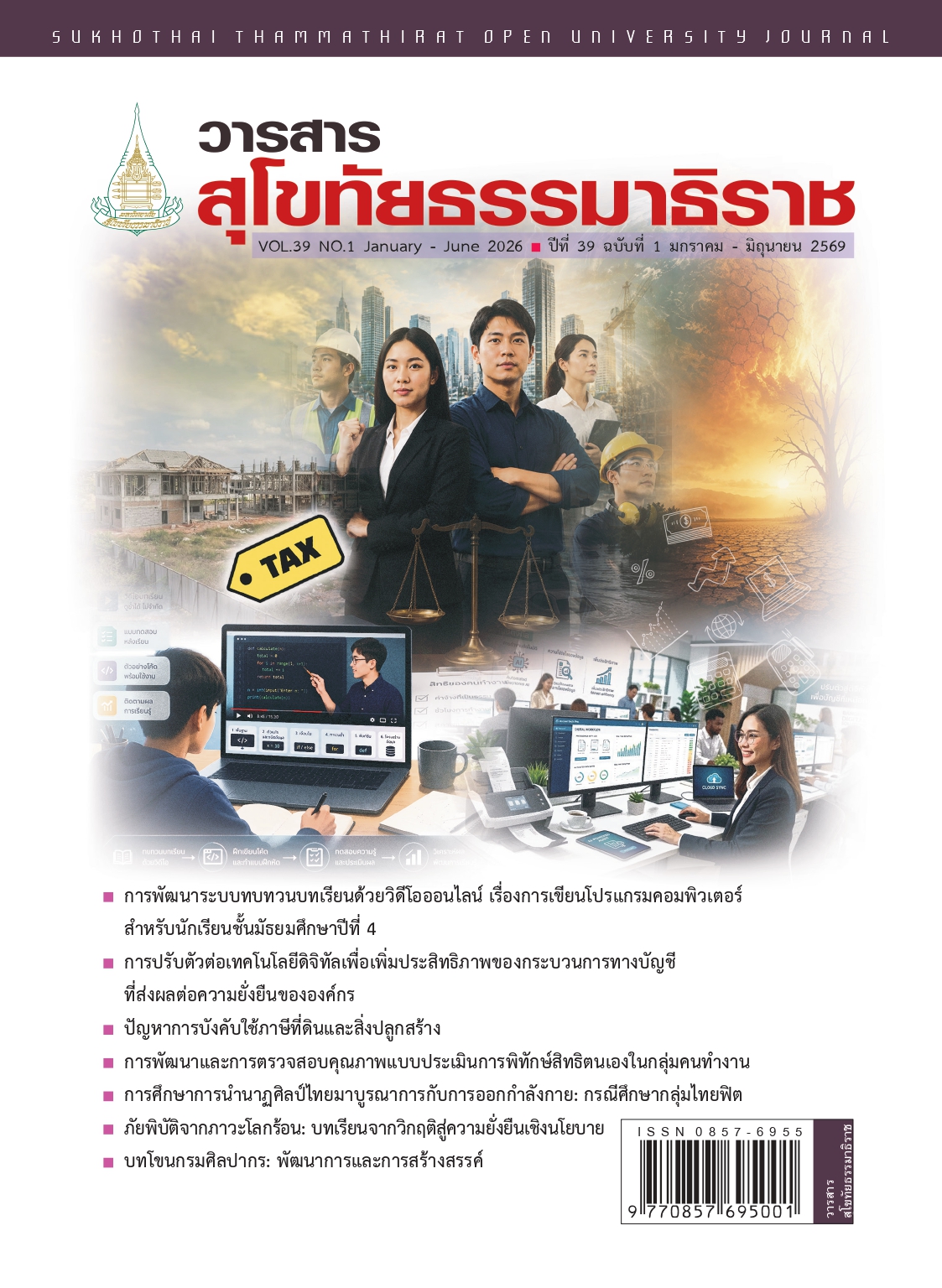
Problems of enforcement of land and building tax laws
Keywords:
Good tax principle, Land and Building Tax, City plan lawAbstract
Abstract
This article aims to (1) study concepts and theories as to land and building tax; (2) study the land and building tax laws of Thailand, Federal Republic of Germany, and Japan; (3) analyze problems on land and building tax; and (4) recommend guidelines for land and building tax collection in accordance with the guidelines and measures appropriate for Thailand.
This research is a qualitative research based upon document research methods from books, textbooks, articles, theses, and independent studies in respect of land and building tax laws of Thailand, Federal Republic of Germany, New Zealand, and Japan so as to recommend guidelines for solving the problems on land and building tax laws of Thailand to be further efficient.
According to the results of study, (1) concepts and theories as to land and building tax are good tax system and tax collection principle; (2) the land and building tax law of Thailand appears in Land and Building Tax Act B.E. 2562 (2019), the land and building tax laws of Federal Republic of Germany appear in Valuation Act (BeWG), Property Tax Act (GrstG) Version 2022 AD. and Rating Valuations Act, 1998, the land and building tax law of New Zealand appears in Local Government (Rating) Act, 2002, and the land and building tax law of Japan appears in Local Tax Law Act; (3) Thailand has a problem on inconsistence with the principle of good tax system which is different from those of Federal Republic of Germany and Japan which determine the tax rate in accordance with the potentiality of fair land utilization as inconsistent with the principle of earning from exemption of the land and building tax base value used in high land residence and the problem on lack of integration with other laws which is different from Federal Republic of Germany, Japan, and New Zealand which integrate city plan law with the land and building tax system; and (4) Thailand ought to calculate the tax by taking into account the land potentiality and determine the fair tax rate in pursuance of real utilization by improving laws to be in pursuance of the good tax principle so as to minimize the tax avoidance gap by integrating with the city plan law and reduce tax exemption rate in order for the tax collection to be more efficient to meet the law’s objective so as to reduce social inequality and promote fair and sustainable land utilization.
Keywords : Good tax principle / Land and building tax / City plan law.
References
Adam, S. (1776). An Inquiry into the Nature and Causes of the Wealth of Nations. London: W. Strahan and T. Cadell.
Anon, M. (2021). Property Law: Basic Knowledge of Concepts, General Principles, and General Provisions (4th ed.). Vinyuchon Publishing House, Bangkok. (in Thai)
Department of Local Administration. (2019). Guidelines for the implementation of the Land and Building Tax Act B.E. 2562. Bangkok: Ministry of Interior. (in Thai)
Fiscal Policy Office. (2020). Property tax reform and fiscal decentralization in Thailand. Bangkok: Ministry of Finance. (in Thai)
Ministry of Finance. (2019). Land and Building Tax Act B.E. 2562 (2019). Bangkok: Government Gazette. (in Thai)
Nakorn Yimsiriwattana. (2005). Teaching Materials for Course EC 341 Government Finance Chapter 5 Taxation (TAX) (2nd ed.). Faculty of Economics, Ramkhamhaeng University, Bangkok. (in Thai)
Wikorn Rakpuangchon. (2017). Commentary on Property Law. Bangkok: Phim Dee Publishing. (in Thai)
Downloads
Published
How to Cite
Issue
Section
License
Copyright (c) 2026 Sukhothai Thammathirat Open University

This work is licensed under a Creative Commons Attribution-NonCommercial-NoDerivatives 4.0 International License.
บทความที่ได้รับการตีพิมพ์เป็นลิขสิทธิ์ของวารสารมหาวิทยาลัยสุโขทัยธรรมาธิราช
ข้อความที่ปรากฏในบทความแต่ละเรื่องในวารสารวิชาการเล่มนี้เป็นความคิดเห็นส่วนตัวของผู้เขียนแต่ละท่านไม่เกี่ยวข้องกับมหาวิทยาลัยสุโขทัยธรรมาธิราช และคณาจารย์ท่านอื่นๆในมหาวิทยาลัยฯ แต่อย่างใด ความรับผิดชอบองค์ประกอบทั้งหมดของบทความแต่ละเรื่องเป็นของผู้เขียนแต่ละท่าน หากมีความผิดพลาดใดๆ ผู้เขียนแต่ละท่านจะรับผิดชอบบทความของตนเองแต่ผู้เดียว
ห้ามนำข้อความทั้งหมด หรือบางส่วนไปพิมพ์ซ้ำ เว้นแต่จะได้รับอนุญาตจากกองบรรณาธิการวารสาร

