
Roles of Thai Women according to the Ten Admonitions
Article Sidebar
Main Article Content
Abstract
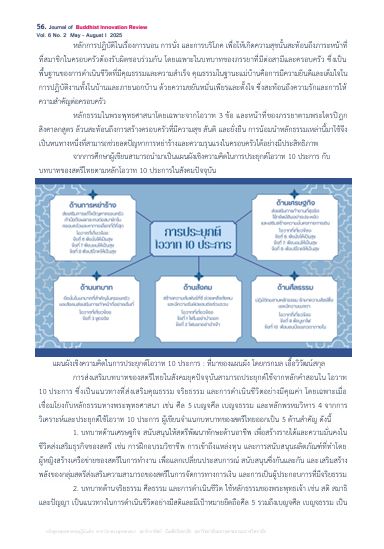
This article aims to study the promotion of Thai women's roles based on the Tenfold Virtuous Precepts (Owat 10 Prakan) in five key aspects: (1) Economic – emphasizing women's roles in honest, diligent, and frugal livelihood following the principle of right livelihood (Samma-Ajiva); (2) Morality and Ethics – highlighting the observance of the Five Precepts and gratitude; (3) Social – encouraging women's participation in building a harmonious community through loving-kindness, compassion, and equanimity; (4) Divorce and Domestic Violence – applying the principles of patience, forgiveness, and peaceful communication to reduce conflict; and (5) Child-Rearing – acknowledging women as the first teachers who instill moral values from early childhood. The study finds that adopting the Tenfold Virtuous Precepts to promote women's roles significantly contributes to family stability, fosters a morally grounded society, and supports sustainable social development.
Article Details

This work is licensed under a Creative Commons Attribution-NonCommercial-NoDerivatives 4.0 International License.
เรื่องลิขสิทธิ์/เป็นความคิดเห็นของผู้เขียน
References
Books :
Cohen, B.J. (1979). Introduction to Sociology. New York: Mc Graw Hill.
Mahachulalongkornrajavidyalaya. (2539). Thai Tripitaka Mahachulalongkornrajavidyalaya. Bangkok: MCU Press.
Mahachulalongkornrajavidyalaya. (2558). Commentaries Thai Tripitaka. Mahachulalongkornrajavidyalaya. Bangkok: MCU Press.
National Economic and Social Development Board. (2023). Action Plan for Women's Development 2023–2027. Bangkok: (Office of the National Economic and Social Development Council,2023)
National Office of Buddhism. (2019). The Five Precepts, the Five Precepts, and Buddhist Principles. Bangkok: National Office of Buddhism Printing House.
Phra Phromkunaphon (P.A. Payutto). (2004). Dharma and life. Bangkok: Mahachulalongkornrajavidyalaya University.
Phra Phromkunaphon (P.A. Payutto). (2013). Buddhism, revised and expanded edition. Bangkok: Mahachulalongkornrajavidyalaya University.
Preecha Changkhwanyuen. (1998). Women in Eastern Scriptures. Bangkok: Chulalongkornrajavidyalaya Press.
Somdej Phra Buddhaghosacariya (P.A. Payutto). (2021). Buddhist Dictionary, Dhamma Compilation Edition. 43rd printing. Bangkok: Sahathammik Company Limited.
Journal :
Anthitha Aksornsri. (July-September 2021). The Role of Thai Women in the Era of Thailand 4.0. Academic Research Journal. 4(3): 300-308.
Panpila Kuldilok. (September-December 2017). Social Movement through New Media in the Globalization Era. Journal of Humanities and Social Sciences. 25(49): 59-77.
Supawadi Khuntongchan. (January-June 2016). The relationship between globalization and basic values in Thai society. Journal of Humanities and Social Sciences Ubon Ratchathani Rajabhat University. 7(1): 160-185.
Report :
Department of Women's Affairs and Family Institute. (2020). Report on the Gender Equality Promotion Operations of Government Agencies in 2019. Bangkok: Department of Women's Affairs and Family Institute: Ministry of Social Development and Human
Security.
Department of Women's Affairs and Family Institute. (2019). Report on the Gender Equality Promotion Operations of Government Agencies.
Thesis
Phra Mahakamon Thawaro (Mangkhammee). (2000). The Status of Women in Buddhism. Master of Buddhist Studies Thesis. Department of Buddhism. Graduate School: Mahachulalongkornrajavidyalaya University.
Electronic media Pharanee Phuprasit.
The role of Thai women and equality in society. [Online]. Retrieved from https://www.thaihealth.or.th. (19 October 2024) Sudarat Keyuraphan. Women's voices and the reduction of gender inequality in politics and economics. [Online]. Retrieved from https://www.ptp.or.th/news/562. (20 October 2024)
Thitthananya Wajadee. The role of Thai women in the present era. [Online]. Retrieved from https://mgron line.com entertainment/detail/9620000021291. (16 September 2024)
เอกสารอ้างอิง
หนังสือ :
ปรีชา ช้างขวัญยืน. (2541). สตรีในคัมภีร์ตะวันออก. กรุงเทพมหานคร: โรงพิมพ์จุฬาลงกรณราชวิทยาลัย.
พระพรหมคุณาภรณ์ (ป.อ. ปยุตฺโต). (2556). พุทธธรรม ฉบับปรับขยาย. กรุงเทพมหานคร: มหาวิทยาลัยมหาจุฬาลงกรณราชวิทยาลัย.
พระพรหมคุณาภรณ์ (ป.อ.ปยุตโต). (2547).ธรรมะกับชีวิต. กรุงเทพฯ: มหาวิทยาลัยมหาจุฬาลงกรณราช-วิทยาลัย.
มหาจุฬาลงกรณราชวิทยาลัย. (2539). พระไตรปิฎกภาษาไทย ฉบับมหาจุฬาลงกรณราชวิทยาลัย. กรุงเทพมหานคร: โรงพิมพ์มหาจุฬาลงกรณราชวิทยาลัย.
สมเด็จพระพุทธโฆษาจารย์ (ป.อ. ปยุตฺโต). (2564). พจนานุกรมพุทธศาสตร์ ฉบับประมวลธรรม. พิมพ์ครั้งที่ 43. กรุงเทพมหานคร : บริษัท สหธรรมิก จำกัด.
สำนักงานคณะกรรมการพัฒนาการเศรษฐกิจและสังคมแห่งชาติ. (2566). แผนปฏิบัติการด้านการพัฒนาสตรี พ.ศ.2566-2570). กรุงเทพมหานคร : สำนักงานสภ
พัฒนาการเศรษฐกิจและสังคมแห่งชาติ สำนักนายกรัฐมนตรี (2565).
วารสาร :
พรรณพิลาศ กุลดิลก. (กันยายน-ธันวาคม 2560). การขับเคลื่อนสังคมผ่านสื่อใหม่ในยุคโลกาภิวัฒน์. วารสารวิชาการมนุษยศาสตร์และสังคมศาสตร์. 25(49): 59-77.
สามารถ บุญรัตน์ ดร.. (กรกฎาคม-ธันวาคม 2559). ภาวะผู้นำสตรี: กรอบแนวคิดตามแนวของพระพุทธศาสนา. วารสารสถาบันวิจัยพิมลธรรม. 3(2): 1-10.
สุภาวดี ขุนทองจันทร์. (มกราคม-มิถุนายน 2559). ความสัมพันธ์ระหว่างโลกาภิวัตน์กับค่านิยมพื้นฐานในสังคมไทย. วารสารมนุษยศาสตร์และสังคมศาสตร์ มหาวิทยาลัยราชภัฏอุบลราชธานี. 7(1): 160-185.
อัญธิษฐา อักษรศรี. (กรกฎาคม-กันยายน 25564). บทบาทของสตรีไทยในยุคไทยแลนด์ 4.0. วารสารวิจัยวิชาการ. 4(3): 300-308.
รายงานวิจัย
กรมกิจการสตรีและสถาบันครอบครัว. (2563). รายงานการดำเนินงานการส่งเสริมความเสมอภาคระหว่างเพศของหน่วยงานภาครัฐ ประจำปี 2562. กรุงเทพมหานคร: กรมกิจการสตรีและสถาบันครอบครัวกระทรวงการพัฒนาสังคมและความมั่นคงของมนุษย์.
วิทยานิพนธ์ :
พระมหากมล ถาวโร (มั่งคำมี). (2543). สถานภาพสตรีในพระพุทธศาสนา. วิทยานิพนธ์พุทธศาสตรมหาบัณฑิต สาขาวิชาพระพุทธศาสนา บัณฑิตวิทยาลัย มหาวิทยาลัยมหาจุฬาลงกรณราชวิทยาลัย.
สื่ออิเล็กทรอนิกส์ :
ภรณี ภู่ประเสริฐ. บทบาทสตรีไทยและความเท่าเทียมในสังคม. [ออนไลน์]. แหล่งที่เข้าถึงข้อมูล https: www.thaihealth.or.th. (วันที่สืบค้น 19 ตุลาคม 2567).
สุดารัตน์ เกยุราพันธุ์. เสียงสะท้อนของสตรีกับการลดความเหลื่อมล้ำทางเพศในภาคการเมืองและเศรษฐกิจ. [ออนไลน์]. แหล่งที่เข้าถึงข้อมูล https: www.ptp.or.th/news/562. (วันที่สืบค้น 20 ตุลาคม 2567)
ธิตติ์ธันญญา วาจาดี. บทบาท “สตรีไทย” ในยุคปัจจุบัน. [ออนไลน์]. แหล่งที่เข้าถึงข้อมูล https: mgron line.com entertainment/detail/9620000021291. (วันที่สืบค้น 16 กันยายน 2567)
หนังสือภาษาต่างประเทศ :
Cohen,B.J. (1979). Introduction to Sociology. New York: Mc Graw Hill.
