
The Depression according to the Loka-dhamma
Article Sidebar
Main Article Content
Abstract
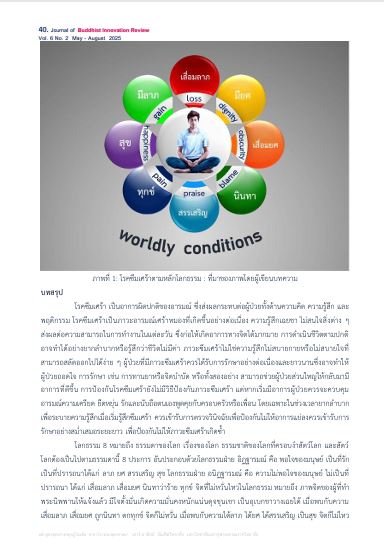
Depression is a type of mental illness caused by an imbalance of neurotransmitters in the brain, which affects daily life in terms of emotions, thoughts, and behaviors. Common causes of depression include stress, mental conditions from upbringing, and dealing with bad situations. There are two general treatment methods: medication and psychological treatment for depressed patients. In Buddhism, The Loka-dhamma is mentioned as the nature of the world that dominates living beings, and living beings must follow these eight natural conditions: gain, status, praise, happiness, loss, disgrace, criticism, and suffering. These worldly conditions occur to both ordinary people who have not learned and those who have learned. The difference is that the first group of people do not know or understand the truth, are infatuated, and are happy or sad, allowing worldly conditions to continuously dominate their minds and not escape suffering. Those who have learned see the truth that whatever happens to them is impermanent, suffering, and changes according to the rules of the Tilakkhaṇa, which is the source of suffering from loss of gain, loss of status, criticism, and suffering itself. Whenever we are disappointed and unfulfilled, we should consider the principles of the Loka-dhamma and use the truth as a factor to heal our hearts and eliminate the suffering that causes depression.
Article Details

This work is licensed under a Creative Commons Attribution-NonCommercial-NoDerivatives 4.0 International License.
เรื่องลิขสิทธิ์/เป็นความคิดเห็นของผู้เขียน
References
Book:
Faculty of Medicine, Ramathibodi Hospital. (1997). Introduction to the clinic. Bangkok: Chai Charoen 58.
Phra Phromkunaphon (P.A. Payutto). (2013). Buddhist Dictionary Compiled Edition. 24th printing. Bangkok: Dharma Council Buddhist Printing House.
Mahachulalongkornrajavidyalaya University. (2539). Thai Tripitakas. Bangkok: MCU Press
Phra Sri Maha Pho Hospital. (2008). Guidelines for monitoring depression at the provincial level. 2nd. Ubon Ratchathani: Siritham Offset Co., Ltd.
San Australia. A guide to living with depression. Translated by Darastella Sri Sangkom. n.p., n.d.
Journal :
Suthanan Chunjam et al. (October-December 2011). A survey of research on depression in Thailand. Rama Nurs J. 17(3); 422.
Sudaporn Sathityutthakan. (2018). Depression in schizophrenic patients: important issues in nursing practice. Chulalongkorn University Journal of Nursing. 30(3); 1.
Anuphong Khamma. (January-March 2013). Factors related to successful suicide: A case study of Sukhothai Province. Journal of the Psychiatric Association of Thailand. 58(1); 12.
Bell A C, D'Zurilla T J. (2009). Problem-solving therapy for depression: A meta-analysis. Clinical Psychology Review. 2(9); 348–353.
Mello M.F. et al. (2005). A systematic review of research findings on the efficacy of interpersonal therapy for depressive disorders. Eur Arch Psychiatry Clin Neurosci. 25 (5); 75– 82.
Peraton L G, Kumar S, And Machotka Z. (2010). Excercise parameters in the treatment of clinical depression: a systematic review of randomized controlled trials. Journal of Evaluation in Clinical. 1(6); 597-624.
Electronics :
Department of Mental Health. (2022). Open statistics of depression and Thai society, the silent emotional danger of modern people. [Online]. Retrieved from https://dmh.go.th/news-dmh/view.asp?id=31459. (access 1 September 2023)
Thitiporn Supasittharamrong. (2022). Depression. [online]. (Retrieved from www. medparkhospital.com. (accessed 1 July 2023)
เอกสารอ้างอิง :
หนังสือ :
คณะแพทย์ศาสตร์โรงพยาบาลรามาธิบดี. (2540). บทนำคลินิก. กรุงเทพมหานคร: ชัยเจริญ 58.
พระพรหมคุณาภรณ์ (ป.อ.ปยุตฺโต). (2556). พจนานุกรมพุทธศาสตร์ ฉบับประมวลธรรม. พิมพ์ครั้งที่ 24. กรุงเทพมหานคร: โรงพิมพ์พระพุทธศาสนาของธรรมสภา.
มหาวิทยาลัยมหาจุฬาลงกรณราชวิทยาลัย. (2539). พระไตรปิฎกฉบับภาษาไทย ฉบับมหาจุฬาลงกรณราชวิทยาลัย. กรุงเทพมหานคร: โรงพิมพ์มหาจุฬาลงกรณราชวิทยาลัย.
โรงพยาบาลพระศรีมหาโพธิ์. (2551). แนวทางการดูแลเฝ้าระวังโรคซึมเศร้าระดับจังหวัด. พิมพ์ครั้งที่ 2. อุบลราชธานี: หจก.ศิริธรรมออฟเซ็ท.
San Australia. คู่มือสำหรับการดำเนินชีวิตกับโรคซึมเศร้า. แปลโดย ดาราสเตลลา ศรีสังคม. ม.ป.ท., ม.ป.ป.
บทความ :
สุทธานันท์ ชุนแจ่ม และคณะ. (ตุลาคม-ธันวาคม 2554). การสำรวจงานวิจัยที่เกี่ยวกับภาวะซึมเศร้าในประเทศไทย. Rama Nurs J. 17(3); 422.
สุดาพร สถิตยุทธการ. (กันยายน – ธันวาคม 2561). อาการซึมเศร้าในผู้ป่วยจิตเภท: ประเด็นสำคัญในการปฏิบัติการพยาบาล. วารสารพยาบาลศาสตร์ จุฬาลงกรณ์มหาวิทยาลัย. 30(3); 1.
อนุพงศ์ คำมา. (มกราคม-มีนาคม 2556). ปัจจัยที่เกี่ยวข้องกับการฆ่าตัวตายสำเร็จ: กรณีศึกษาจังหวัดสุโขทัย. วารสารสมาคมจิตแพทย์แห่งประเทศไทย. 58(1); 12.
Bell A C, D'Zurilla T J. (2009). การบำบัดด้วยการแก้ปัญหาสำหรับภาวะซึมเศร้า: การวิเคราะห์เชิงอภิมาน Clinical Psychology Review. 2(9); 348–353.
Mello M.F. และคณะ (2005). การทบทวนอย่างเป็นระบบของผลการวิจัยเกี่ยวกับประสิทธิผลของการบำบัดแบบระหว่างบุคคลสำหรับโรคซึมเศร้า Eur Arch Psychiatry Clin Neurosci. 25 (5); 75–82.
Peraton L G, Kumar S และ Machotka Z. (2010). พารามิเตอร์การออกกำลังกายในการรักษาภาวะซึมเศร้าทางคลินิก: การทบทวนอย่างเป็นระบบของการทดลองแบบสุ่มที่มีการควบคุม วารสารการประเมินทางคลินิก 1(6); 597-624.
สื่ออิเล็กทรอนิกส์ :
กรมสุขภาพจิต. (2565). เปิดสถิติ โรคซึมเศร้ากับสังคมไทย ภัยเงียบทางอารมณ์ของคนยุคใหม่. [ออนไลน์]. เข้าถึงข้อมูลจาก https://dmh.go.th/news-dmh/view.asp?id=31459. (วันที่สืบค้น 1 กันยายน 2566)
ฐิติพร ศุภสิทธิ์ธำรง. (2565). โรคซึมเศร้า. [ออนไลน์]. เข้าถึงข้อมูลจาก https://www.medparkhospital.com. (วันที่สืบค้น 1 กรกฎาคม 2566)
