
The Application of Equanimity in Daily Life in the Modern World -
Article Sidebar
Main Article Content
Abstract
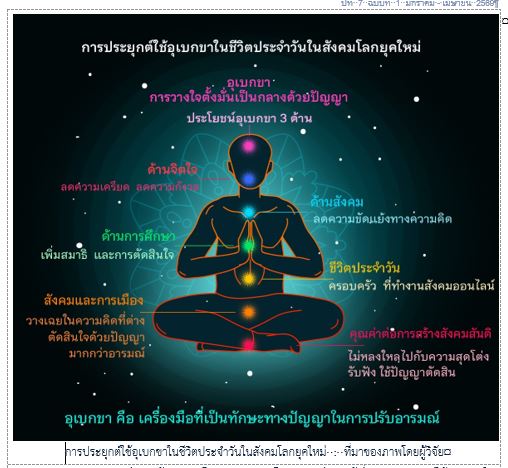
This academic article aims to propose a framework for applying the principle of upekkhā (equanimity) in daily life within the context of contemporary global digital society, and to enhance awareness of the importance of maintaining mental balance amid rapid social and technological changes. Upekkhā is understood as a state of impartiality guided by wisdom, free from emotional bias and reactivity to external stimuli. The application of upekkhā-pāramī is not merely a scriptural ideal but a practical approach that can be integrated into everyday life, including family relationships, professional settings, and online interactions, as well as broader social and political contexts.
This article employs a conceptual and analytical approach, synthesizing Buddhist teachings with contemporary perspectives on emotional regulation and digital literacy. It argues that upekkhā functions as a cognitive-emotional skill that enables individuals to regulate affect, critically evaluate information, and make balanced decisions in complex environments. The practical implications of applying upekkhā include the cultivation of mental stability, reduction of stress and anxiety, mitigation of ideological conflicts, enhancement of concentration, and decreased negative reactivity in digital communication.
Ultimately, the integration of upekkhā into modern life contributes to a balanced and sustainable way of living in the digital age, fostering well-being at personal, social, and ethical levels.
Article Details

This work is licensed under a Creative Commons Attribution-NonCommercial-NoDerivatives 4.0 International License.
เรื่องลิขสิทธิ์/เป็นความคิดเห็นของผู้เขียน
References
Reference
Book :
Boon Nilkes. (1991). Upekkha in Buddhism. Bangkok: Mahachulalongkornrajavidyalaya Printing House.
Mahachulalongkornrajavidyalaya. (1996). Thai Tripitaka Mahachulalongkornrajavidyalaya Edition B.A.2539. Bangkok: MCU Press.
Ñāṇamuni. (2017). The path of purification (Visuddhimagga). Kandy: Buddhist Publication Society.
Phra Brahmakhunaporn (P. A. Payutto). (2016). Dictionary of Buddhism (Dhamma categories) 34ed. Bangkok: Mahachulalongkornrajavidyalaya University.
Porn Rattanasuwan. (1986). Buddhist Teachings in the Tripitaka. Bangkok: Mahamakut Buddhist University Press.
Somdet Phra Buddhaghosacariya (P. A. Payutto). (2018). Buddhadhamma: Expanded edition 50ed. Bangkok: Palitham Publishing.
Turkle Sherry. (2015). Reclaiming Conversation: The Power of Talk in a Digital Age. New York: Penguin Press.
UNESCO. (2018). A global framework of reference on digital literacy skills for indicator 4.4.2. Paris: UNESCO.
Boon Nilkes. (1991). Upekkha in Buddhism. Bangkok: Mahachulalongkornrajavidyalaya Printing House.
Journal :
Cortland J. Dahl, Christine D. Wilson-Mendenhall, and Richard J. Davidson. (2020) The Plasticity of Well-Being: A Training-Based Framework for the Cultivation of Human Flourishing. Proceedings of the National Academy of Sciences, 117(51); 32197–32206.
Davidson Richard J. and Kabat-Zinn, Jon. (2011). Alterations in Brain and Immune Function Produced by Mindfulness Meditation. Psychosomatic Medicine Journal. 65(4); 564-570.
Jirachada Chiangkoon. (January-April 2023). Equanimity in meditation practice and worldly success. Buddhist Psychology Journal. 8(1); 143-153.
Phra Kru Sutthaphavanapithan, Phra Maha Wichian Krairikshsilp, Jetnipat Phithiyanuwat. (July-December 2022). Upekkha: A way of life for peace. Journal of MCU Buddhasothorn Parithat. 2 (2); 172-184.
Priyanuch Wutichupradit and Suphat Chupradit. (July-December 2022). The Influence of Social Media Addiction on the Mental Health of University Students in Thailand. Sutthiparitat Journal. 36(3); 189.
Thawatchai Triworachai et al. (January-June 2023). Leadership of executives based on the Four Sublime States of Mind in Lam Ta Sao Municipality, Wang Noi District, Phra Nakhon Si Ayutthaya Province. Journal of Philosophy Review.23(1); 71-72.
Wilson Mendenhall. (2020). The plasticity of well-being: A training-based framework for the cultivation of human flourishing. Proceedings of the National Academy of Sciences. 117(51); 32197–32206.
เอกสารอ้างอิง
หนังสือ :
บุณย์ นิลเกษ. (2534). อุเบกขาในพระพุทธศาสนา. กรุงเทพมหานคร: โรงพิมพ์มหาจุฬาลงกรณราชวิทยาลัย
พร รัตนสุวรรณ. (2529). พุทธธรรมในพระไตรปิฎก. กรุงเทพมหานคร: โรงพิมพ์มหามกุฏราชวิทยาลัย.
พระธรรมปิฎก (ป.อ. ปยุตฺโต). (2540). พุทธธรรม. พิมพ์ครั้งที่ 8. กรุงเทพมหานคร: มหาจุฬาลงกรณราชวิทยาลัย.
พระพรหมคุณาภรณ์ (ป.อ.ปยุตฺโต). (2553). พจนานุกรมพุทธศาสตร์ ฉบับประมวลศัพท์. พิมพ์ครั้งที่ 14. กรุงเทพมหานคร: บริษัท ธนธัชการพิมพ์ จำกัด.
พระมหาสมปอง มุทิโต. (2542). อุเบกขาในพระพุทธศาสนา. กรุงเทพมหานคร: มหาจุฬาลงกรณราชวิทยาลัย.
พระมหาสันทัด จันทร์ทาทอง. (2544). อุเบกขาในพระพุทธศาสนา. กรุงเทพมหานคร: โรงพิมพ์มหาจุฬาลงกรณราชวิทยาลัย.
มหาวิทยาลัยมหาจุฬาลงกรณราชวิทยาลัย. (2539). พระไตรปิฎกภาษาไทย ฉบับมหาจุฬาลงกรณราชวิทยาลัย. กรุงเทพมหานคร: โรงพิมพ์มหาจุฬาลงกรณราชวิทยาลัย.
พระอุดรคุณาธิการ และจําลอง สารพัดนึก. (2630). อุเบกขาในพระพุทธศาสนาเถรวาท พจนานุกรมพุทธศาสตร์. กรุงเทพมหานคร: มหามกุฏราชวิทยาลัย.
หนังสือแปล :
พระพุทธโฆสาจารย์. (2536). วิสุทธิมรรค. แปลไทยโดย สมเด็จพระมหาสมณเจ้ากรมพระปรมานุชิตชิโนรส. กรุงเทพมหานคร: โรงพิมพ์มหามกุฏราชวิทยาลัย.
บทความ :
จิรชฎา เชียงกูล. (มกราคม-เมษายน 2566). อุเบกขาในการเจริญภาวนากรรมฐาน กับความสำเร็จในทางโลก. วารสารพุทธจิตวิทยา. 8(1); 143-153.
ธวัชชัย ตรีวรชัย และคณะ. (มกราคม-มิถุนายน 2566). ภาวะผู้นำของผู้บริหารตามหลักพรหมวิหาร4 ในเทศบาลเมืองลำตาเสา อำเภอวังน้อย จังหวัดพระนครศรีอยุธยา. วารสารปรัชญาปริทรรศน์. 23(1); 71-72.
พระครูสุตภาวนาพิธาน, พระมหาวิเชียร ไกรฤกษ์ศิลป์, เจตนิพัทธ์ พิธียานุวัฒน์. (กรกฎาคม-ธันวาคม 2565). อุเบกขา: แนวทางการดำเนินชีวิตเพื่อสันติสุข. วารสาร มจร พุทธโสธรปริทรรศน์. 2 (2); 172-184.
ประทวน วันนิจ และมนูญ สอนโพนงาม. (กรกฎาคม-ธันวาคม 2565). วิกฤตวัฒนธรรม เปลี่ยนผ่านวิถีชีวิตสังคมไทยในยุคดิจิทัล. วารสารวนัมฎองแหรกพุทธศาสตร์ปริทรรศน์. 9(2); 117.
ปริยานุช วุฒิชูประดิษฐ์ และสุภัทร ชูประดิษฐ์. (กรกฎาคม-กันยายน 2565). อิทธิพลของการติดสื่อสังคมออนไลน์ต่อภาวะสุขภาพจิตของนักศึกษามหาวิทยาลัยในประเทศไทย. วารสารสุทธิปริทัศน์. 36(3); 189.
