
The Buddhist Teaching Method Based on the Earth Element for Attaining Enlightenment
Article Sidebar
Main Article Content
Abstract
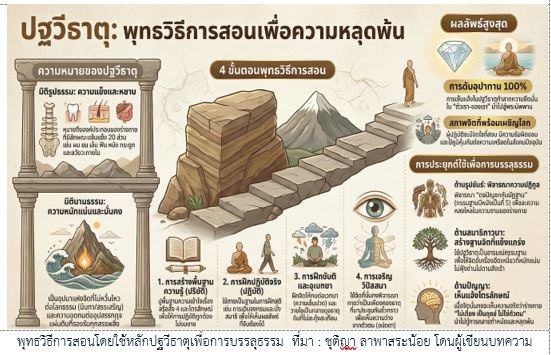
The Buddhist teaching method utilizing the principle of the earth element, designed to achieve the cessation of suffering caused by clinging to the body as a "self". This principle utilizes both the physical attribute of the earth element (solidity) and its abstract qualities (steadfastness, endurance). The teaching methodology consists of four stages: 1) building foundational knowledge, 2) practical implementation, 3) cultivating patience and equanimity, and 4) developing insight meditation. The application of this method involves three areas: 1) the contemplation of the physical body to perceive its impermanence and impurity; 2) concentration meditation , using the earth element as a meditation subject to cultivate a tranquil, stable mind; and 3) wisdom, which employs this stable mind to contemplate the Three Characteristics. When profound insight arises, realizing the body is merely a collection of elements and not a self, it leads to the relinquishing of clinging and the attainment of liberation, the ultimate goal in Buddhism.
Article Details

This work is licensed under a Creative Commons Attribution-NonCommercial-NoDerivatives 4.0 International License.
เรื่องลิขสิทธิ์/เป็นความคิดเห็นของผู้เขียน
References
Reference :
Book :
Phra Khru Tilakanurak. (2015). A Study of Fundamental Meditation in Mindfulness of the Body. Ayutthaya: Mahachulalongkornrajavidyalaya University.
Phra Dhammapitaka (P. A. Payutto). (2000). Buddhadhamma: Revised and Expanded Edition. 9th ed. Bangkok: Mahachulalongkornrajavidyalaya University Press.
Phra Dhammapitaka (P. A. Payutto). (2018). Dictionary of Buddhism: Compendium of Terms. 31th. Bangkok: Sahadhammik Co., Ltd.
Mahachulalongkornrajavidyalaya University. (2539). Thai Tripitaka: Mahachulalongkornrajavidyalaya University. Bangkok: Mahachulalongkornrajavidyalaya University Press.
Somdej Phra Buddhaghosacharya (P.O. Payutto). (2018). Dictionary of Buddhist Terms. Bangkok: Sahathamik Printing Company Limited.
Ven. Kandhasarabhivong (Trans.). (2009). Abhidhammathasangaha and Paramatthadipani. 3rd. Bangkok: Prayoonsanthai Printing Limited Partnership.
Translated Books :
Bhadantacariya Buddhaghosa. (2021). Visuddhimagga: Translation and Explanation. Volume 4. (Translated by Ven. Kandhasarabhivong). Bangkok: Prayoonsanthai Printing Limited Partnership.
Buddhaghosa Thera. (2025). Visuddhimagga. (Translated by Somdej Phra Phutthacharn (Aj Asabhama Thera). Taipei: The Corporate of The Buddha Educational Foundation.
Journal :
Wichanati, S., Ngamchitcharoen, W. (May–August 2018). A Comparative Study of Rupakhandha and Scientific Truth. Journal of Buddhist Studies, Chulalongkorn University. 25(2);11.
Phramaha Thongsuk Paññavanno(Phrommidet). (April–August 2025). Awakening in Daily Life according to the Principle of the Dependent OriginationAcademic Articles. Journal of Buddhist Innovation Review. 6(2); 15-29.
Electronic media :
Mahachulalongkornrajavidyalaya University. (1996). Thai Tripitaka: Mahachulalongkornrajavidyalaya University Edition. Bangkok: Mahachulalongkornrajavidyalaya University Printing House. Source: https://84000.org/tipitaka. (Accessed 7 October 2025)
Somdej Phra Buddhaghosacharya (P. O. Payutto). (2018). Dictionary of Buddhism: Compendium of Terms. Source: https://www.watnyanaves.net. (Accessed 7 October 2025)
Somdej Phra Buddhaghosacharya (P. O. Payutto). (2003). Dictionary of Buddhist studies: A compilation of Dhamma. Source: https://www.watnyanaves .net. (Accessed 7 October 2025)
