
Developing The Faculty Of Mindfulness (Satindriya) And Buddhists Awakening
Article Sidebar
Main Article Content
Abstract
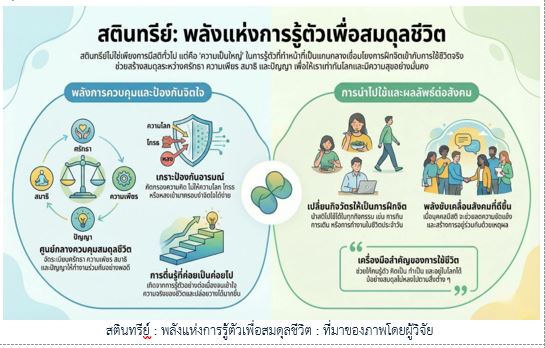
This article aims to study the development of saddhindriya (faculty of mindfulness) as a means to enhance the Buddhist way of life in contemporary society. Saddhindriya is defined as mindfulness endowed with strength and mastery over its function, capable of controlling the mind to prevent negligence and heedlessness. It also coordinates the Five Spiritual Faculties—faith, energy, concentration, and wisdom—ensuring their balanced development. When mindfulness is firmly established, the other faculties support one another and lead to stable wisdom. Furthermore, the article explores the interrelationship of saddhindriya with other significant doctrinal frameworks, such as the Four Foundations of Mindfulness (satipaṭṭhāna), which provide the direct path to cultivating mindfulness; the Threefold Training (tisikkhā), where mindfulness serves as the basis for morality, concentration, and wisdom; and the Seven Factors of Enlightenment (bojjhaṅga), where mindfulness is the primary factor for attaining liberation. From the perspective of Buddhist psychology, saddhindriya functions as a psychological immunity system that regulates emotions, manages thoughts, and strengthens mental stability. Its application extends to various domains, including education, work, family life, and the digital society. In conclusion, saddhindriya is not only a doctrinal principle but also a practical faculty that integrates inner cultivation with social development, contributing to individual well-being and the creation of a sustainable culture of mindfulness in society.
Article Details

This work is licensed under a Creative Commons Attribution-NonCommercial-NoDerivatives 4.0 International License.
เรื่องลิขสิทธิ์/เป็นความคิดเห็นของผู้เขียน
References
Reference :
Book :
Mahachulalongkornrajavidyalaya University. (1996). Thai Tripitaka Mahachulalongkornrajavidyalaya University Edition. Bangkok: Mahachulalongkornrajavidyalaya University Press.
Phra Brahmakhunaporn (P.A. Payutto). (2011). Buddhist Dictionary: A Compilation of Dhamma. 19th edition. Bangkok: Buddhadhamma Foundation.
Phra Dhammakosajarn (Prayoon Dhammacitto). (2002). Buddhist Psychology. Bangkok: Mahamakut Buddhist University Press.
Phra Dhammapitaka (P.A. Payutto). (2013). Buddhadhamma. Bangkok: Buddhadhamma Foundation.
Sathien Phothinanthana. (1979) Buddhist Studies. Bangkok: Odeon Store Printing House.
Somdej Phra Buddhaghosacharya (P. A. Payutto). (2021). Buddhist Dictionary: A Compilation of Terms. Bangkok: Buddhatham Foundation Printing House.
Suphi Thumthong. (2011). Development of Sense Restraint. Bangkok: Siriwatana Interprint Public Company Limited.
Translated book :
Buddhaghosacarya. (1987). Visuddhimagga. Translated by Somdej Phra Maha Veerawong. Bangkok: Mahamakutrajavidyalaya.
Phra Anuruddhacarya. (2009). Abhidhammatthasangaha and Paramatthadipani. Translated by Phra Kanthasara Abhivong. 3rd ed. Bangkok: Prayurasarn Thai Co., Ltd.
Thesis :
Nattachit Lauhweera. (2011). A Study of the Development of the Faculties in the Indriyabhavana Sutra. Master's Thesis in Buddhist Studies, Graduate School: Mahachulalongkornrajavidyalaya University.
เอกสารอ้างอิง
หนังสือ :
พระธรรมโกศาจารย์ (ประยูร ธมฺมจิตฺโต). (2545). พุทธจิตวิทยา. กรุงเทพมหานคร: โรงพิมพ์มหามกุฏราช-วิทยาลัย.
พระพรหมคุณาภรณ์ (ป.อ. ปยุตฺโต). (2556). พุทธธรรม. พิมพ์ครั้งที่ 15. กรุงเทพมหานคร: มูลนิธิพุทธธรรม.
พระพรหมคุณาภรณ์ (ป.อ. ปยุตฺโต). (2554). พจนานุกรมพุทธศาสตร์ ฉบับประมวลธรรม. พิมพ์ครั้งที่ 19. กรุงเทพมหานคร: มูลนิธิพุทธธรรม.
มหาจุฬาลงกรณราชวิทยาลัย. (2539). พระไตรปิฎกภาษาไทย ฉบับมหาจุฬาลงกรณราชวิทยาลัย. กรุงเทพมหานคร: โรงพิมพ์มหาจุฬาลงกรณราชวิทยาลัย.
สมเด็จพระพุทธโฆษาจารย์ (ป. อ. ปยุตฺโต). (2564). พจนานุกรมพุทธศาสน์ ฉบับประมวลศัพท์. พิมพ์ครั้งที่ 35. กรุงเทพมหานคร: โรงพิมพ์มูลนิธิพุทธธรรม.
สุภีร์ ทุมทอง. (2554). การพัฒนาอินทรียสังวร. กรุงเทพมหานคร: ศิริวัฒนาอินเตอร์พริ้นท์ จำกัด (มหาชน)
เสถียร โพธินันทะ. (2522) พุทธธรรมศึกษา. กรุงเทพมหานคร: โรงพิมพ์โอเดียนสโตร์.
หนังสือแปล :
พระพุทธโฆสาจารย์. (2530). วิสุทธิมรรค. แปลโดย สมเด็จพระมหาวีรวงศ์. กรุงเทพมหานคร: มหามกุฏราชวิทยาลัย.
พระอนุรุทธาจารย์. (2552). อภิธัมมัตถสังคหะและปรมัตถทีปนี. แปลโดย พระคันธสาราภิวงศ์. พิมพ์ครั้งที่ 3. กรุงเทพมหานคร: ประยูรสาส์นไทย จำกัด.
วิทยานิพนธ์ :
ณัฏฐจิตต์ เลาห์วีระ. (2554). ศึกษาการพัฒนาอินทรีย์ในอินทริยภาวนาสูตร. วิทยานิพนธ์พุทธศาสตรมหาบัณฑิต สาขาวิชาพระพุทธศาสนา. บัณฑิตวิทยาลัย
มหาวิทยาลัยมหาจุฬาลงกรณราชวิทยาลัย.
