การพัฒนาคุณภาพชีวิตในโลกยุคเทคโนโลยีปัญญาประดิษฐ์
Article Sidebar
Main Article Content
บทคัดย่อ
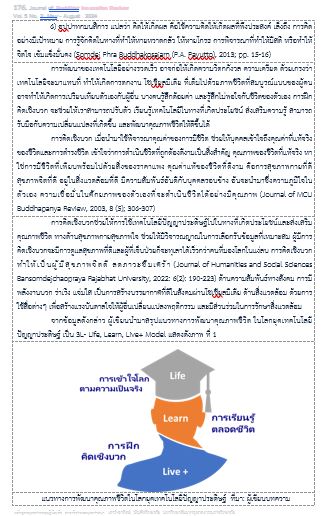
บทความนี้ มีวัตถุประสงค์เพื่อนำเสนอผลกระทบของเทคโนโลยีปัญญาประดิษฐ์กับคุณภาพชีวิตในเชิงบวกและเชิงลบ และนำเสนอแนวทางการพัฒนาคุณภาพชีวิตให้สอดคล้องกับโลกในยุคปัจจุบัน จากการทบทวนวรรณกรรมพบว่า การพัฒนาคุณภาพชีวิตเป็นกุญแจสำคัญในการปรับตัวให้เข้ากับโลกยุคปัจจุบัน การตระหนักรู้ถึงผลกระทบทั้งในเชิงบวกและเชิงลบ จะช่วยให้บุคคลสามารถใช้เทคโนโลยีเพื่อพัฒนาคุณภาพชีวิตของตนเองและสังคมได้ แนวทางการพัฒนาคุณภาพชีวิตในโลกยุคเทคโนโลยีปัญญาประดิษฐ์ ได้แก่ การเข้าใจโลกตามความเป็นจริง การพัฒนาตนเองด้วยการเรียนรู้ตลอดชีวิต และการฝึกคิดเชิงบวก
Article Details

อนุญาตภายใต้เงื่อนไข Creative Commons Attribution-NonCommercial-NoDerivatives 4.0 International License.
เรื่องลิขสิทธิ์/เป็นความคิดเห็นของผู้เขียน
เอกสารอ้างอิง
Books:
English Martin. (1992). How to Feel Great About Yourself and Your Life: A Step by Step Guide to Positive Thinking. New York: AMACOM.
Mahachulalongkornrajavidyalaya University. (1996). Thai Tripitaka Mahachulalongkorn-rajavidyalaya editio. Bangkok: Mahachulalongkornrajavidyalaya Printing House.
Nipon Poapongsakorn et al. (1992). Impact assessment of central organizations. Bangkok: Kasetsart University.
Phra Brahmagunabhorn (P. A. Payutto). (2007). The Buddhist way of thinking. Bangkok: Dhamma Council.
Potter Alice. (1998). Putting the Positive Thinker to Work: 21 Ways 21 Days to a Happy, Fulfilling, Successful Life. New York: Berkley Books.
Somdej Phra Buddhakosajarn (P.A. Payutto). (2013). Ways of Thinking According to Buddhist Principles. 26th printing. Bangkok: Active Print.
Siri Hamsupho. (2000). Population and quality of life development. Bangkok: Odeon Store. Royal Institute of Thailand. (1999). Dictionary of the Royal Institute of Thailand B.E. 2542. Bangkok: Nanmee Books Publications.
World Health Organization. (1998). The World Health Organization Quality of Life User Manual. Switzerland: Division of Mental health and prevention of substance abuse. World Health Organization.
S Sabitha et.al. (2024). Mind Matters-Power of Positive Thinking. India: Saliha Publications.
Journals:
Busara Niyomves. (2024). Reform Lifelong Learning: Harnessing Technology for Effective Teaching and Learning. Interdisciplinary Academic and Research Journal, 4(1): 380-389. (in Thai)
Hsiao, T., Wenloong, C. and Ying, F. L. (2012). A Study on the Relationship between Thinking Styes (Attitudes) and Collaboration Attitudes of College Students in Taiwan. Journal of Educational and Instructional Studies in the World. 2 (2); 46-57. (in Thai)
Jeerawan Srichanchai and Sujima Tilakarayasrup. (2021). The effect of smartphone usage In early childhood: nursing role. Research Article. Journal of MCU Nakhondhat, 8(10): 115. (in Thai)
Pathomporn Talabhat and Dusdee Suwankajorn. (2017). An Analytical Study of PositiveThinking for Life Development in Buddhist Principle. Research Article. Journal of Graduate Studies Review. 13 (Special Issue): 280-291. (in Thai)
Panjanat Vorawattanachai. (2022). Positive Thinking. Journal of Humanities and Social Sciences Bansomdejchaopraya Rajabhat University. 6 (2): 190-223. (in Thai)
Porntip Gadetragoon. (2023). Buddhist psychology for authentic value of life. Research Article. Journal of MCU Buddhapanya Review. 8 (5): 302-310. (in Thai)
Mongkol Thianprathuangchai. (2022). The analyze the thinking of artificial intelligence (AI) and humans in the concept of Theravada Buddhist philosophy. Research Article. Journal of MCU Nakhondhat. 9 (9): 135-146. (in Thai)
Phramaha Chaiya Chartametho. (2023). An Analytical Study of Lifestyle According to The Sammãditthi (Right View) In Buddhism. Journal of MCU Ubon Review. 8 (2): 1617-1624. (in Thai)
Electronic medias:
Chantama Changsalak. (2023). [Online]. Psychologists warn! Prepare to receive 4 mental health risk factors in the digital world. [Retrieved 28 January 2024]. www.istrong.com.
Bank of Thailand. (2022). [Online]. Entering the era of AI and MACHINE LEARNING, thinking and acting instead of people. [Retrieved 28 January 2024]. www.bot.or.th
Pornpen Sotsrichai. (2023). [Online]. ‘Lifelong learning’: A skill that is essential in a fast-paced world. [Retrieved 28 January 2024]. www.bangkokbiznews.com
IBM. (2024). [Online]. What is Artificial Intelligence (AI)?. [28 January 2024]. www.ibm. Com
National Science and Technology Development Agency (NSTDA). (2023). [Online]. Summary of the seminar 'Life in the modern world and living with AI wisely'. [Retrieved 28 January 2024]. www.nstda.or.th/home/news
Academic conference:
Phusadee Klinkasorn. (2019). Lifelong learning and life skills development. The 14th National and International Academic Conference of Sripathum University.
Foreign language books:
Mackenzie, N. I., Eraut, M., and Jones, H. C. (1970). Teaching and Learning: An Introduction to New Methods and Resources in Higher Education. International Association of Universities. Paris: Unesco.
Maslow, A.H. (1954). Motivation and Personality. New York: Harper Collins.
Peterson, R. E. (1979). Lifelong Learning in America. San Francisco: Jossey-Bass.
The WHO Group. (1994). The Development of the World Health Organization Quality of Life Assessment Instrument. New York: Springer-Verlag.
Dean, H. (1985). Choosing Multiple Instruments to Measure Quality of Life. Oncology Nursing Forum. 2 (2): 88-91.
Ferrans, C.E. & Powers, M.J. (1985). Quality of Life Index: Development and Psychometric Properties. Advances in Nursing Science, 8 (1): 15-24.
Hilgard, E. R. (1962). Impulsive versus realistic thinking: An examination of the distinction between primary and secondary processes in thought. Psychological Bulletin. 59 (6): 477–488.
