
Air Attaché Competency Development with Buddhism Integration
Article Sidebar
Main Article Content
Abstract
This research work investigated on 3 objectives: 1) to study the problems related to the competency of the Air Attaché and the process of developing the competency of the Air Attache 2) to study the development of the competency of the Air Attaché according to Buddhist principles and 3) to present a model for developing the competency of the Air Attaché. This is a qualitative field research study. The research instruments include in-depth interview questionnaires and focus group discussion. Data was collected from in-depth interviews with 19 key informants and focus group discussions with 9 experts and combined with documents data analyzing for synthesized to a Buddhist-integrated model for developing the competencies of air attaché.
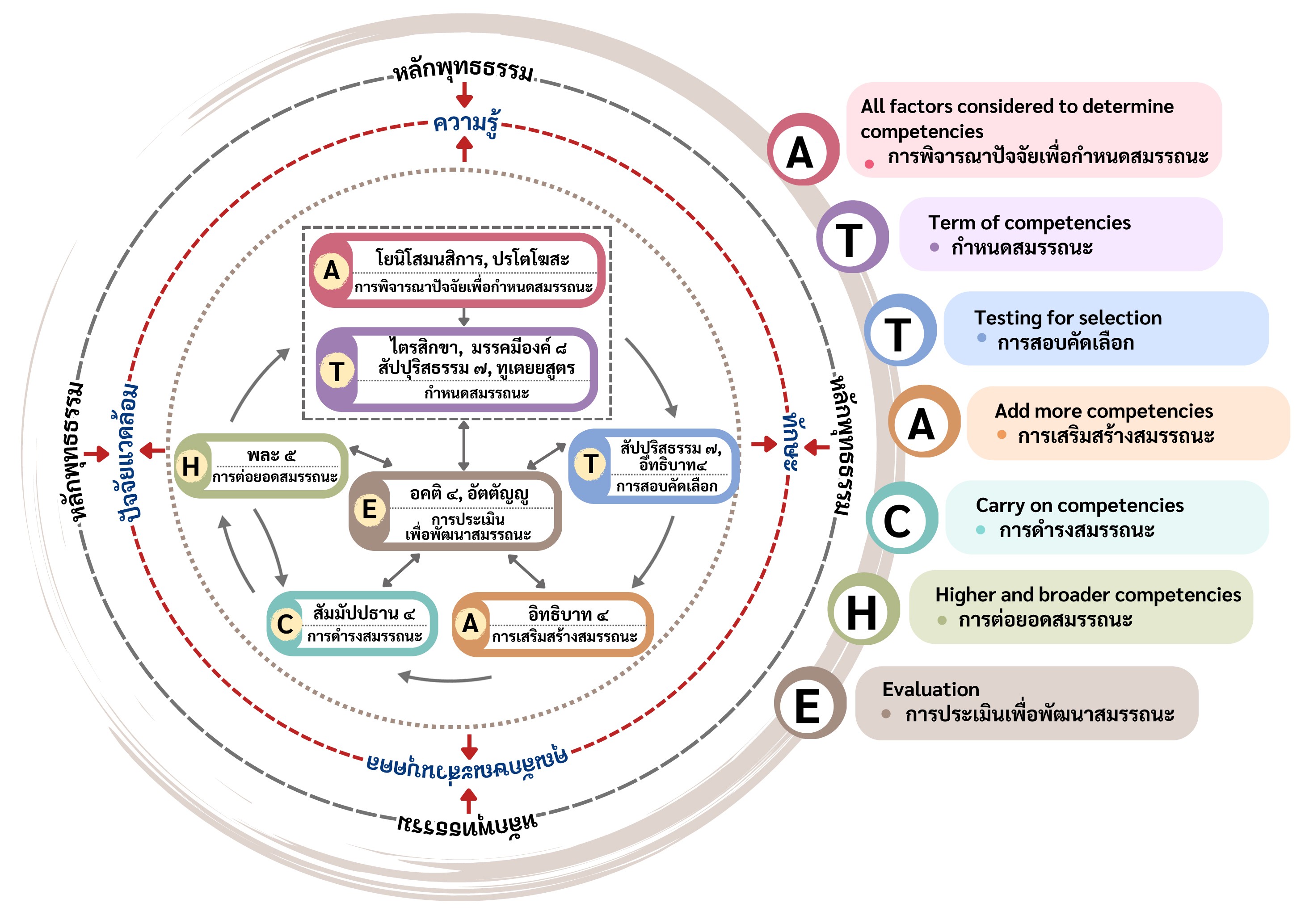
The results of the research found that 1) Four areas problems related to the competency of the Air Attaché are Knowledge, Skill, Personal characteristics, and Environmental factors. These problems can be solved by increasing the efficiency of operations in various steps of the competency development process. 2) The development of the competency of the Air Attaché according to Buddhist principles can be done by integrating Buddhist Principles which are yonisomanasikàra, Paratokhosa, Tri-Sikkhà, the eight Magga, the seven Sappurisa-dhamma, the Thuteyya Sutra, the four Iddhipàda , the four Sammappadhàna , the five Bala, and the four Agati. The research also found that other Buddisht Principles can be integrated to improve the competency of the Air Attache such as Owata Patimokkha, the four Brahmavihàra, the four Saïgahavatthu , Hiri-Ottappa, etc. to support Air Attaché Competency Development. 3) The Buddhist-integrated Air Attaché competency development model can be illustrated 7 steps consist of A : All factor be consideration to determine competency with yonisomanasikàra and Paratokhosa, T : Term of competency, determine the required competencies with the Tri-Sikkhà, the eight Magga, the seven Sappurisa-dhamma, and the Thuteyya Sutra integration, T : Testing for selection with the seven Sappurisa-dhamma and the four Iddhipàda integration, A : Add more competency with the four Iddhipàda integration, C : Carry on competency with the four Sammappadhàna integration, H : Higher and broader competency with the five Bala integration and E : Evaluation to develop competency with the four Agati and Attanyuta integration. Summary of knowledge gain from research into ATTACHE Model.
Article Details

This work is licensed under a Creative Commons Attribution-NonCommercial-NoDerivatives 4.0 International License.
Copyright Notice
The content and information in the articles published in Journal of MCU Palisueksabuddhaghosa Review, are regarded as opinions and responsibilities of article author only. It definitely does not mean that the editor must agree or share any responsibility to the author.
Articles, information, content, figure etc. that have been published in the Journal of MCU Palisueksabuddhaghosa Review is considered as the copyright of the Journal. If any individual or organization will to bring any parts of article for promote or to do anything, must be licensed only in official form from the Journal of MCU Palisueksabuddhaghosa Review.
The content and information in the articles published in Journal of MCU Palisueksabuddhaghosa Review, are regarded as opinions and responsibilities of article author only. It definitely does not mean that the editor must agree or share any responsibility to the author.
Articles, information, content, figure etc. that have been published in the Journal of MCU Palisueksabuddhaghosa Review is considered as the copyright of the Journal. If any individual or organization will to bring any parts of article for promote or to do anything, must be licensed only in official form from the Journal of MCU Palisueksabuddhaghosa Review.
References
จำเนียร จวงตระกูล, การพัฒนาทรัพยากรมนุษย์: ทฤษฎีและการปฏิบัติ. กรุงเทพฯ: ซีเอ็ดยูเคชั่น, 2563.
ชกานาฏ จันทรวงศ์,พันเอกหญิง “บทบาทผู้ช่วยทูตฝ่ายทหารในยุคหลังสงครามเย็น” ภาคนิพนธ์
หลักสูตรรัฐศาสตรมหาบัณฑิต, (คณะรัฐศาสตร์: มหาวิทยาลัยธรรมศาสตร์, 2539).
พรพรรณ โปรเทียรณ์. “รูปแบบการพัฒนาสมรรถนะการปฏิบัติงานตามหลักภาวนา 4 ของบุคลากรสายสนับสนุนวิชาการมหาวิทยาลัยมหาจุฬาลงกรณราชวิทยาลัย”. ดุษฎีนิพนธ์ หลักสูตรปริญญาพุทธศาสตรดุษฎีบัณฑิต สาขาวิชาพุทธบริหารการศึกษา. บัณฑิตวิทยาลัย: มหาวิทยาลัยมหาจุฬาลงกรณราชวิทยาลัย, 2561.
พระพรหมคุณาภรณ์ (ป.อ.ปยุตโต). พุทธธรรม ฉบับปรับขยาย, พิมพ์ครั้งที่ 39. มหาวิทยาลัยมหาจุฬา
ลงกรณราชวิทยาลัย.กรุงเทพฯ: โรงพิมพ์มหาจุฬาลงกรณราชวิทยาลัย,พ.ศ.๒๕๔๗.
มหาจุฬาลงกรณราชวิทยาลัย. พระไตรปิฎกภาษาไทย ฉบับมหาจฬาลงกรณราชวิทยาลัย. กรุงเทพมหานคร : โรงพิมพ์มหาจุฬาลงกรณราชวิทยาลัย, 2539.
วิชัย ชูเชิด, พลตรี. แนวทางการกำหนดยุทธศาสตร์ด้านการทูตฝ่ายทหาร เพื่อรองรับยุทธศาสตร์
ชาติระยะ 20 ปี, (พ.ศ.2561 - 2580), งานวิจัยหลักสูตรการป้องกันราชอาณาจักร รุ่นที่ 60 ประจำปีการศึกษา พุทธศักราช 2560 - 2561.
สมชาย ภคภาสน์วิวัฒน์, รศ.ดร., การทูต,หลักพื้นฐานความสัมพันธ์ระหว่างประเทศ.หน่วยที่ 9.
พิมพ์ครั้งที่ 10. ศูนย์หนังสือมหาวิทยาลัยสุโขทัยธรรมาธิราช ปากเกร็ด นนทบุรี 2563.
สุวนีย์ เอื้อพันธ์ศิริกุล และสืบสกุล นรินทรางกูร ณ อยุธยา. “แนวทางการพัฒนานักการทูตไทยสู่มาตรฐานสากล”. บทความวิชาการ. วารสารสังคมศาสตร์. คณะรัฐศาสตร์ จุฬาลงกรณ์มหาวิทยาลัย. ปีที่ 50 ฉบับที่ 1, 2563.
Roby Thomas. Indian Defence Diplomacy a Handbook. Manohor Parrikka Institute for
Defence Studies and Analyses. New Delhi : KW Publishers Pvt Ltd.2021.
