
Effects of Task-Based Reading Activities for Promoting Grade 5 Students’ Reading Comprehension Ability Using English Fables
Article Sidebar
Main Article Content
Abstract
This research article investigates for: 1) comparison of the English reading comprehension ability of grade 5 students before and after using Task-based reading activities with English fables, 2) study the students’ satisfaction toward learning by using Task-based reading activities with English fables. It was experimental research employing a one-group pretest-posttest design. The tool consists of: 1) 3 lesson plans based on task-based learning integrated with English fables to enhance English reading comprehensive skills, 2) A pretest and posttest to assess students’ English reading comprehension ability and 3) A satisfaction questionnaire on learning through task-based reading activities integrated with English fables. The data were analyzed using mean, standard division and t-test. The experiment was conducted with a sample group of 25 grade 5 students from Bann Khao Khansong School in the academic year 2025, selected through cluster random sampling technique.
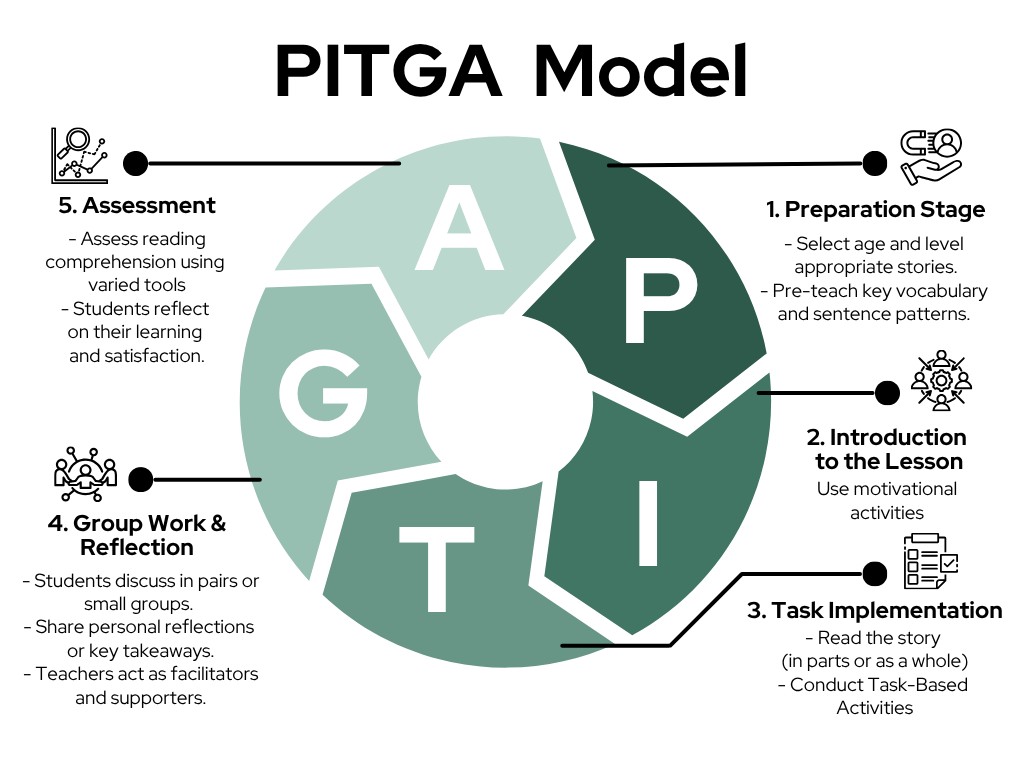
The results were: 1) English reading comprehension ability of grade 5 students before and after using Task-based reading activities with English fables were significantly higher than before at .05. This improvement stemmed from the task‑based learning approaches clearly defined, sequential steps—arranged from simple to complex—that guided learners through each stage in a logical manner, thereby enhancing their comprehension skills. Moreover, integrating English fables into the task‑based activities further supported primary‑level students’ reading‑for‑understanding. The instructional design emphasized the reading process and targeted 6 specific subskills: 1) Identifying the main idea, 2) Locating supporting details, 3) Inferring word meanings from context, 4) Sequencing events, 5) Drawing conclusions and 6) Determining the moral or lesson of the text. 2) the students’ satisfaction toward learning by using Task-based reading activities with English fables was at the highest level. This positive response was attributed to the multifaceted nature of the reading tasks-comprising both tests and exercises, as well as diverse formative assessments conducted during the experimental period-each aligned with the fables’ content and appropriate to primary learners’ comprehension abilities. Furthermore, every phase of the assigned tasks was directly related to the reading material and well matched to the students’ cognitive and linguistic levels, thereby fostering both their engagement and their English reading development.
Article Details

This work is licensed under a Creative Commons Attribution-NonCommercial-NoDerivatives 4.0 International License.
Copyright Notice
The content and information in the articles published in Journal of MCU Palisueksabuddhaghosa Review, are regarded as opinions and responsibilities of article author only. It definitely does not mean that the editor must agree or share any responsibility to the author.
Articles, information, content, figure etc. that have been published in the Journal of MCU Palisueksabuddhaghosa Review is considered as the copyright of the Journal. If any individual or organization will to bring any parts of article for promote or to do anything, must be licensed only in official form from the Journal of MCU Palisueksabuddhaghosa Review.
The content and information in the articles published in Journal of MCU Palisueksabuddhaghosa Review, are regarded as opinions and responsibilities of article author only. It definitely does not mean that the editor must agree or share any responsibility to the author.
Articles, information, content, figure etc. that have been published in the Journal of MCU Palisueksabuddhaghosa Review is considered as the copyright of the Journal. If any individual or organization will to bring any parts of article for promote or to do anything, must be licensed only in official form from the Journal of MCU Palisueksabuddhaghosa Review.
References
กรมวิชาการ กระทรวงศึกษาธิการ. (2533). หลักสูตรการศึกษาขั้นพื้นฐาน พุทธศักราช 2521 (ฉบับปรับปรุง พ.ศ. 2533). กรุงเทพฯ: โรงพิมพ์คุรุสภา.
กระทรวงศึกษาธิการ. (2557). นโยบายการปฏิรูปการเรียนการสอนภาษาอังกฤษในระดับการศึกษาขั้นพื้นฐาน. กรุงเทพฯ: สำนักการต่างประเทศและประชาสัมพันธ์ กระทรวงศึกษาธิการ.
ระพีพรรณ พัฒนาเวช. (2553). คู่มือคัดเลือกหนังสือสำหรับเด็กแต่ละวัย. สืบค้นเมื่อ 30 พฤษภาคม 2568, จาก https://tkp.d.orisma.com/eng/papers_detail/28/
สำนักงานเลขาธิการสภาการศึกษา. (2550). แนวทางการจัดการเรียนรู้ที่เน้นผู้เรียนเป็นสำคัญ การจัดการเรียนรู้แบบกระบวนการแก้ปัญหา. กรุงเทพฯ: ชุมนุมสหกรณ์การเกษตรแห่งประเทศไทย.
สุภัทรา อักษรานุเคราะห์. (2530). การสอนการอ่าน. กรุงเทพฯ: โรงพิมพ์จุฬาลงกรณ์มหาวิทยาลัย.
Anderson, R. C., & Pearson, P. D. (1984). A schema-theoretic view of basic processes in reading comprehension. in P. D. Pearson, Handbook of reading research. Longman.
Beaty, J. J. (1994). Observing development of the young child (4th ed.). Macmillan Publishing Company.
Best, R., & Kahn, P. (1986). Individual differences in foreign language learning. In M. Bond.
Bygate, M. (2001). Effects of task repetition on the structure and control of oral language. In M.
Vygotsky, L. S. (1978). Mind in society: The development of higher psychological processes (M. Cole, V. John-Steiner, S. Scribner, & E. Souberman, Eds.). Harvard University Press.
Willis, J. (1996). A framework for task-based learning. Longman.
