
The process of promoting health of the elderly using the principles of Vipassana meditation
Article Sidebar
Main Article Content
Abstract
This research article aims to: (1) examine the physical and mental well-being of the elderly and the processes for enhancing such well-being, (2) study the Vipassanā meditation as a means to promote physical and mental health among the elderly, and (3) present a practical framework for fostering holistic well-being through Vipassanā practice. This qualitative research employed in-depth interviews with 15 elderly practitioners at Wat Phichaya Yatikaram in Bangkok.
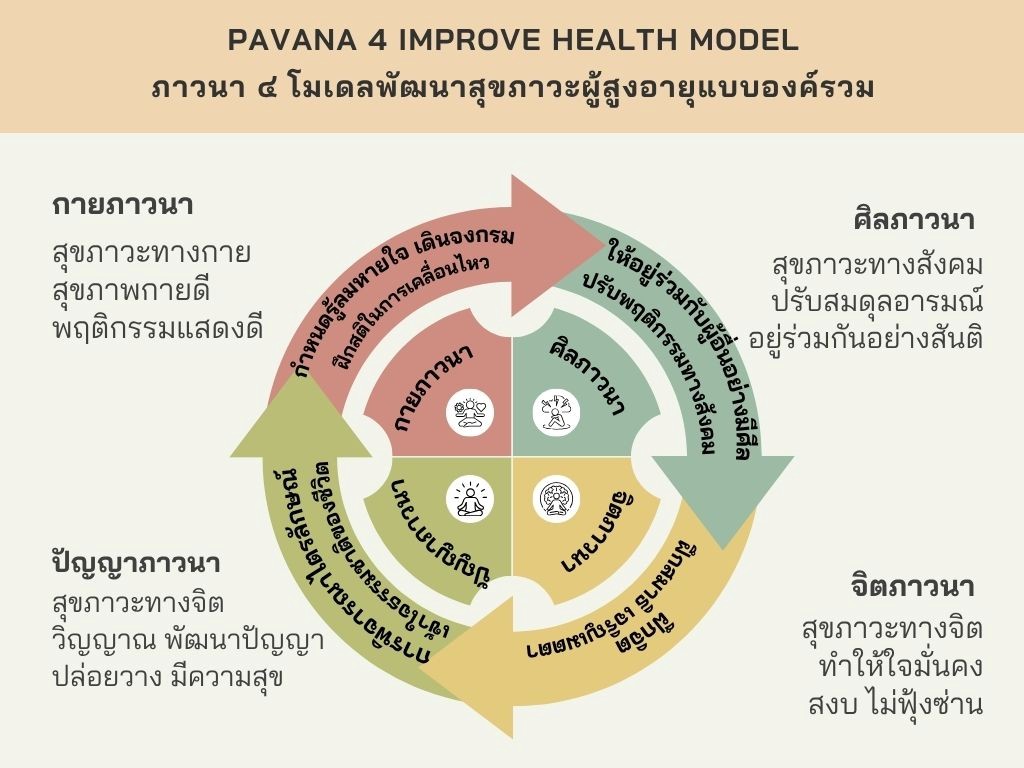
The findings revealed a profound interconnection between physical and mental well-being. Balanced development in both aspects significantly contributes to a sustainable quality of life. Good health, in this context, emerges from mindfulness, acceptance of life’s conditions, and effective coping mechanisms—whether through self-reliance or support from others. Vipassanā meditation was found to be a highly effective means of enhancing the holistic well-being of elderly individuals across 4 dimensions: physical, mental, social, and spiritual. Practitioners reported improved stress management, emotional stability, strengthened family relationships, and a renewed senses of meaning and purpose in life. Regular mindfulness practice, though simple, proved to be a powerful and sustainable tool for daily living. The process of enhancing well-being through Vipassanā is rooted in the Fourfold Training called Bhāvanā: 1) Kāyabhāvanā or Physical development: training of breath awareness and mindful movement, 2) Sīlabhāvanā or Moral cultivation: living ethically and harmoniously with others, 3) Cittabhāvanā or Mental cultivation: developing concentration and loving-kindness to reduce distraction and loneliness, 4) Paññābhāvanā or Wisdom development: contemplating impermanence and gaining deep insight into the nature of life and self. This training led to improvements in sleep quality, reduction in chronic pain, emotional resilience, and a positive attitude toward aging, illness, and death. In conclusion, Vipassanā meditation provides an effective and culturally appropriate model for promoting holistic well-being among the elderly in the Thai context—at individual, family, and community levels.
Article Details

This work is licensed under a Creative Commons Attribution-NonCommercial-NoDerivatives 4.0 International License.
Copyright Notice
The content and information in the articles published in Journal of MCU Palisueksabuddhaghosa Review, are regarded as opinions and responsibilities of article author only. It definitely does not mean that the editor must agree or share any responsibility to the author.
Articles, information, content, figure etc. that have been published in the Journal of MCU Palisueksabuddhaghosa Review is considered as the copyright of the Journal. If any individual or organization will to bring any parts of article for promote or to do anything, must be licensed only in official form from the Journal of MCU Palisueksabuddhaghosa Review.
The content and information in the articles published in Journal of MCU Palisueksabuddhaghosa Review, are regarded as opinions and responsibilities of article author only. It definitely does not mean that the editor must agree or share any responsibility to the author.
Articles, information, content, figure etc. that have been published in the Journal of MCU Palisueksabuddhaghosa Review is considered as the copyright of the Journal. If any individual or organization will to bring any parts of article for promote or to do anything, must be licensed only in official form from the Journal of MCU Palisueksabuddhaghosa Review.
References
กรมสุขภาพจิต กระทรวงสาธารณสุข. บทความสถานการณ์ปัญหาสุขภาพผู้สูงอาย., [ออนไลน์].แหล่งที่มา: www.dmh.go.th/downloadportal/strategy/ผู้สูงอายุ.pdf [9 ส.ค. 2557].
คณะกรรมการผู้สูงอายุแห่งชาติ กระทรวงการพัฒนาสังคมและความมั่นคงแห่งชาติ. แผนผู้สูงอายุแห่งชาติ ฉบับที่ 2 (พ.ศ. 2545 - 2564) ฉบับปรับปรุง ครั้งที่ 1. พ.ศ. 2552. (กรุงเทพมหานคร : โรงพิมพ์เทพเพ็ญ วานิชย์. 2553).
ช่อทิพย์ ศรีวงค์. (2564). ผลของการฝึกสติที่มีต่อความเครียดและคุณภาพชีวิตของผู้สูงอายุ. วารสารการพยาบาล. 36(2).
โชติชัย สุวรรณาภรณ์. ปัญหาโครงสร้างประชากรสูงอายุ เราจะจัดการอย่างไรกับภาระการคลังในอนาคต (2) สำนักงานเศรษฐกิจการคลัง กระทรวงการคลัง. [ออนไลน์]. แหล่งที่มา: http://www.fpo.go.th /FPO /admin/scripts/content.php?id=CNT0002919 [7 ส.ค. 2557].
พรเพ็ญ นามสง่า. (2564). การประยุกต์หลักธรรมเพื่อส่งเสริมการมองโลกเชิงบวกของผู้สูงอายุ. วารสารพุทธศาสน์ศึกษา. 29(1).
พระพรหมคุณาภรณ์ (ป.อ. ปยุตฺโต). พุทธธรรม ฉบับปรับปรุงและขยายความ. พิมพ์ครั้งที่ 11. กรุงเทพมหานคร: โรงพิมพ์สหธรรมิก จากัด. 2549.
พระพรหมคุณาภรณ์ (ป.อ.ปยุตฺโต). (2561). พุทธธรรม. กรุงเทพฯ: มูลนิธิพุทธธรรม.
พระภูชิสสะ ปญญฺาปโชโต (มียศ). (2563). การปฏิบัติวิปัสสนากรรมฐานเพื่อการพัฒนาคุณภาพชีวิต. ขอนแก่น: โรงพิมพ์มหาวิทยาลัยมหาจุฬาลงกรณราชวิทยาลัย. หน้า 112.
พัชรี เขียวสอาด. ปัญหาและความต้องการด้านส่งเสริมสุขภาพและสังคมของผู้สูงอายุในเขต เทศบาลเมืองศรีราชา จังหวัดชลบุรี. ปัญหาพิเศษรัฐประศาสนศาสตรมหาบัณฑิต. สาขาวิชาการบริหารงานท้องถิ่น, วิทยาลัยการบริหารรัฐกิจ, มหาวิทยาลัยบูรพา. 2550.
พัชรี เขียวสะอาด. (2563). การฝึกสติปัฏฐานเพื่อพัฒนาสุขภาวะผู้สูงอายุ. กรุงเทพฯ: สำนักพิมพ์มหาวิทยาลัยธรรมศาสตร์.
มหาจุฬาลงกรณราชวิทยาลัย. พระไตรปฎกภาษาไทย ฉบับมหาจุฬาลงกรณราชวิทยาลัย. กรุงเทพมหานคร:โรงพิมพมหาจุฬาลงกรณราชวิทยาลัย. 2539.
วัลลภ ปิยะมโนธรรม. เทคนิคการรักษาโรคประสาทด้วยตนเอง. พิมพ์ครั้งที่ 2. กรุงเทพมหานคร : บริษัท เยียร์บุ๊คพับริชเชอร์ จำกัด. 2531.
สมปอง นาคะเวช. (2564). ผลของการฝึกวิปัสสนากรรมฐานต่อสุขภาวะผู้สูงอายุ. วารสารพุทธศาสน์ศึกษา. 28(2).
Davidson,R.J., J. Kabat Zinn, J. Schumacher, M. Rosenkranz, D. Muller, S.F. Santorelli, F. Urbanowski, A. Harrington, K. Bonus, and J.F.Sheridan, “Alterations in Brain and Immune Function Produced by Mindfulness Meditation.” Psychosomatic Medicine, 2003.
