
School Administration towards Excellence in the Mon Pin Subdistrict Educational Quality Development Center Under the Chiang Mai Primary Educational Service Area Office 3
Article Sidebar
Main Article Content
Abstract
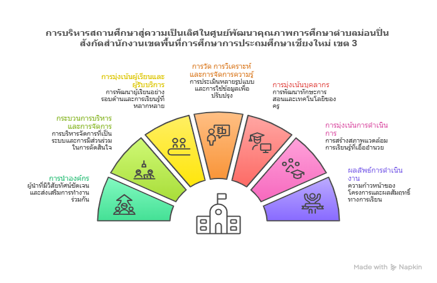
The purposes of this independent study were to: (1) examine educational institution management toward excellence of school administrators in the Mon Pin Subdistrict Educational Quality Development Center under the Chiang Mai Primary Educational Service Area Office 3, and (2) propose guidelines for developing educational institution management toward excellence in this context. The study was conducted based on the Office of the Basic Education Commission Quality Assurance (OBEC QA) framework, which consists of seven components: leadership, management and administrative processes, focus on learners and stakeholders, measurement, analysis and knowledge management, focus on personnel, focus on operations, and operational results. The population of the study comprised 193 participants, including school administrators and teachers working in the Mon Pin Subdistrict Educational Quality Development Center. The research instrument was a questionnaire on educational institution management toward excellence. Data were analyzed using frequency, percentage, mean, and standard deviation.
The findings revealed that the overall level of educational institution management toward excellence was at a high level. When considered by each component, all aspects were also found to be at a high level. Leadership and focus on learners and stakeholders showed the highest mean scores, indicating that school administrators placed strong emphasis on visionary leadership, clear direction, and responsiveness to the needs of learners, parents, and the community.
The guidelines for developing educational institution management toward excellence include strengthening strategic leadership, enhancing transparent and accountable management systems, promoting participation among teachers, personnel, and community stakeholders, utilizing data and evaluation results for continuous improvement, and developing personnel capacity in alignment with the context of mountainous and rural areas. These approaches are expected to contribute to the sustainable improvement of educational quality and effective school management.
Article Details

This work is licensed under a Creative Commons Attribution-NonCommercial-NoDerivatives 4.0 International License.
Copyright Notice
The content and information in the articles published in Journal of MCU Palisueksabuddhaghosa Review, are regarded as opinions and responsibilities of article author only. It definitely does not mean that the editor must agree or share any responsibility to the author.
Articles, information, content, figure etc. that have been published in the Journal of MCU Palisueksabuddhaghosa Review is considered as the copyright of the Journal. If any individual or organization will to bring any parts of article for promote or to do anything, must be licensed only in official form from the Journal of MCU Palisueksabuddhaghosa Review.
The content and information in the articles published in Journal of MCU Palisueksabuddhaghosa Review, are regarded as opinions and responsibilities of article author only. It definitely does not mean that the editor must agree or share any responsibility to the author.
Articles, information, content, figure etc. that have been published in the Journal of MCU Palisueksabuddhaghosa Review is considered as the copyright of the Journal. If any individual or organization will to bring any parts of article for promote or to do anything, must be licensed only in official form from the Journal of MCU Palisueksabuddhaghosa Review.
References
กาญจน์นิภาวรรณ สนิทรักษ์, อโนทัย ประสาน, และพร้อมพิไล บัวสุวรรณ. (2567). รูปแบบการ
บริหารสถานศึกษาสู่ความเป็นเลิศของโรงเรียนเทศบาลสังกัดองค์กรปกครองส่วน
ท้องถิ่นภาคใต้ฝั่งอันดามัน. Journal of Roi Kaensarn Academi. 9(12), 1472–1492.
โกวิท เทพวงศ์. (2561). การบริหารจัดการเพื่อความเป็นเลิศขององค์การยุคใหม่. (พิมพ์ครั้งที่ 2).
กรุงเทพฯ: สำนักพิมพ์จุฬาลงกรณ์มหาวิทยาลัย.
ขวัญเนตร มูลทองจาด. (2564). การวิจัยทางการศึกษา. เชียงใหม่: มหาวิทยาลัยเชียงใหม่.
จงรักษ์ ศรีทิพย์, และดวงใจ ชนะสิทธิ์. (2560). วิเคราะห์องค์ประกอบการบริหารจัดการสู่ความ
เป็นเลิศสำหรับโรงเรียนอนุบาล. วารสารวิจัยและพัฒนา มหาวิทยาลัยราชภัฏสวนสุนันทา.
(2), 13–27.
ธิดารัตน์ วิชญเนตินัย, และอาภาพรรณ ประทุมไทย. (2568). สภาพและแนวทางการบริหาร
สถานศึกษาสู่ความเป็นเลิศทางการศึกษาของสถานศึกษาสหวิทยาเขตภูลังกา สังกัด
สำนักงานเขตพื้นที่การศึกษามัธยมศึกษาพะเยา. วารสารมณีเชษฐาราม วัดจอมมณี.
(9), 577–580.
ปรีชา สาริ, พิมล วิเศษสังข์, และอุดมพันธ์ พิศประสิทธิ์. (2568). การบริหารสถานศึกษาสู่ความเป็น
เลิศของผู้บริหารสถานศึกษาสังกัดสำนักงานเขตพื้นที่การศึกษาประถมศึกษาสุรินทร์
เขต 3. วารสารบัณฑิตวิทยาลัย พิชญทรรศน์. 20(1), 234–237.
พรวิมล กลิ่นศรีสุข. (2564). การวิจัยทางการศึกษา. กรุงเทพฯ: สำนักพิมพ์แห่งจุฬาลงกรณ์ มหาวิทยาลัย.
มหาวิทยาลัยพะเยา. (2565). ฐานข้อมูลวิจัยเชิงพื้นที่ด้านการศึกษา. https://updc.up.ac.th
รุ่งนภา ดอนเงิน. (2567). การศึกษาการบริหารสถานศึกษาสู่ความเป็นเลิศ สังกัดสำนักงานเขต
พื้นที่การศึกษามัธยมศึกษาเชียงราย. วิทยานิพนธ์ปริญญามหาบัณฑิต. มหาวิทยาลัย
พะเยา.
รุ่งรัชดาพร เวหะชาติ. (2550). การบริหารสถานศึกษาสู่ความเป็นเลิศ. กรุงเทพฯ: สำนักพิมพ์แห่ง
จุฬาลงกรณ์มหาวิทยาลัย.
สอาด วงศาเจริญภักดี, และคณะ. (2565). การพัฒนากลยุทธ์การบริหารสถานศึกษาสู่ความเป็น
เลิศของโรงเรียนในเครือมูลนิธิคณะเซนต์คาเบรียลแห่งประเทศไทย. สิกขา วารสารศึกษา
ศาสตร์. 9(1), 133–145.
สันติ บุญภิรมย์. (2552). ภาวะผู้นำและการบริหารการศึกษา. กรุงเทพฯ: ไทยวัฒนาพานิช.
สำนักงานเขตพื้นที่การศึกษาประถมศึกษาเชียงใหม่ เขต 3. (2568). ข้อมูลบุคลากรและสถานศึกษา
ปีการศึกษา 2567. สืบค้นจาก https://www.cmpeo3.go.th
สำนักงานคณะกรรมการการศึกษาขั้นพื้นฐาน. (2563). แนวทางการดำเนินงานประกันคุณภาพ
การศึกษาตาม เกณฑ์ OBEC QA. กรุงเทพฯ: กระทรวงศึกษาธิการ.
อภิธีร์ ทรงบัณฑิตย์. (2560). การประยุกต์ใช้เกณฑ์ Malcolm Baldrige National Quality Award
(MBNQA) ในประเทศไทย. วารสารบริหารการศึกษา มหาวิทยาลัยศรีนครินทรวิโรฒ,
องค์การบริหารส่วนตำบลม่อนปิ่น. (2564). รายงานกิจกรรมร่วมกับสถานศึกษา.
Evans, J. R., & Lindsay, W. M. (2017). Managing for quality and performance excellence.
(10th ed.). Cengage Learning.
