
MOOC and the Sustainable Enhancement of Thai Language Teaching and Learning on Online Platforms
Article Sidebar
Main Article Content
Abstract
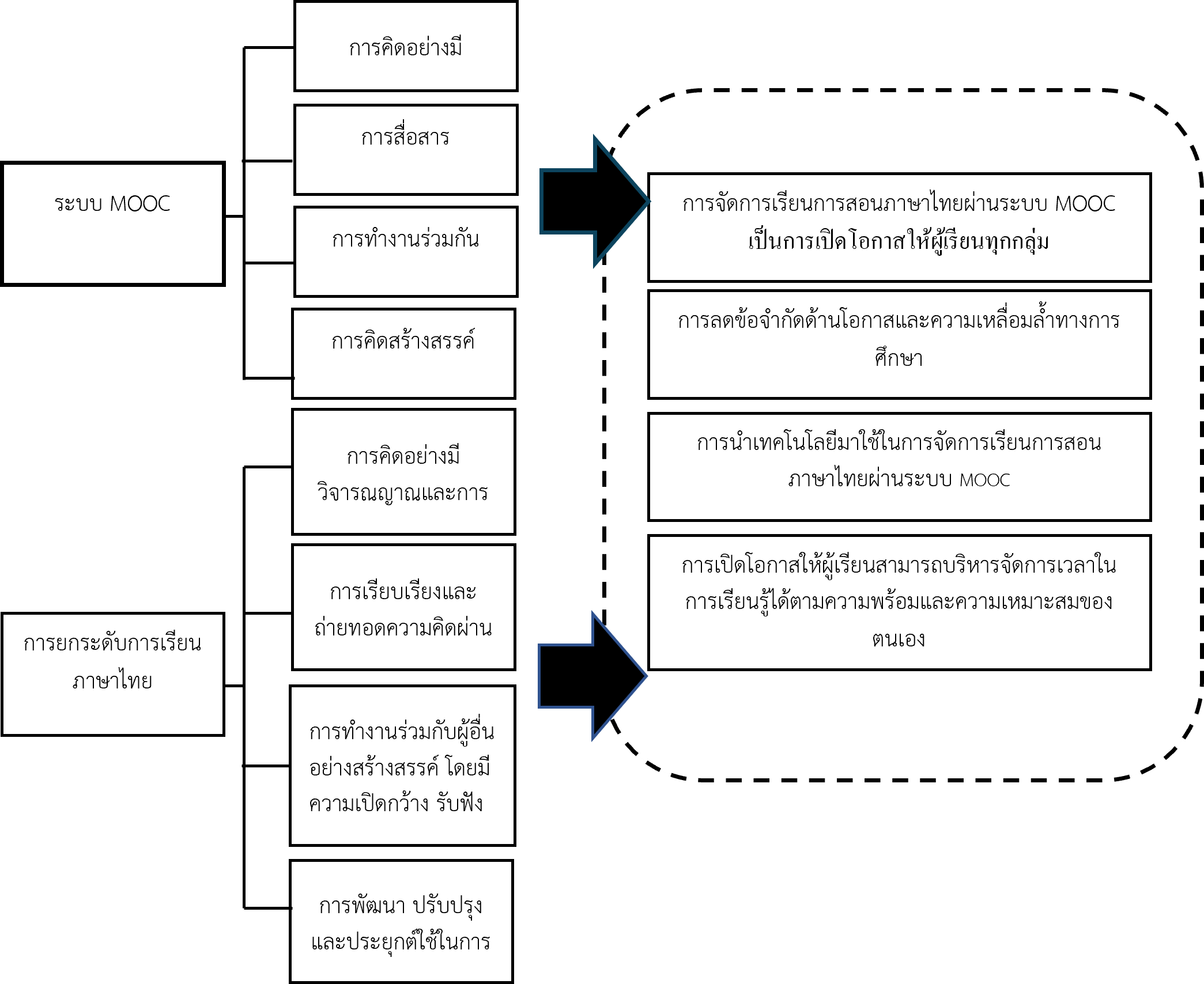
This academic article, entitled “MOOC and the Sustainable Enhancement of Thai Language Teaching and Learning on Online Platforms,” examines the characteristics of Massive Open Online Courses (MOOCs), with an emphasis on the use of online media and open educational resources to broaden learners’ access to knowledge. MOOCs play a significant role for learners, instructors, and educational institutions across multiple dimensions. For learners, MOOCs provide flexible and open access to knowledge, thereby contributing to the sustainable development of Thai language teaching and learning in online systems, The article further explains the instructional process through the Four Cs framework, comprising critical thinking and problem-solving, communication and the effective articulation of ideas through speaking, and collaborative and creative teamwork characterized by openness and respect for diverse perspectives. These competencies serve as guiding principles for organizing Thai language instruction through MOOC platforms, Implementing Thai language teaching via MOOCs creates opportunities for diverse groups of learners, helping to reduce limitations in access and educational inequality. The integration of technology into Thai language instruction through MOOCs also enables learners to manage their learning time according to their readiness and individual circumstances, thereby enhancing learning effectiveness.
Article Details

This work is licensed under a Creative Commons Attribution-NonCommercial-NoDerivatives 4.0 International License.
Copyright Notice
The content and information in the articles published in Journal of MCU Palisueksabuddhaghosa Review, are regarded as opinions and responsibilities of article author only. It definitely does not mean that the editor must agree or share any responsibility to the author.
Articles, information, content, figure etc. that have been published in the Journal of MCU Palisueksabuddhaghosa Review is considered as the copyright of the Journal. If any individual or organization will to bring any parts of article for promote or to do anything, must be licensed only in official form from the Journal of MCU Palisueksabuddhaghosa Review.
The content and information in the articles published in Journal of MCU Palisueksabuddhaghosa Review, are regarded as opinions and responsibilities of article author only. It definitely does not mean that the editor must agree or share any responsibility to the author.
Articles, information, content, figure etc. that have been published in the Journal of MCU Palisueksabuddhaghosa Review is considered as the copyright of the Journal. If any individual or organization will to bring any parts of article for promote or to do anything, must be licensed only in official form from the Journal of MCU Palisueksabuddhaghosa Review.
References
กรุงเทพธุรกิจ (2569). จุฬาฯเสริม Soft Power ด้วยภาษาไทยสำหรับชาวต่างชาติ. สืบค้นข้อมูลจาก https://www.bangkokbiznews.com/health/education/1121117
เฉลิมลาภ ทองอาจ. (2555). การจัดการเรียนรู้ภาษาไทยโดยใช้สมรรถนะในศตวรรษที่ 21 เป็นฐาน : ทฤษฎีสู่การปฏิบัติ. วารสารครุศาสตร์. 46 (1). 179-180.
ชโรชีนีย์ ชัยมินทร์. (2562). MOOC: เพื่อการเรียนรู้ตลอดชีวิตในศตวรรษที่ 21. วารสารมนุษยศาสตร์และสังคมศาสตร์มหาวิทยาลัยราชภัฏเชียงใหม่. 1(1). 46-69.
ณภัทร จาตุศรีพิทักษ์. (2557). วิเคราะห์แนวโน้มการศึกษาออนไลน์. เรียกใช้เมื่อ 30 มกราคม 2567 จากhttps://thaipublica.org/2014/10/settakid2-online-education/
แทนคุณ วงค์ษร (2569). รู้จัก “MOOC” มหาวิทยาลัยออนไลน์ เรียนได้ทั่วโลก. สืบค้นข้อมูลจาก.https://plan.vru.ac.th/?p=3508
นามน จีรังสุวรรณ. (2556). หลักการออกแบบและการประเมินผล. พิมพ์ครั้งที่ 3. กรุงเทพมหานคร: มหาวิทยาลัยเทคโนโลยีพระจอมเกล้าพระนครเหนือ.
ภาสกร ใหลสกุล. (2558). MOOC มุกใหม่ของ อีเลิร์นนิง. สืบค้นข้อมูลจาก https://exampleword presscom20163.wordpress.com/2016/03/20/mooc-มุกใหม่ของ-อีเลิร์นนิง
ภูชิศ สถิตย์พงษ์ (2564). MOOC: นวัตกรรมการจัดการเรียนการสอนในยุคไทยแลนด์ 4.0. วารสารวิชาการ มหาวิทยาลัยการกีฬาแห่งชาติ. 13(1).
รุ่งฤดี แผลงศร (2561). ศาสตร์การสอนภาษาไทยในฐานะภาษาต่างประเทศ. กรุงเทพมหานคร: สำนักพิมพ์แห่งจุฬาลงกรณ์มหาวิทยาลัย, 2561.
สำนักงานคณะกรรมการนโยบายเขตพัฒนาพิเศษภาคตะวันออก (2562). แผนภาพรวมเพื่อการพัฒนาเขตพัฒนาพิเศษภาคตะวันออก (พ.ศ. 2560–2565). สืบค้นข้อมูลจาก https://www. eeco.or.th/th/ filedownload/1478/2afd2456bb1f03995574db27a75.pdf
สุมาลี ชัยเจริญ. (2554). เทคโนโลยีการศึกษา: หลักการ ทฤษฎีสู่การปฏิบัติ. พิมพ์ครั้งที่ 2. ขอนแก่น: คลังนานาวิทยา.
