
Happiness in Teamwork through Buddhist Psychology: Integrating Iddhipada 4 with Emotional Intelligence
Article Sidebar
Main Article Content
Abstract
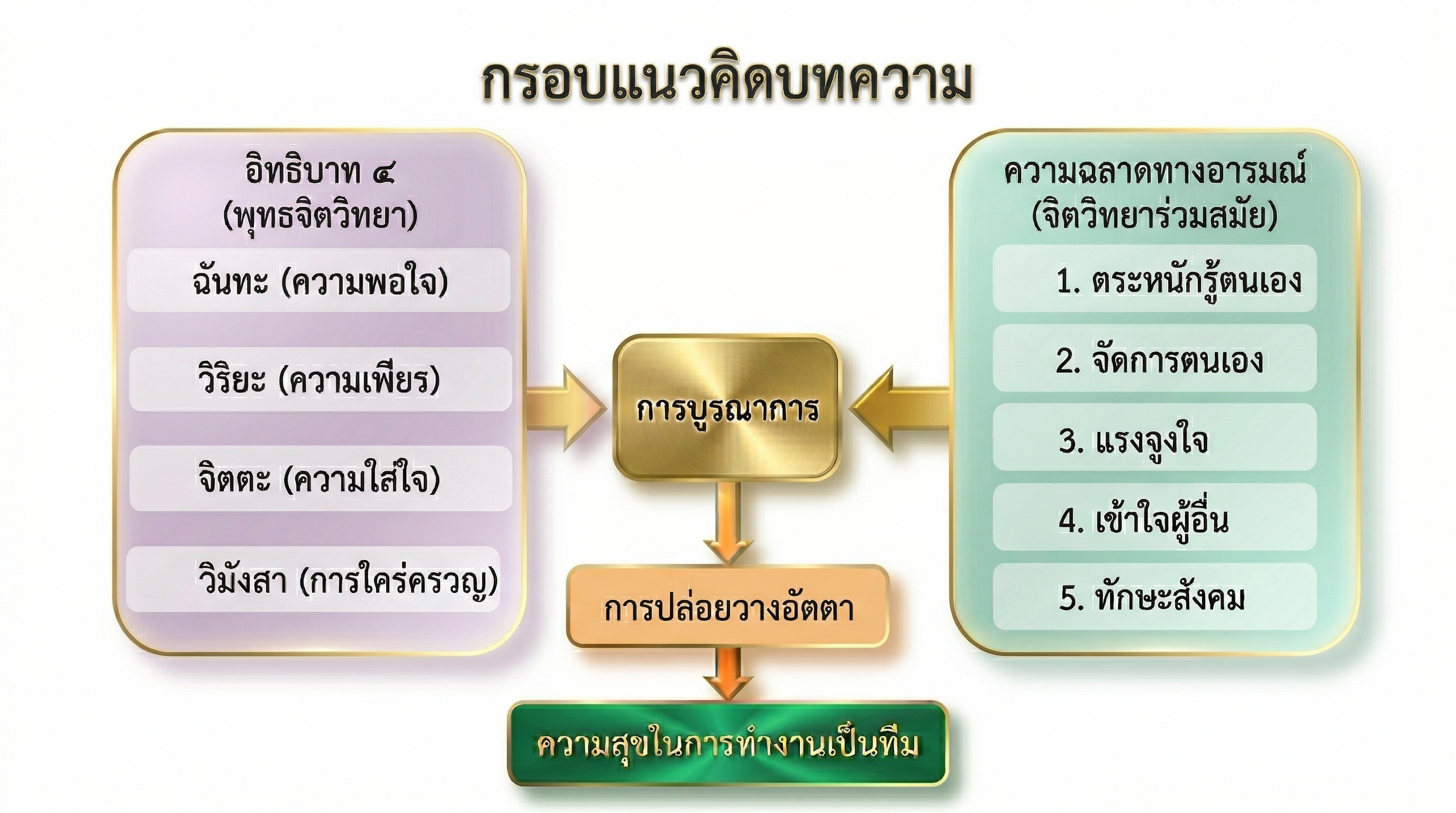
This academic article has three objectives: (1) to study the concept of ego detachment (letting go of self) based on Buddhist psychology, (2) to examine Iddhipada 4 and Emotional Intelligence (EI) in relation to teamwork, and (3) to propose guidelines for building happiness in teamwork within Thai organizations. The study employed conceptual analysis and synthesis drawing from Buddhist scriptures, Buddhist psychology literature, and contemporary organizational psychology research—particularly Goleman’s Emotional Intelligence framework—together with relevant empirical studies in both Thai and English.
The key concept underpinning this article is that most suffering in teamwork arises not from work tasks themselves but from ego attachment. Integrating Iddhipada 4—the Buddhist path to success—with Emotional Intelligence as a contemporary psychological skillset creates conditions for teams to gradually release ego and discover happiness in collaborative work. Findings reveal that when Chanda (aspiration) is integrated with intrinsic motivation and empathy, teams pursue shared missions without competing for personal credit. When Viriya (perseverance) merges with self-regulation, teams sustain balanced collective effort. When Citta (mindful focus) is enhanced by self-awareness, teams work with mindfulness and recognize when ego interferes. When Vimamsa (reflective inquiry) is supported by social skills, teams learn openly without defensive self-protection.
In conclusion, integrating Iddhipada 4 with Emotional Intelligence provides a concrete framework for explaining and promoting happiness in teamwork through Buddhist psychology encompassing mental development, emotional skill cultivation, and the creation of a supportive work environment in Thai organizations.
Article Details

This work is licensed under a Creative Commons Attribution-NonCommercial-NoDerivatives 4.0 International License.
Copyright Notice
The content and information in the articles published in Journal of MCU Palisueksabuddhaghosa Review, are regarded as opinions and responsibilities of article author only. It definitely does not mean that the editor must agree or share any responsibility to the author.
Articles, information, content, figure etc. that have been published in the Journal of MCU Palisueksabuddhaghosa Review is considered as the copyright of the Journal. If any individual or organization will to bring any parts of article for promote or to do anything, must be licensed only in official form from the Journal of MCU Palisueksabuddhaghosa Review.
The content and information in the articles published in Journal of MCU Palisueksabuddhaghosa Review, are regarded as opinions and responsibilities of article author only. It definitely does not mean that the editor must agree or share any responsibility to the author.
Articles, information, content, figure etc. that have been published in the Journal of MCU Palisueksabuddhaghosa Review is considered as the copyright of the Journal. If any individual or organization will to bring any parts of article for promote or to do anything, must be licensed only in official form from the Journal of MCU Palisueksabuddhaghosa Review.
References
กรกนก วงศ์กัลยา. “ความฉลาดทางอารมณ์ของผู้บริหารสถานศึกษากับการทำงานเป็นทีมของครูในสถานศึกษา สังกัดสำนักงานเขตพื้นที่การศึกษาประถมศึกษาสมุทรสงคราม.” วิทยานิพนธ์ศึกษาศาสตรมหาบัณฑิต, มหาวิทยาลัยศิลปากร, 2566.
กรุงเทพธุรกิจ. “วัยทำงานป่วยจิต ระดับความเครียดพุ่ง.” 13 พฤศจิกายน 2567. สืบค้นจาก https://www.bangkokbiznews.com/health/well-being/1148273
กรมสุขภาพจิต. “คนวัยทำงานในกทม. 45% ถูกความเครียดขโมยความสุข.” 2561. สืบค้นจาก https://dmh.go.th/news-dmh/view.asp?id=28253
“หลักอิทธิบาท 4 เพื่อพัฒนาประสิทธิภาพการปฏิบัติงาน.” วารสารสหวิทยาการนวัตกรรมปริทรรศน์ 6, 5 (2566): 242–253.
มงคลธง สมงคล และพงษ์เทพ ล้อประเสริฐ. “อิทธิบาท 4: การบริหารงานอาชีวศึกษาสู่สากล.” วารสาร มจร บาฬีศึกษาพุทธโฆสปริทรรศน์ 10, 1 (2567): 235–248.
พิมพ์ลภัส จิตต์ธรรม. “อิทธิบาท 4 ในการพัฒนาทรัพยากรมนุษย์สู่ความสำเร็จขององค์การ.” วารสารบัณฑิตศึกษาวิชาการ 3, 2 (2568).
พระพรหมคุณาภรณ์ (ป. อ. ปยุตฺโต). พุทธธรรม ฉบับปรับขยาย. พิมพ์ครั้งที่ 45, กรุงเทพฯ: สหธรรมิก, 2559.
สำนักงานสภาพัฒนาการเศรษฐกิจและสังคมแห่งชาติ. รายงานภาวะสังคมไทยไตรมาสหนึ่ง ปี 2567. 2567. อ้างใน ประชาชาติธุรกิจ, 28 พฤษภาคม 2567.
อุบลรัตน์ ม. “หลักอิทธิบาท 4: เพิ่มประสิทธิภาพการปฏิบัติงานให้มีความสุข.” วารสารสหวิทยาการนวัตกรรมปริทรรศน์ 5, 2 (2565): A150–A161.
Côté, S., and C. T. H. Miners. “Emotional Intelligence, Cognitive Intelligence, and Job Performance.” Administrative Science Quarterly 51, 1 (2006): 1–28.
Dambrun, M., and M. Ricard. “Self-Centeredness and Selflessness.” Review of General Psychology 15, 2 (2011): 138–157.
Edmondson, A. C. “Psychological Safety and Learning Behavior in Work Teams.” Administrative Science Quarterly 44, 2 (1999): 350–383.
Goleman, Daniel. Emotional Intelligence: Why It Can Matter More Than IQ. New York: Bantam Books, 1995.
Goleman, Daniel. Working with Emotional Intelligence. New York: Bantam Books, 1998.
Kabat-Zinn, Jon. Full Catastrophe Living. New York: Dell Publishing, 1990.
Miao, C., R. H. Humphrey, and S. Qian. “A Meta-Analysis of Emotional Intelligence and Work Attitudes.” Journal of Occupational and Organizational Psychology 90, 2 (2017): 177–202.
Mindeguia, R., et al. “Team Emotional Intelligence: Emotional Processes as a Link Between Managers and Workers.” Frontiers in Psychology 12 (2021): 619999.
Sahdra, B. K., P. R. Shaver, and K. W. Brown. “A Scale to Measure Nonattachment.” Journal of Personality Assessment 92, 2 (2010): 116–127.
Senge, P. M. The Fifth Discipline. Rev. ed. New York: Doubleday, 2006
