
Guidelines for Promoting Buddhist-Based Operational for Personnel at the Graduate School, Mahachulalongkornrajavidyalaya University
Article Sidebar
Main Article Content
Abstract
This research aimed to: (1) examine the problems related to the performance of personnel at the Graduate School of Mahachulalongkornrajavidyalaya University; (2) study Buddhist principles applicable to the performance of personnel at the Graduate School of Mahachulalongkornrajavidyalaya University; and (3) propose guidelines for promoting Buddhist oriented work practices amongpersonnel at the Graduate School of Mahachulalongkornrajavidyalaya University. This study employed a qualitative research approach. The researcher collected data through documentary research and in-depth interviews with 15 key informants selected through purposive sampling. These informants included administrators, faculty members, staff, Buddhist scholars, and service recipients. The research instrument used was an in-depth interview form, and the data were analyzed and presented descriptively.
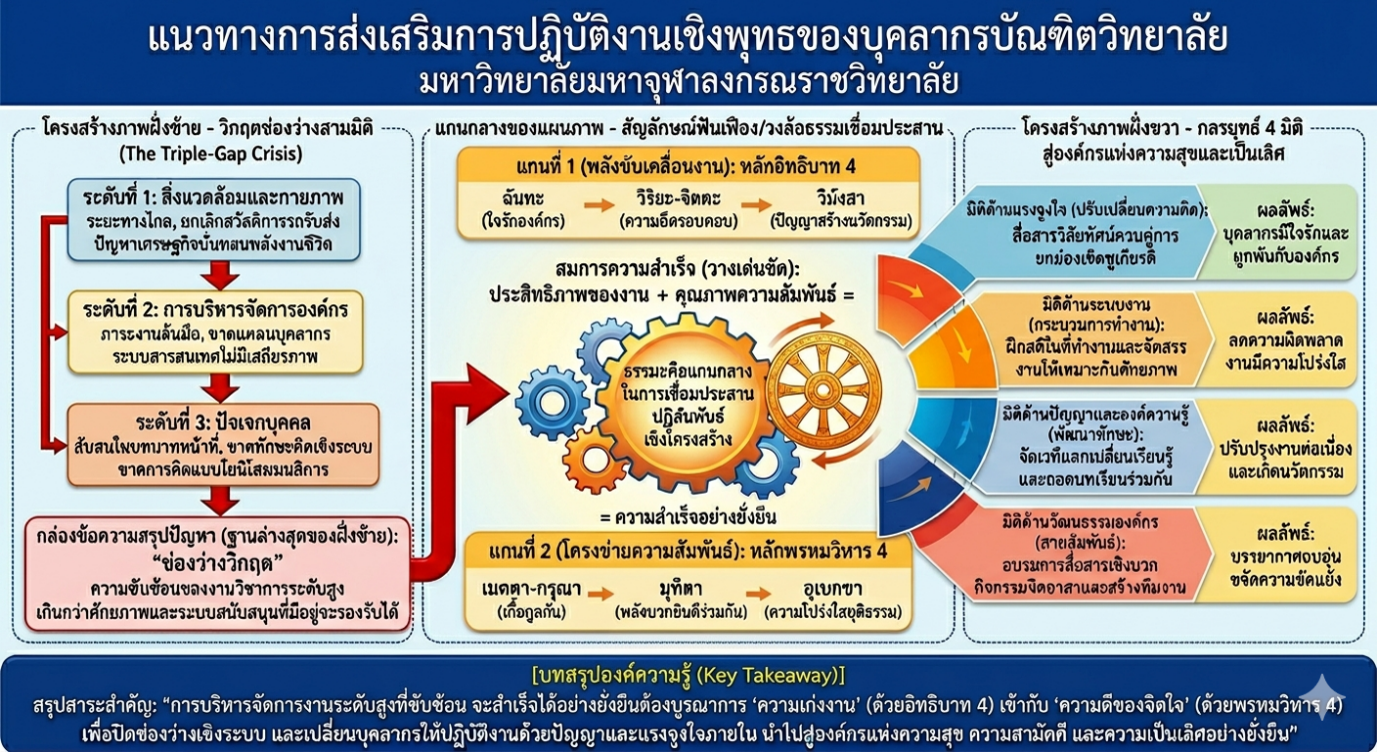
The findings revealed that the problems in personnel performance at the Graduate School were structural and holistic in nature, arising from multiple interconnected factors. Internal factors included a limited number of personnel, excessive workloads, urgent coordination demands, and a lack of specialized experts. External factors involved unclear policies, inadequate technological support, and insufficient budget allocation. Organizational and individual-level factors were also identified, such as a lack of systems thinking skills, role ambiguity, and insufficient work commitment. These issues collectively affected work efficiency and quality.
The Buddhist principles applied in this study were the Four Bases of Success (Iddhipāda 4) and the Four Sublime States of Mind (Brahmavihāra 4), both of which play a significant role in enhancing work efficiency and the quality of relationships within the organization. The Iddhipāda 4—chanda (aspiration), viriya (effort), citta (attention), and vimamsa (investigation)—help foster intrinsic motivation, perseverance, attentiveness, and systematic thinking. The Brahmavihāra 4—mettā (loving-kindness), karuṇā (compassion), muditā (sympathetic joy), and upekkhā (equanimity)—contribute to a supportive, cooperative, and fair working environment, promoting unity and a strong organizational culture.
The proposed guidelines for promoting Buddhist-oriented work practices involve applying the Iddhipāda 4 and Brahmavihāra 4 as frameworks for developing organizational relationships, alongside enhancing nine key work-related skills: (1) creativity, (2) analytical thinking, (3) teamwork, (4) communication, (5) information literacy, (6) adaptability, (7) leadership, (8) social skills, and (9) results-oriented performance. These guidelines should be implemented through concrete developmental activities, enabling personnel to effectively integrate Buddhist principles into their actual work practices.
Article Details

This work is licensed under a Creative Commons Attribution-NonCommercial-NoDerivatives 4.0 International License.
Copyright Notice
The content and information in the articles published in Journal of MCU Palisueksabuddhaghosa Review, are regarded as opinions and responsibilities of article author only. It definitely does not mean that the editor must agree or share any responsibility to the author.
Articles, information, content, figure etc. that have been published in the Journal of MCU Palisueksabuddhaghosa Review is considered as the copyright of the Journal. If any individual or organization will to bring any parts of article for promote or to do anything, must be licensed only in official form from the Journal of MCU Palisueksabuddhaghosa Review.
The content and information in the articles published in Journal of MCU Palisueksabuddhaghosa Review, are regarded as opinions and responsibilities of article author only. It definitely does not mean that the editor must agree or share any responsibility to the author.
Articles, information, content, figure etc. that have been published in the Journal of MCU Palisueksabuddhaghosa Review is considered as the copyright of the Journal. If any individual or organization will to bring any parts of article for promote or to do anything, must be licensed only in official form from the Journal of MCU Palisueksabuddhaghosa Review.
References
แผนพัฒนาบัณฑิตวิทยาลัย มหาวิทยาลัยมหาจุฬาลงกรณราชวิทยาลัย, ฉบับที่ 13 พ.ศ. 2565 – 2569.
ชนะเอก เชี้ยวบางยาง และคณะ, ปัจจัยการทํางานที่ส่งผลต่อประสิทธิภาพการปฏิบัติงานของผู้บริหาร ในกรุงเทพมหานครและปริมณฑล, วารสารนวัตกรรมการจัดการศึกษาและการวิจัย, ปีที่ 5 ฉบับที่ 4 กรกฎาคม -สิงหาคม 2566 หน้า 840.
ประวัติบัณฑิตวิทยาลัย มหาวิทยาลัยมหหาจุฬาลงกรณราชวิทยาลัย, สืบค้น 1 สิงหาคม 2568 จาก https://www.mcu.ac.th/pages/graduateschool-page.
พระครูปลัดวิฐชญฐานนท์ อคฺคปญฺโญ (รักษาชาติ), “การพัฒนาศักยภาพการปฏิบัติงานของบุคลากรสำนักงานเทศบาลเมืองดอนสัก อำเภอดอนสัก จังหวัดสุราษฎร์ธานี ตามแนวพระพุทธศาสนา”, วารสาร มจร อุบลปริทรรศน์, ปีที่ 6 ฉบับที่ 2 (พฤษภาคม-สิงหาคม 2564) หน้า 461-462.
พระมหาสุรชัย ชยาภิวฑฺฒโน, “การบริหารงานบุคคลตามแนวพุทธปรัชญา: กรณีศึกษาพระอัครสาวก”, วารสารวิชาการวิทยาลัยบริหารศาสตร์, ปีที่ ๒ ฉบับที่ ๑ (มกราคม-มีนาคม ๒๕๖๒) หน้า ๗๐-๗๑.
วิชญาภา เมธีวรฉัตร, “พุทธวิธีการพัฒนาศักยภาพของบุคลากรองค์การบริหารส่วนตำบลหนองปลิง จังหวัดนครสวรรค์”, บัณฑิตศึกษาปริทรรศน์ วิทยาลัยสงฆ์นครสวรรค์, ปีที่ ๘ ฉบับที่ ๑ (มกราคม-เมษายน ๒๕๖๓) หน้า ๔๔๖-๔๔๗.
สำนักงานคณะกรรมการการอุดมศึกษา, แนวทางการบริหารงานบุคลากรในสถาบันอุดมศึกษา, (กรุงเทพมหานคร: สกอ., 2563), หน้า 78.
