
Behavioral Patterns of AI Behavioral Patterns of Artificial Intelligence Integration in Instructional Management Among Student Teachers
Article Sidebar
Main Article Content
Abstract
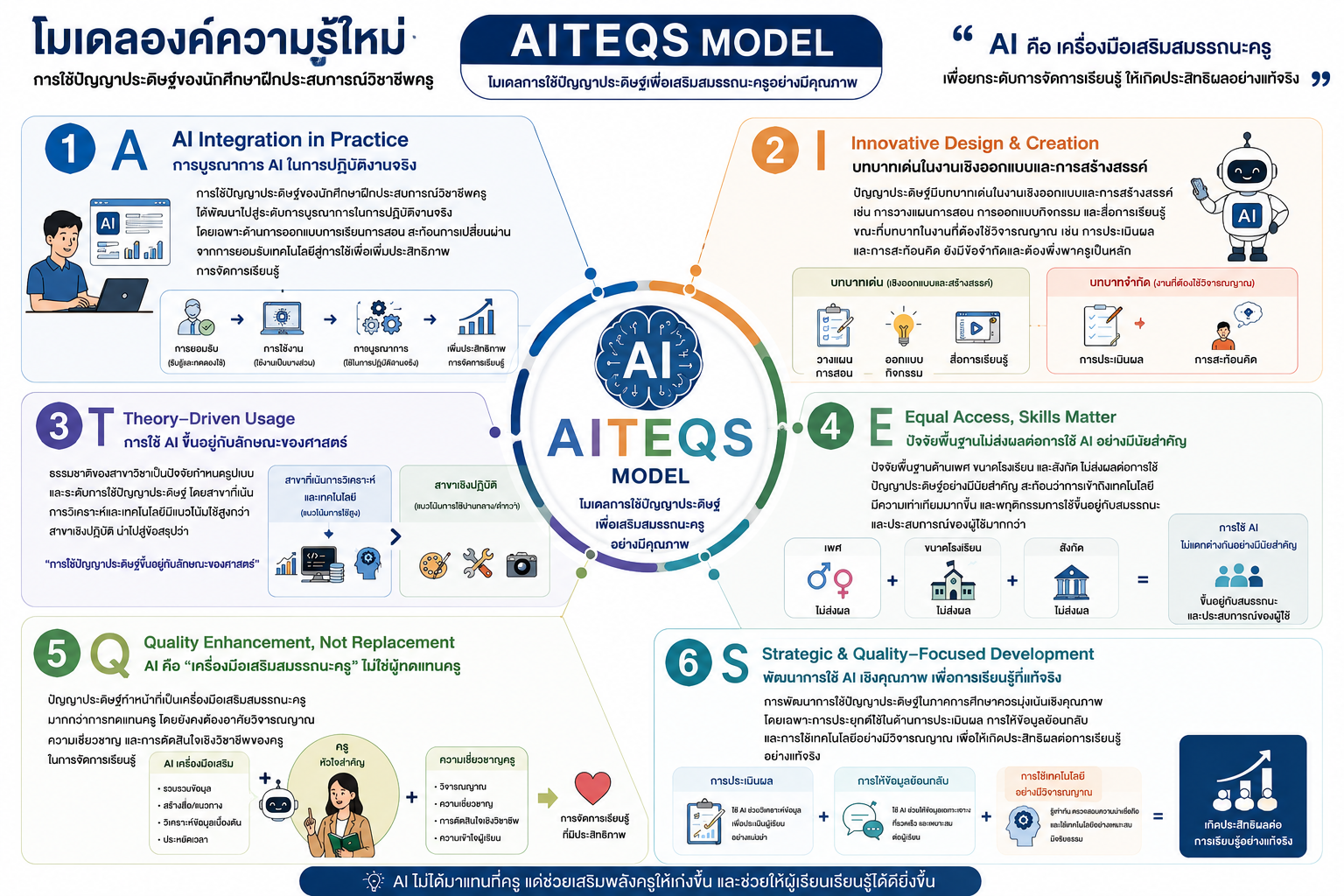
The objectives of this research were: 1) to examine the levels of Artificial Intelligence (AI) integration in teaching and learning among student teachers during their professional internships; and 2) to compare these behavioral patterns based on gender, major, school size, and institutional affiliation. This study employed a quantitative survey research design. The population comprised 755 student teachers practicing in educational institutions during the 2025 academic year. A sample size of 270 participants was determined and selected through proportional stratified random sampling, categorized by major, gender, school size, and affiliation. The final participants were recruited via simple random sampling using a random number table. The research instrument was a 5-point Likert scale questionnaire assessing AI application behaviors. Data were analyzed using descriptive statistics, including frequency (n), percentage (%), mean (𝑥̄), and standard deviation (S.D.), while inferential statistics involved t-tests and One-Way ANOVA.
The findings revealed that: 1) the level of AI application in instructional management among pre-service teachers was at a moderate level (𝑥̄ = 3.48, S.D. = 0.83). 2) Student Teachers with different academic majors exhibited statistically significant differences in their AI utilization behaviors at the .05 level. However, no significant differences were found when categorized by gender, school size, or school affiliation.
Article Details

This work is licensed under a Creative Commons Attribution-NonCommercial-NoDerivatives 4.0 International License.
Copyright Notice
The content and information in the articles published in Journal of MCU Palisueksabuddhaghosa Review, are regarded as opinions and responsibilities of article author only. It definitely does not mean that the editor must agree or share any responsibility to the author.
Articles, information, content, figure etc. that have been published in the Journal of MCU Palisueksabuddhaghosa Review is considered as the copyright of the Journal. If any individual or organization will to bring any parts of article for promote or to do anything, must be licensed only in official form from the Journal of MCU Palisueksabuddhaghosa Review.
The content and information in the articles published in Journal of MCU Palisueksabuddhaghosa Review, are regarded as opinions and responsibilities of article author only. It definitely does not mean that the editor must agree or share any responsibility to the author.
Articles, information, content, figure etc. that have been published in the Journal of MCU Palisueksabuddhaghosa Review is considered as the copyright of the Journal. If any individual or organization will to bring any parts of article for promote or to do anything, must be licensed only in official form from the Journal of MCU Palisueksabuddhaghosa Review.
References
ทิพาจินต์ ไทยพิสุทธิกุล. (2568). บทบาทของ AI กับการศึกษาไทยในปัจจุบัน. สืบค้นเมื่อ 15 กันยายน
, จาก Mahidol University Learning AI
สาขาวิชาพระพุทธศาสนา.(2568).รายงานผลการนิเทศนักศึกษาสาขาวิชาพระพุทธศาสนา
ปีการศึกษา 2567. อุดรธานี : สาขาวิชาพระพุทธศาสนา คณะครุศาสตร์ มหาวิทยาลัยราชภัฏอุดรธานี.
สำนักงานพัฒนาวิทยาศาสตร์และเทคโนโลยีแห่งชาติ. (2565). แผนปฏิบัติการด้านปัญญาประดิษฐ์
แห่งชาติ เพื่อการพัฒนาประเทศไทย (พ.ศ. 2565–2570). เอไอไทยแลนด์.
http://www.ai.in.th/about-ai-thailand/
อัมพร วรานนท์วนิช, นัฎฤดี ปั้นกิจวานิชเจริญ, วิภาวี วันละ และกิตติธเนศ วิวรรธน์โชติ.(2566).
การศึกษาปัญหาการฝึกประสบการณ์วิชาชีพครูกรณีศึกษาปัญหา การฝึกประสบการณ์วิชาชีพครูของนักศึกษาวิชาชีพครู สาขาวิชาภาษาจีน คณะมนุษยศาสตร์และสังคมศาสตร์ มหาวิทยาลัยราชภัฏนครปฐม.วารสารสังคมศาสตร์วิจัย ปีที่ 14 ฉบับที่ 2 (กรกฎาคม-ธันวาคม 2566).หน้า 93-104
Bandura, A.(1986).Social foundations of thought and action: A social cognitive theory. Prentice-Hall.
Davis, F. D. (1989). Perceived usefulness, perceived ease of use, and user acceptance of information
technology. MIS Quarterly, 13(3), 319–340.
Dick, W., & Carey, L. (2015). The Systematic Design of Instruction. Pearson.
Ditrod, N., Nuchkong, V., & Masantiah, C. (2024). Awareness of the use of artificial intelligence in
learning for undergraduate students, Faculty of Education, Ramkhamhaeng University. Interdisciplinary Academic and Research Journal, 4(6), 43–58.
European Commission. (2022). DigComp 2.2: The digital competence framework for citizens.
Publications Office of the European Union.
Holmes, W., Bialik, M., & Fadel, C. (2022). Artificial intelligence in education: Promises and
implications for teaching and learning. Center for Curriculum Redesign.
Luckin, R., et al. (2016). Intelligence unleashed: An argument for AI in education. Pearson.
Maslej, N., Fattorini, L., Perrault, R., Gil, Y., Parli, V., Kariuki, N., Capstick, E., Reuel, A.,
Brynjolfsson, E., Etchemendy, J., Ligett, K., Lyons, T., Manyika, J., Niebles, J. C., Shoham,
Y., Wald, R., Walsh, T., Hamrah, A., Santarlasci, L., Lotufo, J. B., Rome, A., Shi, A., &
Oak, S. (2025, April). The AI Index 2025 Annual Report. AI Index Steering
Commmittee, Institute for Human-Centered AI, Stanford University, Stanford, CA.
Mishra, P., & Koehler, M. J. (2006). Technological pedagogical content knowledge. Teachers College
Record, 108(6), 1017–1054.
Meeplat, N., Suebsom, K., Nillawong, N., & Armiroh, A. (2024). The development of learning processes
using artificial intelligence systems to promote higher-order thinking skills. Journal of MCU
Nakhondhat
Panitpichetvong, P., Phattanurakkul, C., Thatreenaranont, N., & Limyotin, A. (2024). Using generative
artificial intelligence for teaching and learning in higher education. Academic Journal
Bangkokthonburi University.
Partnership for 21st Century Skills. (2019). Framework for 21st century learning. P21.
Russell, S., & Norvig, P. (2021). Artificial intelligence: A modern approach(4th ed.).
Pearson Education.
van Dijk, J. (2020). The Digital Divide. Polity Press.
Vygotsky, L. S. (1978). Mind in society: The development of higher psychological processes.
Harvard University Press.
Zawacki-Richter, O., et al. (2019). Systematic review of AI in higher education. International Journal
of Educational Technology in Higher Education, 16(39).
