GYOTAKU: THE AESTHETIC FORMS OF FRESHWATER FISH FROM SUPHAN BURI
Keywords:
Gyotaku fish printmaking, Suphan Buri freshwater fish patterns, rubbing print, fish printmakingAbstract
This creative research aimed to: 1) investigate and compile information on fish species and the cultural context of communities along the Tha Chin River in Suphan Buri Province; 2) create fish prints of various sizes based on local fish species from Suphan Buri using the Gyotaku, or fish-rubbing printmaking technique; and 3) assess undergraduate students’ satisfaction with the creative project Gyotaku: The Aesthetic Forms of Freshwater Fish from Suphan Buri. The participants consisted of 20 second-year undergraduate students majoring in Art Education at Suphan Buri College of Fine Arts. The artworks were analyzed using principles of art and aesthetics, while arithmetic means were employed to examine satisfaction levels.
The findings revealed that: 1) the Suphan Buri River has played a vital role in sustaining livelihoods and cultural development from the Dvaravati to the Rattanakosin periods. It has long been home to diverse ethnic groups, including Thai, Chinese, Lao, Lao Phuan, Lao Wiang, Lao Song, Vietnamese, and Mon communities, with Chinese residents historically serving as market owners. A survey of fish species available at Suphan Buri Market and Pho Phraya Market during the August 2024 season identified 12 species;
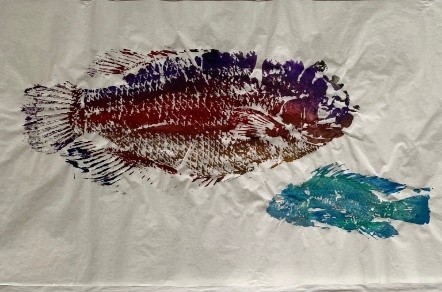
2) the creative process resulted in more than 50 fish prints of various dimensions that corresponded to the actual sizes of the fish, executed using Chinese ink and color following artistic principles. Gyotaku, as a foundational printmaking method, involves uncomplicated procedures suitable for embossed print molding, such as freshwater fish from Suphan Buri, allowing the artist to capture the rhythm and movement inherent in each fish’s form. A single fish can be used to produce multiple prints depending on the creator’s intention, and 3) student satisfaction with the Gyotaku artworks was rated at the highest level, with an overall mean score of 4.65.
References
นฤชิต เสาวคนธ์. (2548). ความหลากหลายชนิดของปลาในอ่างเก็บน้ำเขื่อนกระเสียว จังหวัดสุพรรณบุรี. [ปริญญานิพนธ์วิทยาศาสตร์มหาบัณฑิต]. มหาวิทยาลัยเกษตรศาสตร์.
บุญชม ศรีสะอาด. (2560). การวิจัยเบื้องต้น. พิมพ์ครั้งที่ 10. สุวีริยาสาส์น.
ประภาพร วิถีสวัสดิ์. (2542). โครงสร้างประชากรของปลาในบริเวณป่าชายเลนแม่น้ำท่าจีน จังหวัดสมุทรสาคร. [ปริญญาวิทยาศาสตร์มหาบัณฑิตไม่ได้ตีพิมพ์]. จุฬาลงกรณ์มหาวิทยาลัย.
ปัติมา โฆษิตเกษม. (2564). ภาพพิมพ์ซิลค์สกรีน: นวัตกรรมพัฒนาทักษะงานศิลปะเชิงพาณิชย์สู่สังคมไทยยุคดิจิทัล. สถาบันบัณฑิตพัฒนศิลป์.
_______. (2567). เกียวทาคุ: ลีลาปลาแม่น้ำสุพรรณบุรี. สถาบันบัณฑิตพัฒนศิลป์.
วิบูลย์ ลี้สุวรรณ. (2531). สาระน่ารู้ในศิลปะ. โอเดียนสโตร์.
สุภาภรณ์ จินดามณีโรจน์. (2554). ประวัติศาสตร์สังคมของชุมชนลุ่มน้ำท่าจีน. มหาวิทยาลัยศิลปากร.
สุรางค์ โค้วตระกูล (2564). จิตวิทยาการศึกษา. (พิมพ์ครั้งที่ 13). จุฬาลงกรณ์มหาวิทยาลัย.
KIND. (2020). Gyotaku. https://kindconnext.com/kindcult/gyotaku.
Peter B. Moyle & Marilyn A. Moyle. (1991). Department of Wildlife and Fisheries Biology, University of California, Printed in the Netherlands.
Yusuke Miyazaki And Atsunobu Murase. (2020). Fish rubbings, ‘gyotaku’, as a source of historical biodiversity data. ZooKeys. 904: 89–101.
Downloads
Published
Issue
Section
License
Copyright (c) 2025 ฝ่ายผลิตสื่อสิ่งพิมพ์และตำราวิชาการ กองส่งเสริมวิชาการและงานวิจัย สถาบันบัณฑิตพัฒนศิลป์ กระทรวงวัฒนธรรม

This work is licensed under a Creative Commons Attribution-NonCommercial-NoDerivatives 4.0 International License.
บทความที่ได้รับการตีพิมพ์เป็นลิขสิทธิ์ของ สบศ.



