
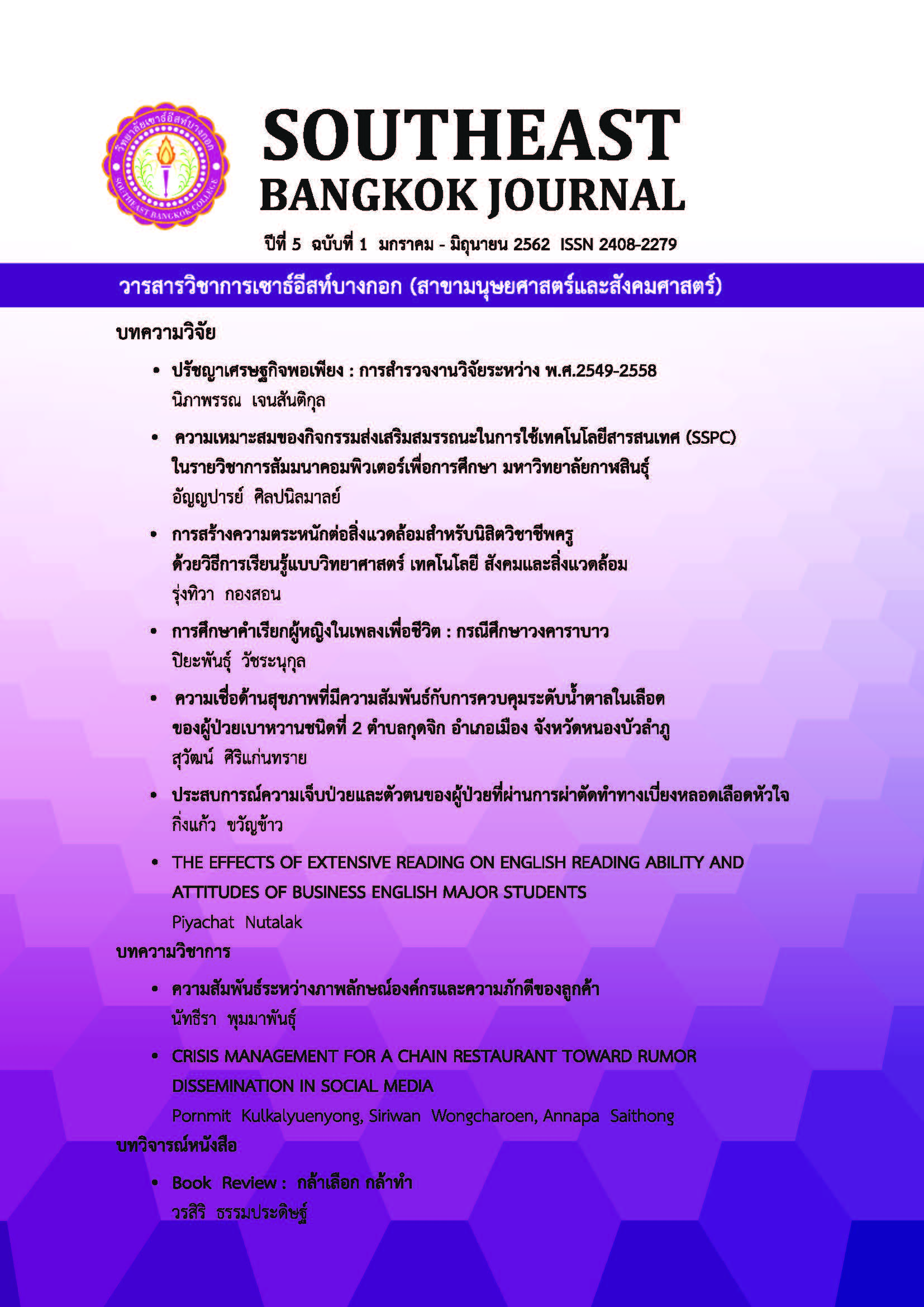
THE EFFECTS OF EXTENSIVE READING ON ENGLISH READING ABILITY AND ATTITUDES OF BUSINESS ENGLISH MAJOR STUDENTS
Article Sidebar
Main Article Content
บทคัดย่อ
งานวิจัย เรื่องผลของการอ่านแบบกว้างขวางที่มีต่อความสามารถในการอ่านของนักศึกษาวิชาเอกภาษาอังกฤษธุรกิจ มีวัตถุประสงค์เพื่อ พัฒนาความสามารถในด้านการอ่านของนักศึกษา
วิชาเอกภาษาอังกฤษธุรกิจด้วยกลยุทธ์การอ่านแบบกว้างขวาง และศึกษาทัศนคติของนักศึกษาที่มีต่อการเรียนรู้ด้วยตนเองด้วยการอ่านแบบกว้างขวาง กลุ่มตัวอย่างที่ใช้ในการวิจัยครั้งนี้เป็นนักศึกษาวิชาเอกภาษาอังกฤษธุรกิจชั้นปีที่ 2 คณะศิลปศาสตร์ วิทยาลัยเซาธ์อีสท์บางกอก ปีการศึกษา 2560 จำนวน 14 คน นักศึกษาได้ทำแบบทดสอบเพื่อวัดความสามารถด้านการอ่านภาษาอังกฤษก่อนเริ่มการทดลอง หลังจากนั้นให้นักศึกษาได้ฝึกอ่านด้วยตนเองเป็นเวลา 12 สัปดาห์ เครื่องมือที่ใช้ในการวิจัยประกอบด้วย แบบทดสอบความสามารถด้านการอ่านก่อนและหลังการทดลอง และแบบสอบถามทัศนคติเกี่ยวกับการส่งเสริมการเรียนรู้ด้วยตนเองด้วยการอ่านแบบกว้างขวาง ผลการวิจัยพบว่า ค่าเฉลี่ยคะแนนทดสอบความสามารถในการอ่านหลังการทดลองสูงกว่าก่อนการทดลอง โดยมีความแตกต่างกันอย่างมีนัยสำคัญทางสถิติที่ระดับ 0.05 นอกจากนั้นยังพบว่ากลุ่มตัวอย่างมีทัศนคติที่ดีต่อการเรียนรู้ด้วยตนเอง ข้อเสนอแนะจากการวิจัยครั้งนี้คือ ผู้สอนภาษาอังกฤษควรใช้กลยุทธ์การอ่านแบบกว้างขวางเพื่อพัฒนาความสามารถด้านการอ่านและเสริมสร้างทักษะการเรียนรู้ด้วยตนเองให้กับผู้เรียน
Article Details
เอกสารอ้างอิง
Beglar, D., Hunt, A., & Kite, Y. (2012). The effect of pleasure reading on Japanese university EFL learners’ reading rates. Language Learning, 62, 665–703. Retrieved from: http://dx.doi.org/10.1111/j.1467-9922.2011.00651.x
Chandavimol, M. (1998). Reading comprehension: An active engagement or a passive experience? PASAA, 28(December), 31-42.
Chantakloi, S. (2017). Enhancing Positive Motivation in EFL Reading Class Using Self- Selected Online Reading Texts. In Proceedings of the 11th International Conference on Applied Computer Technology and Information System. Bangkok: Southeast Bangkok College..
Day, R., & Bamford, J. (2004). Extensive reading in the second language classroom. New York, NY: Cambridge University Press.
Day, R., Prentice, N. et al. (2016). Extensive Reading, revised edition – Into the Classroom. Oxford University Press.
Dickinson, L. (1995). Introduction. In Proceedings of seminar on self-access learning and learner independence: a South East Asian perspective. Bangkok: KMITT.
Godwin-Jones, R. (2011). Emerging Technologies: Autonomous Language Learning. Language Learning and Technology. Vol15, N0.3.4-11.
Grabe, W. & Stoller, F.L. (2002). Teaching and researching reading. Harlow, UK: Pearson Education.
Guo, S. (2012) Using Authentic Materials for Extensive Reading to Promote English Proficiency, Published by Canadian Center of Science and Education, English Language teaching; Vol. 5, No. 8; 2012 Retrieved from: http://www.ccsenet.org/elt.
Holec, H. (1981). Autonomy and Foreign Language Learning. Oxford: Pergamon. (First published 1979, Strasbourg: Council of Europe).
Horst, M. (2005). Learning L2 vocabulary through extensive reading: A measurement study. Canadian Modern Language Review, 61(3). 355-382.
Huffman, J. (2014). Reading rate gains during a one-semester extensive reading course Reading in a Foreign Language, 26, 17-33.
Imamura, K. (2012). How extensive reading, reading span, and reading speed are interrelated. Extensive Reading World Congress Proceedings, 1, 124–127.
Iwahori, Y. (2008). Developing reading fluency: A study of extensive reading in EFL. Reading in a Foreign Language, 20, 70–91.
Kelly, L. (1969). 25 centuries of language teaching. Rowley, MA: Newbury House.
Levy, S. L. (2017). Extensive Reading in English as a Foreign Language/English as a Second Language Contexts. Report from the Faculty of Clinical Psychology Kyoto Bunkyo University. No. 9 March 2017. 69-84.
Little, D. (1991). Learner Autonomy 1: Definition, Issues and Problems. Dublin: Authentik.
Littlewood, W. (1996). Autonomy: an anatomy and a framework. System. 24(4),427- 435.
Maley, A. (n.d.) Extensive reading: why it is good for our students... and for us. Retrieved from http://www.teachingenglish.org.uk/article/extensive-reading-why-it-good-our-student%E2%80%A6-us
Nation, P. (2009). Teaching ESL/ESL Reading and Writing (1st ed.). New York and London: Routledge, Taylor & Francis Group.
Pigada, M & Schmitt, N. (2006). Vocabulary acquisition from extensive reading: A case study. Reading in a Foreign Language, 18(1). 1-28.
Richards, J. (2015). The Changing Face of Language Learning: Learning Beyond the Classroom. RELC Journal. Singapore. Jan 13, Vol. 10.
Richards, J. (2016) Autonomous Learner. Retrieved from: http://www.professorjackrichards.com/autonomous-learner/
Si, D. (2014). The Teaching Mode of Autonomous Learning in University English Teaching. Asian Culture and History; Vol. 6, No. 2; 2014. Published by Canadian Center of Science and Education. Retrieved from: http://www.ccsenet.org/ach.
Singh, R. (1991) Education for the twenty-first century: Asia-Pacific perspective. Bangkok: UNESCO.
Srisermbhok, A. (2017). Fostering English Literacy for Autonomous Learning through IT. In Proceedings of the 11th International Conference on Applied Computer Technology and Information System. Bangkok: SBC.
Swatevacharkul, R. (2010). Are Tertiary Students Ready for Learner Autonomy? SUDDHIPARITAD JOURNAL. Volume 27 (pp. (pp.39-60), 2010.
Wisaijorn, P. (2017). Effects of Extensive Reading on Thai Students. PASAA PARITAT JOURNAL. Volume 32 (pp. 29-62), 2017.
Yao, S. (2016). Web-based Autonomous English Learning of Engineering Students. iJET - Volume 11, Issue 6, 2016. Retrieved from: http:// www.i-jet.org.
Zhao, W. (2014) Research on College English Autonomous Learning Strategies Based on the Digital Instructional Platform. Theory and Practice in Language Studies, Vol. 4, No. 9, pp. 1918-1923, September 2014 © 2014 ACADEMY PUBLISHER Manufactured in Finland.
