
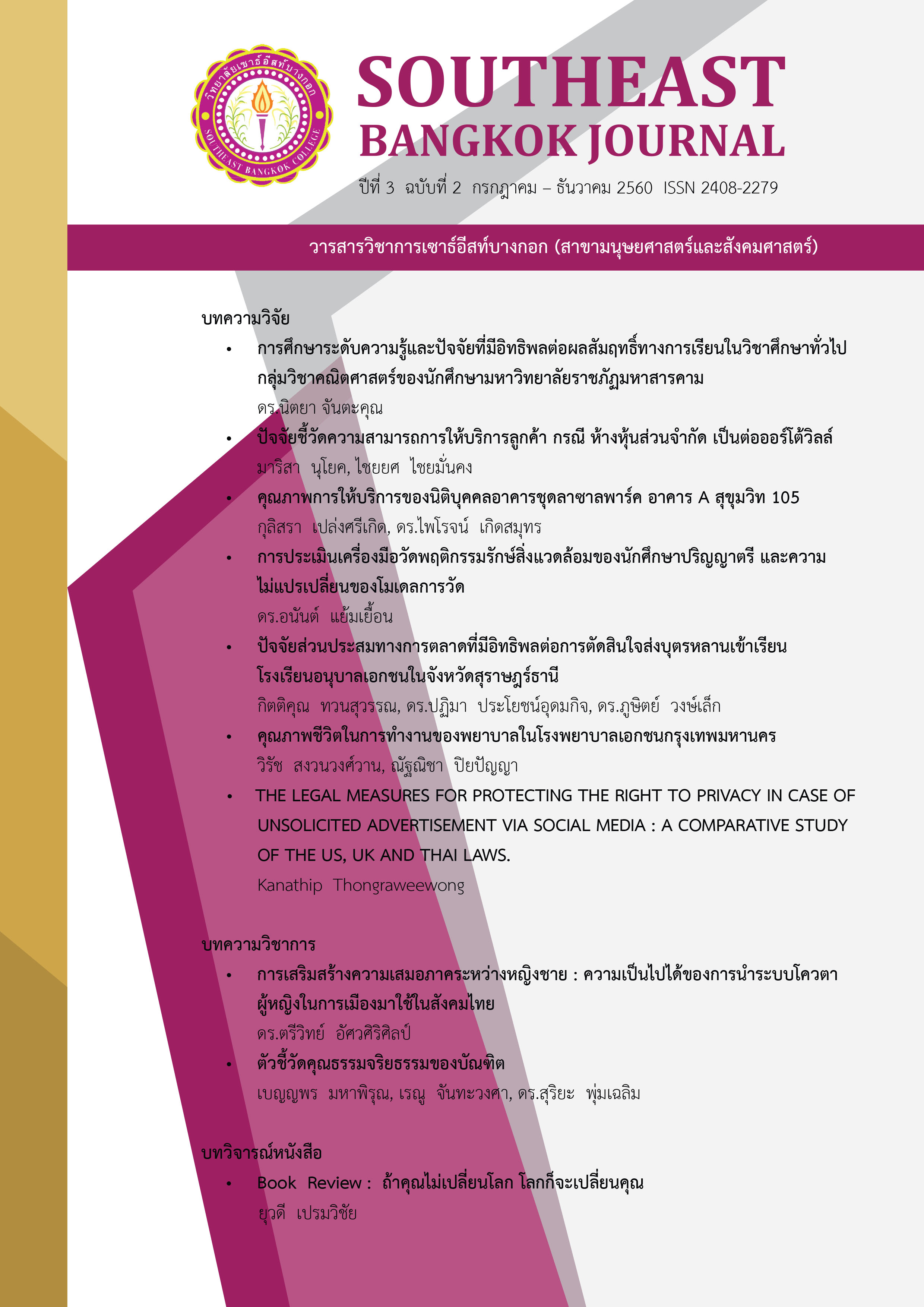
THE LEGAL MEASURES FOR PROTECTING THE RIGHT TO PRIVACY IN CASE OF UNSOLICITED ADVERTISEMENT VIA SOCIAL MEDIA : A COMPARATIVE STUDY OF THE US, UK AND THAI LAWS
Article Sidebar
Main Article Content
Abstract
Apart from using media websites as medium of personal communication by individuals, business entities also use social media websites as a tool for advertising their products and services. Such advertising which comprises of several form including text, images and graphic can directly reach to an individual, especially a consumer
who uses Smartphone. However, such advertisement can lead to the invasion of privacy for the recipient who does not consent to receive such advertisement. Hence, this research aims to study the application of related Thai law to the case of violation of privacy by initiating advertisement through social network websites without consent or “unsolicited advertisement”. Thus, this research is qualitative and information is collected by analysis of documents. The comparative analysis of Thai laws and US laws is applied as part of content analysis. The findings of this research indicate that there are no specific laws in recent Thai legal system to protect the right of privacy in case of unsolicited advertisement through social network websites. By contrast,
there are related specific laws in the US which can be applied to protect the privacy from unsolicited advertisement. Although there are currently various laws which can be applied to protect such right, this research indicates that the problems of content, element, and scope of such laws make them inappropriate to be applied to protect the right to privacy in case of unsolicited advertisement. Consequently, this research proposes suggestions such as enacting a specific laws and amending the existing laws in order to protect the right of privacy in case of unsolicited advertisement through social network websites.
Article Details
References
Birnhack, Michael. (2008). The EU data protection directive: An engine of a globalregime. Computer Law & Security Report, 24(6), 508-520.
Borghi, Maurizio., Ferretti, Federico., and Karapapa, Stavroula. (2013). Online data processing consent under EU law: A theoretical framework and empirical evidence from the UK. International Journal of Law and Information Technology, 21(2),
109-153.
Broecker, Edwin J. (1990). FAX unto others…: A constitutional analysis of unsolicited facsimile statutes. Indiana Law Review, 23(3), 703-730.
Carey, Peter. (2009). Data protection: A practical guide to UK and EU law. New York: Oxford University Press.
Decew, Judith Wagner. (1997). In pursuit of privacy: Law ethics and the rise of technology. US: Cornell University Press.
Donnelly, Jack. (1982). Human rights and human dignity. The American Law Review, 76(2), 303-316.
Edwards, Lillian. (2005). Canning the spam and cutting the cookies: Consumer privacy online and EU regulation. In Lillian Edwards (Ed.), The New Legal Framework for E-Commerce in Europe (pp.31-66). North America: Hart publishing.
Ford, Roger A. (2005). Preemption of state spam laws by the federal can-spam act. The University of Chicago Law Review, 355-384.
Gavison, Ruth. (1980). Privacy and the limits of law. The Yale Law Journal, 89(3), 421-471.
Hatcher, Jordan S., and Edwards, Lilian. (2009). Consumer privacy law 2: Data collection, Profiling and targeting. In Lillian Edwards and Charlotte Waelde (Eds.), Law and the Internet. North America: Hart publishing.
Hendricks, Evan., Hayden, T., and Novick, J. D. (1990). Your right to privacy: A basic guide to legal rights in an information society. US: Southern Illinois University Press.
Hinde, Stephen. (2000). Smurfing, Swamping, Spamming, Spoofing, Squatting, Slandering, Surfing, Scamming, and other mischiefs of the world wide web. Journal Computers and Security, 19(4), 312-320.
Hollings, Ernest. (1991). Congressional record, Proceedings and debates of the 102nd congress, First session, November, 1991. Retrieved September 9, 2015, from http:// memory.loc.gov/ammem/amlaw/lwcrlink.html
Kanathip Thongraweewong. (2010). Legal measures for protecting the right to privacy : A study of invasion of privacy by direct sale business. Botbandit Law Journal, 66(4), 46-80.
Kanathip Thongraweewong. (2012). Legal measures for protecting the right to privacy: A study of invasion of privacy through the use of social network websites. APHEIT Journal, 18(1).
Kanathip Thongraweewong. (2014, July). The legal protection of right to privacy in case of “google street view”: A comparative study of Thai and US laws, Conference proceedings. International Conference 2014 (BUU2014). Burapha University, Thailand.
Kanathip Thongraweewong. (2014, May). State telecommunication surveillance : A comparative study of the US and Thai telecommunication privacy laws. Conference proceedings of the forth international conference on digital
information and communication technology and its applications (DICTAP 2014). University of the Thai Chamber of Commerce, Thailand.
Kanathip Thongraweewong. (2016, June). Comment addressed. In Forum for opinion on draft computer crime act B.E. 2559. National human rights commission, The Government Complex Commemorating His Majesty.
Khong, Dennis. (2004). An economic analysis of spam law. Erasmus Law & Economics Review, (1), 23-45.
Meyerowitz, Steven. (2008). Virginia supreme court rejects state’s anti-spam law on first amendment grounds. Privacy & Data Security Law Journal, 1024-1039.
Minogue Kenneth. (1978). The history of the Idea of human right. In Walter Laqueur and Barry Rubin (Eds.), The Human Rights Reader (p.3-16). Philadelphia: Temple University Press.
Moorefield, Gary. (1999). spam-It’s not Just for breakfast anymore: Federal legislation and the fight to free the internet from unsolicited commercial e-mail. Boston University Journal of Science and Technology Law, (10), 10.
Mossoff, Adam. (2004). Spam-Oy, What a nuisance!. Berkley Technology Law Journal, 19(2), 1-42.
Orwin, Chifford., and Pangle, Thomas. (1984). The philosophical foundation of human rights. In M. F. Platter (Ed.), Human Rights in Our Time: Essays in Memory of Victor Baras. Boulder, CO: Westview Press.
Posner, Richard. (1998). Economic analysis of law (5th ed.). New York:Aspen Law & Business.
Poullet, Yves. (2006). EU data protection policy. The directive 95/46/EC: Ten years after. Computer Law & Security Review, 22(3), 206–217.
Pressler, Larry. (1991). Congressional record, Proceedings and debates of the 102nd Congress, First session, November, 1991. Retrieved September 9, 2015, from http://memory.loc.gov /ammem/ amlaw/lwcrlink.html
Ramsay, Iain. (1989). Consumer protection text and materials. London: Weidenfeld and Nicolson.
Rice, Cindy M. (2002). The TCPA: A justification for the prohibition of spam in 2002? unsolicited commercial e-mail: Why is it such a problem?. North Carolina Journal of Law & Technology, (3), 375-382.
Samoriski, H. (1999). Unsolicited commercial e-mail, The internet and the first amendment: Another free speech showdown in cyberspace?. Journal of Broadcasting & Electronic Media, 43(4), 670-689.
Simon, Marc. (2004). The can-spam act of 2003: Is congressional regulation of unsolicited commercial e-mail constitutional. Journal of High Technology Law, 4(85), 85-115.
Sorkin, David. (1997). Unsolicited commercial e-mail and the telephone consumer protection act of 1991. Buffalo Law Review, (45), 1001-1032.
Sorkin, David. (2003). Spam legislation in the United States, John Marshall. Journal of Computer & Information Law, 22(1), 3-12.
Wacks, Raymond. (1989). Personal information: Privacy and the law. Oxford: Clarendon Press.
Wall, David S. (2005). Digital realism and the governance of spam as cybercrime. European Journalon Criminal Policy and Research, 10(4), 309-335.
Wallace, Ryan P., Lusthaus, Adam M., and Kim, Jong Hwan. (2005). Computer crimes. American Criminal Law Review, 42(2), 223-276.
Wong, Katherine L. (2007). The future of spam litigation after omega world travel v. mummagraphics. Harvard Journal of Law and Technology, 20(2), 459-476.
