
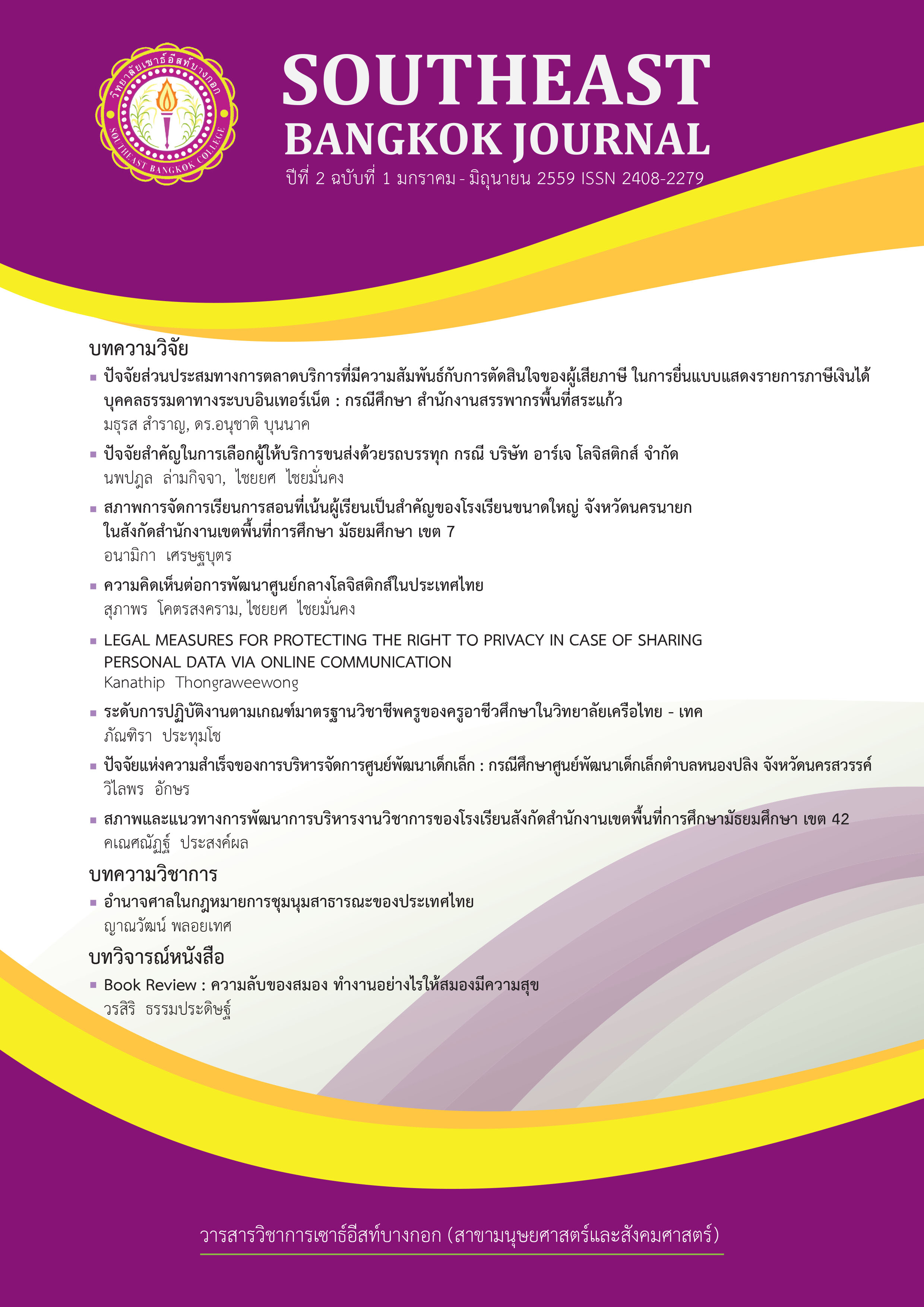
OPINIONS ON DEVELOPMENT OF LOGISTICS HUB IN THAILAND
Article Sidebar
Main Article Content
Abstract
The objectives of this study were 1) to study the opinion of the engaging to transport and trade at Laem Chabang Port about the development of logistics hub in Thailand. 2) to compare the opinion of the engaging whom were engaged to transport and trade at Laem Chabang Port about the development of logistics hub in Thailand. The samples consisted of 385 the engaging whom were engaged to transport and trade at Laem Chabang Port Questionnaires were used as research instrument for data collection process within this study with content validity 100 technique as between 0.66 to 1.00 and the reliability value of 0.81. The statistics have been used to defined percentage, mean, standard deviation, t-test and Analysis of Variance (One-way ANOVA).
The results of this study were summarized as follows: 1) The opinion of the engaging whom were engaged to transport and trade at Laem Chabang Port about the development of logistics hub in Thailand both in total and individual subject were high level. 2) the engaging whom were engaged to transport and trade at Laem Chabang Port with difference of age and work experience had difference opinion about the development of logistics hub in Thailand at .05 level of statistical significance and the engaging whom were engaged to transport and trade at Laem Chabang Port with difference of gender education level and occupation had not difference opinion about the development of logistics hub in Thailand.
Article Details
References
กรมศุลกากร. (2557). รายงานศุลกากรประจําปี. กรุงเทพฯ: กระทรวงการคลัง
กระทรวงพาณิชย์. (2557). ข้อมูลสรุปการค้าระหว่างประเทศของไทยกับโลก. สืบค้น 17 ธันวาคม 2557, จาก http://www.ops3.moc.go.th/infor/MenuComTH/trade_sum/report.asp
การท่าเรือแห่งประเทศไทย. (2551). รายงานประจําปี. สืบค้น 1 ธันวาคม 2557, จาก http://www.1.part.co.th/AnnualReport/y51/futureplan.pdf
ไชยยศ ไขยมั่นคง และมยุขพันธุ์ ไชยมั่นคง. (2554). กลยุทธ์การขนส่ง, กรุงเทพฯ: วิชั่นพรีเพรส.
ธนิต โสรัตน์. (2549), เมื่อประเทศไทยอยากเป็น Transport Logistics Hub ศูนย์กลางโลจิสติกส์ของภูมิภาคอินโดจีนและจีนตอนใต้, กรุงเทพฯ: พราวเพรส (2002).
พรรณี ลีกิจวัฒนะ. (2558), วิธีการวิจัยทางการศึกษา (พิมพ์ครั้งที่10). กรุงเทพฯ: มีนเซอร์วิสซัพพลาย
ภัชรี นิ่มศรีกุล. (2552). การประยุกต์ใช้การตัดสินใจแบบหลายหลักเกณฑ์เพื่อคัดเลือกศูนย์กลางโลจิสติกส์ด้านการขนส่งสินค้าในประเทศไทยบนแนวระเบียงเศรษฐกิจ. (วิทยานิพนธ์วิทยา
ศาสตรมหาบัณฑิต สาขาวิชาวิศวกรรมอุตสาหการ มหาวิทยาลัยเชียงใหม่)
สํานักงานคณะกรรมการพัฒนาการเศรษฐกิจและสังคมแห่งชาติ (สศช.). (2556). รายงานฉบับสมบูรณ์แผนยุทธศาสตร์การพัฒนาระบบโลจิสติกส์ของไทย ฉบับที่ 2 (2556-2560). สืบค้น 21 ตุลาคม 2557, จาก http://www.nesdb.go.th/Portals/0/tasks/dev logis/report/data 0411041213.pdf
สุวรรณา โพธิอ่อน และไพโรจน์ เร้าธนชลกุล. (2552). การศึกษาผลกระทบจากการเปลี่ยนแปลงระบบการทํางาน และปัจจัยสนับสนุนเพื่อทําให้เกิดการยอมรับระบบพิธีการศุลกากรไร้ เอกสาร (e-Customs). ใน การประชุมสัมมนาวิชาการด้านการจัดการโลจิสติกส์และโซ่อุปทาน ครั้งที่ 9 (น. 24-34), ชลบุรี: มหาวิทยาลัยบูรพา.
อิทธิพล ปานงาม และคณะ. (2541), การศึกษาปัจจัยเปรียบเทียบศักยภาพของท่าเรือในภูมิภาคอินโดจีน, กรุงเทพมหานคร: สถาบันการขนส่ง จุฬาลงกรณ์มหาวิทยาลัย
Conbach, L. J. (1970). Essentials of Psychological Testing. New York: Happer and Row.
Sangren, Suzie. (2014). A simple solution to nagging questions about survey, sample size and validity, Quirk Marketing Research Media, (January 1999). Retrieved
from http://www.quirks.com/articles/a1999/19990101.aspx
Thailand Board of Investment (BOI). (2556). Industry Focus Logistics. Retrieved May 3,2015, from http://www.boi.go.th/tir/issue contentphp?issueid=116963Bpage%3D42
