
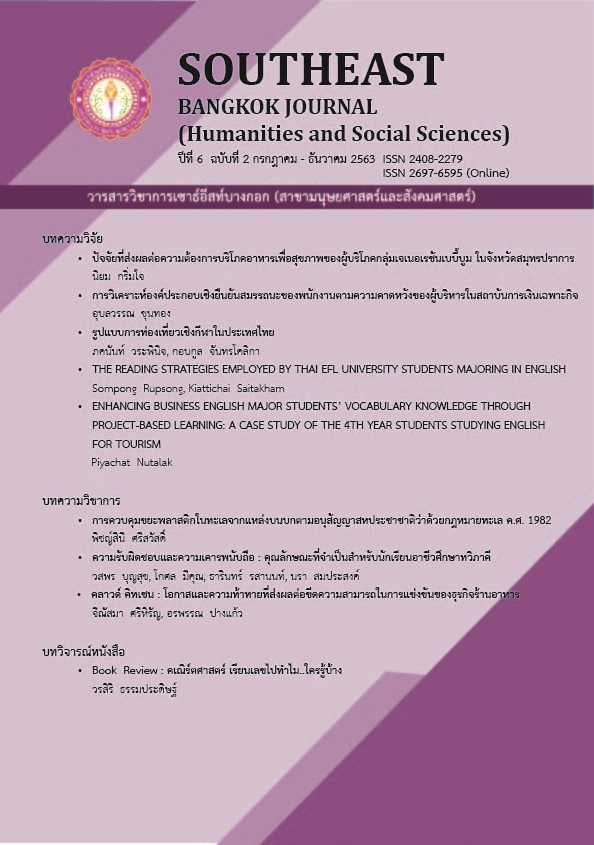
ENHANCING BUSINESS ENGLISH MAJOR STUDENTS’ VOCABULARY KNOWLEDGE THROUGH PROJECT-BASED LEARNING: A CASE STUDY OF THE 4TH YEAR STUDENTS STUDYING ENGLISH FOR TOURISM
Article Sidebar
Main Article Content
Abstract
This study aimed; to 1) investigate the effectiveness of project-based learning on students’ level of vocabulary knowledge, and 2) find out the students’ attitudes towards project-based learning. The participants included 16 fourth-year students enrolling in the academic year 2019 at the Faculty of Liberal Arts, Southeast Bangkok College. There were four males and twelve females, aged 21-22. A quantitative analysis of the participants’ written essays, using Cobb’s Lextutor Vocabulary Profiler, explored if there were any differences in the level of vocabulary knowledge between pre-project and post-project essays. The findings revealed that the students’ level of vocabulary knowledge improved significantly and the students had positive attitudes towards project-based learning. The results showed that the participants significantly used less K1 words in their post-project essays which reflected their better level of vocabulary. In addition, the students showed their improvement of vocabulary knowledge by using more K1 families and K1 types in their post-project essays. Moreover, the students significantly used higher number of AWL words in their post-project essays. According to the results, it can be concluded that classroom activities such as searching information for creating an end product throughout project-based learning such as the exploration of data for creating tourism advertisement, tourism itinerary, and tourism marketing helped students acquire more academic words.
Article Details
References
Al-Darayseh, A. (2014). The impact of using explicit/implicit vocabulary teaching strategies on improving students' vocabulary and reading comprehension. Theory and Practice in Language Studies, 4(6), 1109-1118.
Algeo, J., & Pyles, T. (2010). The origins and development of the English language. Boston, MA: Wadsworth Cengage Learning.
Castañeda (2014). English teaching through project based learning method, in rural area. Cuadernos de Lingüística Hispánica n°. 23, Enero-Junio (pp. 151-170).
Cobb, T. (2007). Computing the vocabulary demands of L2 reading. Language Learning & Technology, 11(3), 38–63.
Coxhead, A. (2000). A new academic word list. TESOL Quarterly, 34(2), 213-238.
Hulstijn, J. H., & Laufer, B. (2001). Incidental vocabulary acquisition in a second language : the construct of task-induced involvement. Applied Linguistics, 22(1), 1-26.
Kennedy, G. (2003). Structure and Meaning in English. Oxon, NY: Routledge.
Kimsesiz, F., Dolgunsöz, E., & Konca, M.Y. (2017). The effect of project-based learning in teaching EFL vocabulary to young learners of English: the case of pre-school children. International Journal of Languages’ Education and Teaching, 5(4), 426–439.
Kunze, C. (2009). Hectic, hippic and hygienic: adjective in Victorian fiction: a semantic analysis. Frankfurt Am Main: Peter Lang.
McDonnell, K. (2007). Can 40 seconds of compassion reduce patient anxiety. Journal of Clinical Oncology, 17(1), 371.
Nation, I. S. P. (2011). Research into practice: vocabulary. Language Teaching, 44(4), 529-539. Retrieved September 2, 2019, from http://dx.doi.org/10.1017/S0261 444811000267.
Nasser, O. (2015). Implicit vocabulary acquisition in project-based learning with iPad technology. (Master’s thesis, Teaching English to Speakers of Other Languages).
Shafaei, A. & Rahim, H.A. (2015, July). Does project-based learning enhance Iranian EFL learners’ vocabulary recall and retention. Iranian Journal of Language Teaching Research, 3(2), 83-99.
West, M. (1953). A general service list of English words. London: Longman.
Yang, W., & Dai, W. (2011). Rote memorization of vocabulary and vocabulary development. English Language Teaching, 4(4), 61.
