
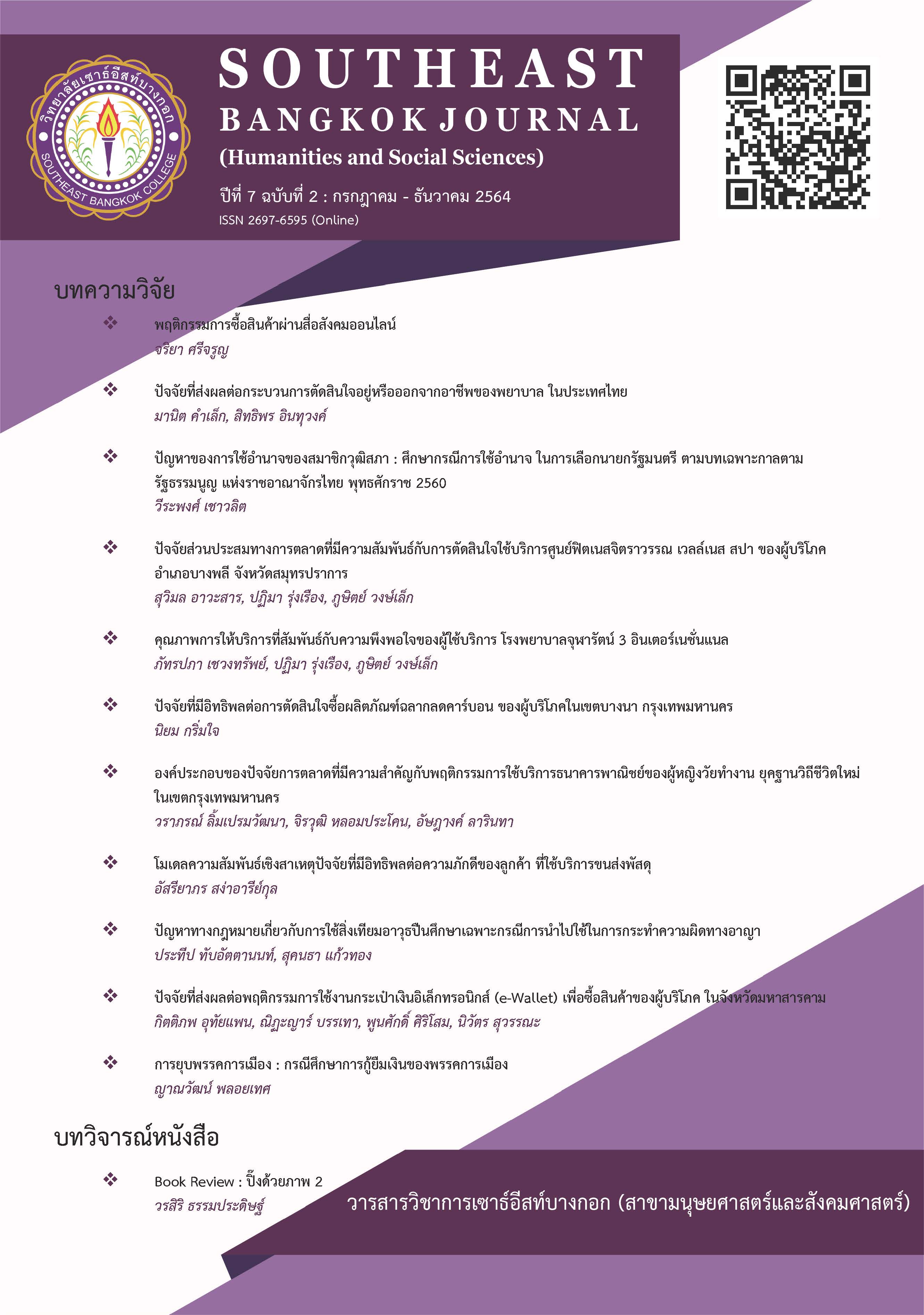
FACTORS AFFECTING USAGE BEHAVIOR OF ELECTRONIC WALLET FOR THE GOODS PURCHASING OF CONSUMER IN MAHA SARAKHAM PROVINCE
Article Sidebar
Main Article Content
Abstract
The purposes of this research were to study electronic wallet (e-Wallet) usage behavior for purchase of consumer goods in Maha Sarakham province, to compare satisfaction and attitudes towards the use of e-wallets in consumer purchases in Maha Sarakham province classified by personal factors, and to study the factors affecting e-wallet usage behavior in consumer purchases in Maha Sarakham Province. A data collection tool in this study was questionnaires. The sample population was citizens living in Maha sarakham province of 400 people. Statistics that were used in this research were the percentage, average, standard deviation, t-test, F-test and multiple linear regression. The results of this study showed that most of the people who used to use the electronic wallet (63.75%) lived in municipal areas of Mueang Maha Sarakham district by being a male under the age of 20 years of high school education/ vocational certificate, self-employed and have an average monthly income 15,001-20,000 baht. Payment methods via electronic wallet were True Money Wallet and PaoTang. The frequency of use most often was 2-5 times/month. Expenses for the payment of goods or services are 3,000-3,500 baht/week. The places to pay through e-wallets were a convenience store and pay for the parcel delivery service. Comparison of satisfaction and attitude towards the use of e-wallets for consumer purchases in Maha Sarakham province that classified by personal factors using t-test and F-test showed that the income levels, frequency of use and Expenses for the payment of goods affect to customer satisfaction and attitudes towards the use of purse with statistically significant at 0.01 level. Factors affecting electronic wallet usage behavior were education(x1), district(x4), average monthly income(x6), the awareness and access to the benefits of use(x9) safety aspect(x10) and intention of use(x11) with significantly at the 0.01 level. The multiple regression equation was and the regression coefficient is R2 =0.652
Article Details
References
วัชรากรณ์ ร่วมรักษ์. (2560). Mobile Wallet กระเป๋าเงินดิจิทัล ในยุคสังคมไร้เงินสด. สืบค้น 19 สิงหาคม 2564. จาก https://1th.me/zfSMe
Marketeer. (2562). สงคราม e-Wallet 2020 ใครใช้บ่อยกว่า…ชนะ. สืบค้น 12 พฤศจิกายน 2563. จาก https://marketeeronline.co/archives/122047.
สำนักงานสถิติจังหวัดมหาสารคาม. (2562). ข้อมูลจำนวนประชากรจังหวัดมหาสารคาม. สืบค้น 12 พฤศจิกายน 2563. จาก http://maha sarakham.nso.go.th/images/documents/others/mkm-geninfo- withgis.pdf.
บุญชม ศรีสะอาด. (2553). วิจัยเบื้องต้น. พิมพ์ครั้งที่ 8. กรุงเทพฯ: สุวีริยาสาส์น.
กัลยา วานิชย์บัญชา. (2554). การวิเคราะห์สถิติ: สถิติสำหรับการบริหารและวิจัย. พิมพ์ครั้งที่ 13 กรุงเทพฯ: โรงพิมพ์จุฬาลงกรณ์มหาวิทยาลัย
นันทิยา ฉายารัตนรักษ์. (2561). ปัจจัยส่วนบุคคลที่มีความสัมพันธ์กับพฤติกรรมการใช้งานประเป๋าเงินอิเล็กทรอนิกส์ (e-Wallet) ในการซื้อสินค้าของผู้บริโภคในอำเภอเมือง จังหวัดนครศรีธรรมราช. บริหารธุรกิจ วิชาเอกบริหารธุรกิจ มหาวิทยาลัยรามคำแหง
กฤตโสภา ทิพย์ปัญญาวงศ์. (2559). การศึกษาปัญหาและแรงจูงใจในการใช้งานเงินอิเล็กทรอนิกส์ (e- Money) ผ่านโทรศัพท์มือถือในประเทศไทย. วิทยาศาสตรมหาบัณฑิต สาขาวิชาการบริหาร การตลาด มหาวิทยาลัยธรรมศาสตร์
Hinkle, D.E.; William, W.; & Stephen G. J. (1998). Applied Statistics for the Behavior Sciences. 4th ed., NY: Houghton Mifflin.
