
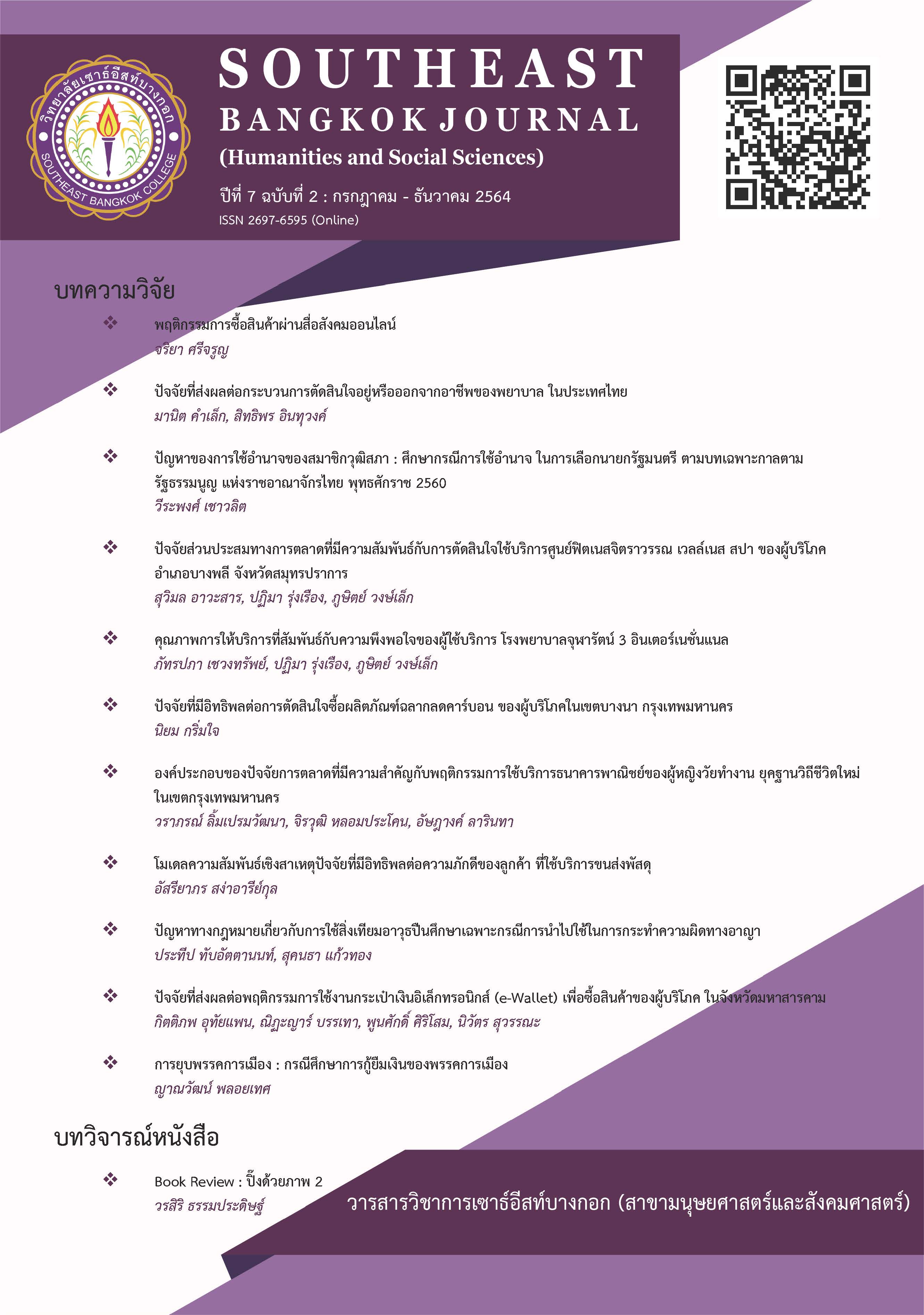
DISSOLUTION OF POLITICAL PARTIES: CASE STUDY OF BORROWING MONEY OF POLITICAL PARTIES
Article Sidebar
Main Article Content
Abstract
Articles of this research have been the case with the Constitutional Court to disband the ruling party due to the political leader of the political party of the loan, aims to study the concepts and theories of political parties and political party laws of Germany and the law pertaining to political parties of Japan. Research was Documentary Research which study of foreign laws and interviews. Public legal scholars whose issues are as follows: Issue 1 Problems with the type of juristic person of political parties, Issue 2, the problem of rulings inconsistent with the rule of law and interpretation, and Issue 3, the problem of dissolution of political parties in the case of borrowing money that is inconsistent with the provisions of the law and principles of foreign law.
Research results, documents and interviews in all three issues, 1) it was found that political parties were legal entities under public law. While under public law, political parties may not have legal powers or play a role in the public service, but they play a role in educating people in a democratic system, in line with the principles of the Federal Constitutional Court of Germany considering the existence of a political party. public participation It is a special public juristic person. 2) It was found that the decision to dissolve a political party was not in accordance with the principles of the rule of law. The cause of the dissolution of a political party does not contain a provision in the law, but arises from interpretation in order to Linking to the cause of the dissolution of a political party is an interpretation that is not tied to the true will. 3) In the last point It was found that the provisions that the court used to dissolve a political party had no intention of punishing the offender, not the cause of the dissolution of a political party. This is not in accordance with the intent and inconsistent with foreign law principles
Article Details
References
กิจบดี ชินเบญจภุช. (2564). หลักกฎหมายมหาชน พิมพ์ครั้งที่ 3. กรุงเทพฯ: สำนักพิมพ์รามคำแหง.
บวรศักดิ์ อุวรรณโณ. (2564). กฎหมายมหาชน เล่ม 1 วิวัฒนาการทางปรัชญา และลักษณะของกฎหมายมหาชนยุคต่างๆ, พิมพ์ครั้งที่ 7. กรุงเทพฯ : สำนักพิมพ์วิญญูชน.
บวรศักดิ์ อุวรรณโณ. (2538). กฎหมายมหาชน เล่ม 2 การแบ่งแยกกฎหมายมหาชน-กฎหมายเอกชน และพัฒนาการกฎหมายมหาชนในประเทศไทย, พิมพ์ครั้งที่ 2, กรุงเทพฯ: คณะนิติศาสตร์ จุฬาลงกรณ์มหาวิทยาลัย.
มานิตย์ วงศ์เสรี . (2561). นิติวิธี การใช้และการตีความกฎหมายศึกษาเปรียบเทียบระบบกฎหมายไทยและระบบกฎหมายเยอรมัน, กรุงเทพฯ : สำนักพิมพ์วิญญูชน.
นิยม รัฐอมฤต. 2540การเมืองไทยยุคปัจจุบัน ปัญหาการพัฒนาพรรคการเมืองไทย (กรุงเทพมหานคร:สำนักพิมพ์มหาวิทยาลัยรามคำแหง ) หน้า 21-22
นพดล เฮงเจริญ. (2564). การตีความรัฐธรรมนูญ. สืบค้น เมษายน 2564. จาก http://public-law.net/publaw.
วรเจตน์ ภาคีรัตน์. (2555). หลักนิติรัฐและหลักนิติธรรม . วารสารจุลนิติ, 9(1), 49-67.
วรเจตน์ ภาคีรัตน์. (2551). การใช้และการตีความกฎหมายมหาชน. เอกสารเสนอในงานรำลึก 100 ปี ชาติกาล ศาสตราจารย์จิตติ ติงศภัทิย์ เมื่อ 30 มีนาคม 2551, 33-34.
ศนันกรณ์ โสตถิพันธุ์. (2564). คำอธิบายนิติกรรมสัญญา, พิมพ์ครั้งที่ 24. กรุงเทพ: สำนักพิมพ์วิญญูชน
Benton, Ted and Craib, Ian. (2001). Philosophy of Social Science. New York
Wolfe, Christopher (1997). Judicial activism. Rowman & Littlefield Publishers.
Herman Finer. (1949). The Theory and Practice of Modern Government. New York: Holt, Rinehart & Winston.
G.A. Jacobsen and M.H. Lipman. (1969). Political Science. New York: Barnes and Noble.
