
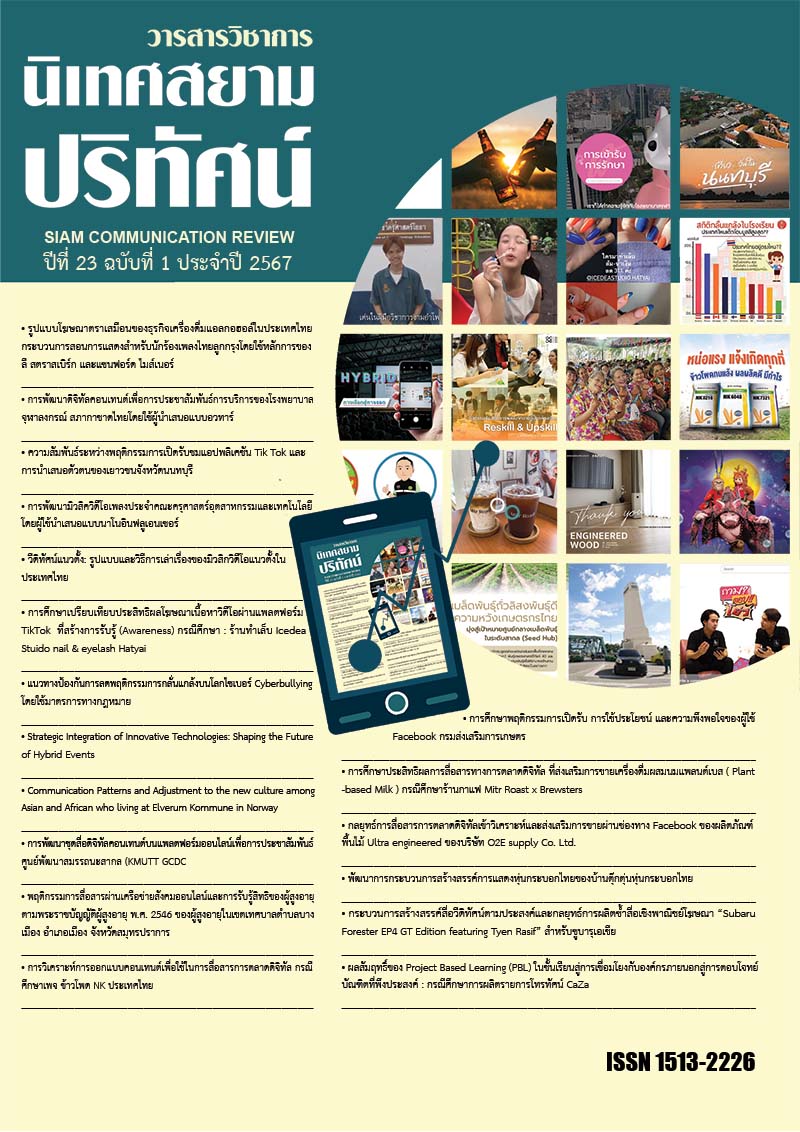
Strategic Integration of Innovative Technologies: Shaping the Future of Hybrid Events
Article Sidebar
Main Article Content
บทคัดย่อ
ภาพรวมของการตลาดอีเว้นต์ได้รับการเปลี่ยนแปลงครั้งใหญ่ตั้งแต่เกิดการแพร่ระบาดของโควิด-19 ซึ่งนำไปสู่การเพิ่มอีเว้นต์แบบผสมผสานที่ผสมผสานมิติทั้งแบบตัวต่อตัวและแบบเสมือนเข้าด้วยกัน งานวิจัยนี้สำรวจ "การบูรณาการเชิงกลยุทธ์ของเทคโนโลยีนวัตกรรม: รูปแบบการจัดงานแบบไฮบริดอีเว้นท์ในอนาคต" ที่เจาะลึกถึงข้อได้เปรียบของกิจกรรมไฮบริดอีเว้นท์ กลยุทธ์การตลาดเชิงปฏิบัติ การรวบรวมข้อมูล และบทบาทสำคัญของเทคโนโลยี โดยวัตถุประสงค์ของงานวิจัยมีการประเมินประสิทธิผลของกลยุทธ์การจัดไฮบริดอีเว้นท์ รูปแบบการบูรณาการที่เหมาะสม การพิจารณาการมีส่วนร่วมของผู้ชมอย่างละเอียด และการคาดการณ์แนวโน้มในอนาคต ซึ่งวิเคราะห์ทั้งจากแหล่งข้อมูลปฐมภูมิของการสำรวจความพึงพอใจของผู้เข้าร่วมงานแบบไฮบริดอีเว้นท์ และแหล่งข้อมูลทุติยภูมิที่เป็นรายงานของภาคอุตสาหกรรมและวรรณกรรมทางวิชาการร่วมด้วย โดยสรุป งานวิจัยนี้ได้นำเสนอภาพรวมที่ครอบคลุมกลยุทธ์การตลาดของการจัดงานแบบไฮบริดอีเว้นท์ โดยมีข้อมูลเชิงลึกที่เป็นประโยชน์เพื่อเป็นแนวทางที่มีประสิทธิภาพต่อการเปลี่ยนแปลงอย่างต่อเนื่อง
Article Details

อนุญาตภายใต้เงื่อนไข Creative Commons Attribution-NonCommercial-NoDerivatives 4.0 International License.
เอกสารอ้างอิง
Antchak, V., Lück, M., & Pernecky, T. (2021). Understanding the core elements of event portfolio strategy: lessons from Auckland and Dunedin. International Journal of Contemporary Hospitality Management, 33(7), 2447-2464.
Asim, M. M., & Rasul, A. (2020). Networked identities: Exploring the role of social networking to optimize event marketing by Higher Education Institutions in the Middle East. Asia Pacific Media Educator, 30(2), 180-199.
Belair-Gagnon, V. (2019). News on the fly: Journalist-audience online engagement success as a cultural matching process. Media, Culture & Society, 41(6), 757-773.
BOUFIM, M., & BARKA, H. (2021). Digital marketing: Five stages maturity model for digital marketing strategy implementation. IJBTSR International Journal of Business and Technology Studies and Research, 3(3), 15-pages.
Broersma, M. (2019). Audience engagement. The international encyclopedia of journalism studies, 1-6.
Christina, I. D., Fenni, F., & Roselina, D. (2019). Digital marketing strategy in promoting product. Management And Entrepreneurship: Trends Of Development, 4(10), 58-66.
Firmansyahrani, S., Younna, S., Vanessa, V., & Noor, A. (2022). Conference hybrid event as a new alternative event in the covid-19 pandemic. Journal of Business on Hospitality and Tourism, 8(1), 301-310.
Hussien, H. M., & Touni, R. (2022). The Role of Hybrid Events in Reviving the Hotel Industry in Egypt after the COVID-19 Pandemic: An Exploratory Study. International Journal of Heritage, Tourism and Hospitality, 16(1), 38-50.
Hammoud, G. A., Tawfik, H. F., & Rady Mohamed, S. S. (2022). Technological Innovation in Tourism and Events industry: A hybrid future of Events. International Journal for Tourism, Archeology & Hospitality (IJTAH), 2(3).
Jain, V. (2021). An overview on social media influencer marketing. South Asian Journal of Marketing & Management Research, 11(11), 76-81.
Jayawarna, S., & Dissanayake, R. (2019). Strategic planning and organization performance: A review on conceptual and practice perspectives. Archives of Business Research, 7(6), 155-163.
Kanjanapokin, K. (2019). Hybrid event marketing :when digital and event become one. Ookbee Publisher.
Koningstein, M., & Azadegan, S. (2021). Participatory video for two-way communication in research for development. Action Research, 19(2), 218-236.
Kun, A. L., & Shaer, O. (2023). Designing an Inclusive and Engaging Hybrid Event: Experiences from CHIWORK. arXiv preprint arXiv:2306.15600.
Lapborisuth, P., Koorathota, S., Wang, Q., & Sajda, P. (2022). Integrating neural and ocular attention reorienting signals in virtual reality. Journal of Neural Engineering, 18(6), 066052.
Lekgau, R., & Tichaawa, T. M. (2022). Exploring the Use of Virtual and Hybrid Events for MICE Sector Resilience: The Case of South Africa. African Journal of Hospitality African Journal of Hospitality, Tourism and Leisure, (114), 814-2223.
Lenin, R., & Manivannan, P. (2022). THE IMPACT OF DIGITAL ADVERTISING ON CONSUMER BEHAVIOR. International Journal on Global Business Management & Research, 11(1), 105-119.
Mahadewi. (2023, January). Hybrid Event: Utilization of Digital Technology in Organizing Events during the COVID-19 Pandemic in Indonesia. In Proceedings (Vol. 83, No. 1, p. 53). MDPI.
Mahendher, S., Sharma, A., Chhibber, P., & Hans, A. (2021). Impact of COVID-19 on digital entertainment industry. UGC Care J, 44, 148-161.
Nilsson, L. (2020). Hybrid Events Breaking the Borders: Transferring your hybrid event into an engaging and inclusive experience for different audiences and stakeholders.
Priyatmoko, R., Rusata, T., Muttaqien, P. F., Rosyidi, M. I., & Pradjwalita, C. F. P. (2022). Virtual and hybrid event: how Indonesian event organizers adapt during the COVID-19 pandemic. International Journal of Applied Sciences in Tourism and Events, 6(2), 106-119.
Sabiq, M. (2021). Hybrid event strategy for the fishing community (Case study of the fisherman community of Beba hamlet, Takalar regency during the Covid-19 pandemic). Akuatikisle: Jurnal Akuakultur, Pesisir dan Pulau-Pulau Kecil, 5(2), 39-43.
Sari, D. M. F. P., & Aprialita, S. D. (2020). The influence of content, influencer, and experiential marketing on customer engagement of online game applications. REVIEW OF MANAGEMENT, ACCOUNTING, AND BUSINESS STUDIES, 1(1), 27-36.
Silver, C. M., Joung, R. H., Morris, M. S., Wang, K. S., Ghaferi, A. A., Bilimoria, K. Y., & Clarke, C. N. (2022). Comparison of COVID-19 rates among in-person and virtual attendees of a National Surgical Society Meeting in the US. JAMA Network Open, 5(9), e2230300-e2230300.
Sileyew, K. J. (2019). Research design and methodology. Cyberspace, 1-12.
Simons, I. (2019). Events and online interaction: The construction of hybrid event communities. Leisure Studies, 38(2), 145-159.
Szmuda, T., Syed, M. T., Singh, A., Ali, S., Özdemir, C., & Słoniewski, P. (2020). YouTube as a source of patient information for coronavirus disease (Covid‐19): a content‐quality and audience engagement analysis. Reviews in Medical Virology, 30(5), e2132.
Woyo, E., & Nyamandi, C. (2022). Application of virtual reality technologies in the comrades’ marathon as a response to COVID-19 pandemic. Development Southern Africa, 39(1), 20-34.
Yahata, H., Kato, K., Shimokawa, M., Kawamura, K., Shimono, N., Kawana, K., ... & Kimura, T. (2023). Study of the effects of in‐person attendance at academic conferences on the health of the attendees under COVID‐19 pandemic. Journal of Obstetrics and Gynaecology Research, 49(4), 1083-1089.
Zarotis, G. F. (2021). Event Management and Marketing in Tourism. Glob. Acad. J. Humanit. Soc. Sci, 3, 75-81.
