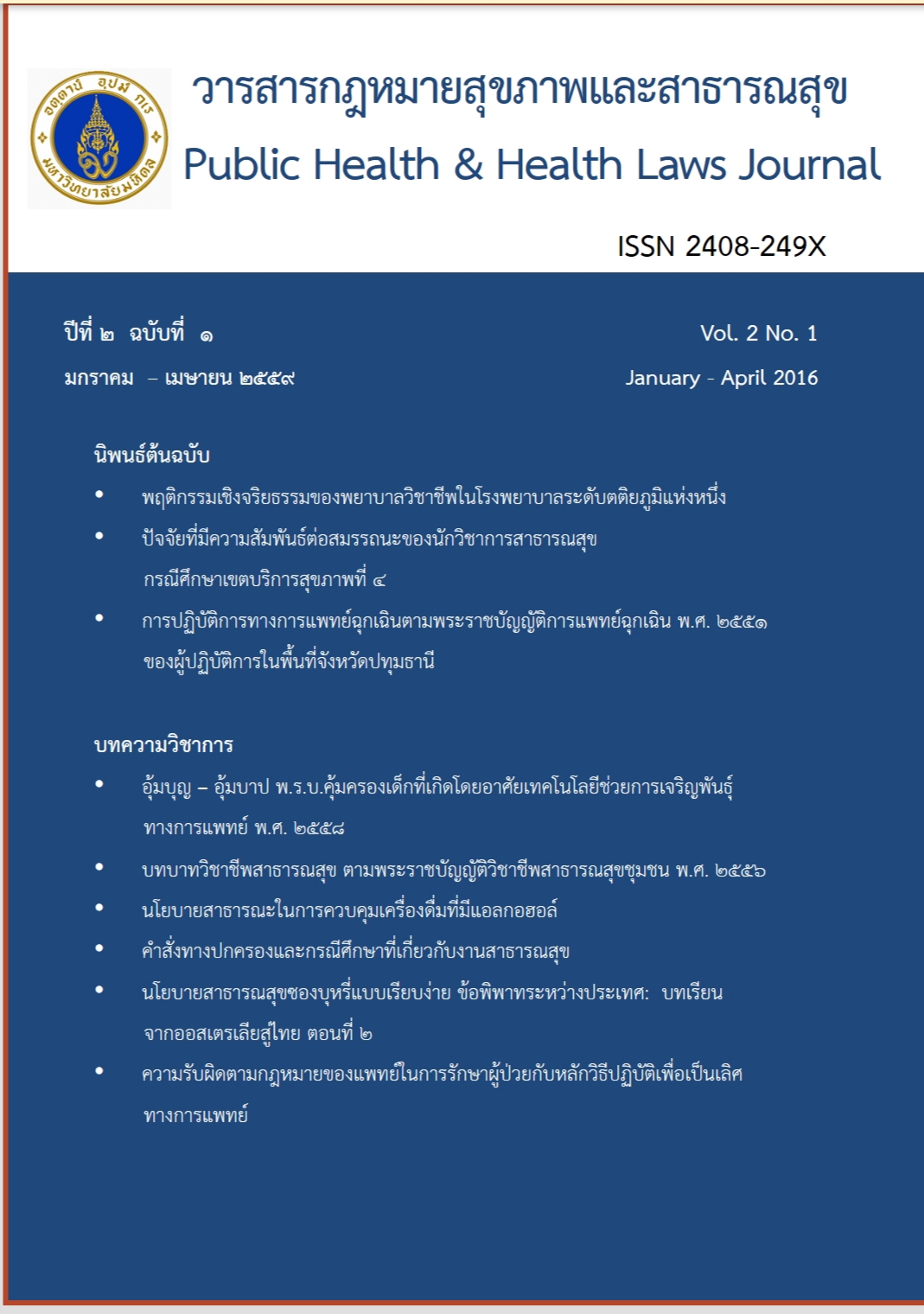
Factors associated with the competency of public health technical officers : A case study of regional service provider 4
Keywords:
Competency of public health technical officer, leadership, motivationAbstract
This descriptive research aimed to study the factors associated with the competency of Public health technical officer as a case study of Regional Service Provider 4. The samples were 352 PH technical officers selected through a three-stage random sampling. Data were collected through a self-administered questionnaire from January-March 2015 and were analyzed by frequency distribution, percentage, mean, standard deviation, Pearson’s correlation coefficient, and stepwise multiple regression analysis. Demographic data : Fifty six point eight (56.8%) of the participants were female, 44.6% were aged 41-50 years, 69.6% held a marital status as living together with spouse, 84.9% held a bachelor degree, and 84.4% held a position in their professional level. The scores of most participants (87.2%) for the overall capacity were in a high level. Considering each component of the competency separately; the scores on the parts of achievement motivation, service mind, expertise, integrity, teamwork, critical thinking and interpersonal skill were in a high level. The leadership factor and the motivation factor had a moderate level of positive correlation with the competency of public health technical officer at the level of statistical significance of 0.001 (r=0.683, p-value<0.001; r=0.390, p-value<0.001 respectively). Three variations that could work together to predict the competency of public health technical officers in the case study of Regional Service Provider 4 included the marital status, the leadership factor and the motivation factor; and they could predict such competency as correctly as 48.9%. The study suggests that authorities concerned could use these findings in making a strategic plan for the development of their human resources, encouraging them to actively improve their competency.
References
จิริสุดา บัวผัน. (2554). ปัจจัยที่มีอิทธิพลต่อการปฏิบัติงานตามสมรรถนะหลักของทันตแพทย์ในโรงพยาบาลชุมชนเขตสาธารณสุขที่ 12. วารสารวิจัย มข. 6(6) กรกฎาคม-สิงหาคม.
ฉัตรสุมน พฤฒิภิญโญ. (2554). การบริหารจัดการเพื่อการพัฒนาระบบสุขภาพ. กฎหมายสาธารณสุขและการบังคับใช้. (พิมพ์ครั้งที่ 1) กรุงเทพ ฯ: มหาวิทยาลัยสุโขทัยธรรมธิราช.
นิตยา อินกลิ่นพันธุ์. (2539). ความสัมพันธ์ระหว่างปัจจัยพื้นฐาน ความรู้สึกมีพลังอำนาจในความพึงพอใจในปัจจัยการทำงานกับการรับรู้สมรรถภาพในการปฏิบัติงานของพยาบาลประจำการในปัจจัยการทำงานกับการรับรู้สมรรถภาพในการปฏิบัติงานของพยาบาลประจำโรงพยาบาลชัยนาท. วิทยานิพนธ์หลักสูตรพยาบาลศาสตรมหาบัณฑิต.กรุงเทพฯ:มหาวิทยาลัยมหิดล.
พูลศักดิ์ พุ่มวิเศษ. (2544). ความสัมพันธ์ระหว่างระบบสาธารณสุขกับสังคมเศรษฐกิจและการเมือง. นนทบุรี:โรงพิมพ์มหาวิทยาลัยสุโขทัยธรรมธิราช.
ศันสนีย์ วงม่วย และวิทัศน์ จันทร์โพธิ์ศรี. (2556). แรงจูงใจที่มีผลต่อสมรรถนะประจำกลุ่มงานของนักวิชาการสาธารณสุขที่ปฏิบัติงานในโรงพยาบาลส่งเสริมสุขภาพตำบล จังหวัดเพชรบูรณ์. วารสารวิจัยสาธารณสุขศาสตร์ มหาวิทยาลัยขอนแก่น 6(3). กรกฎาคม-กันยายน.
ศิริญญ์ รุ่งหิรัญ. (2554). ปัจจัยที่มีอิทธิพลต่อสมรรถนะการปฏิบัติงานของพยาบาลวิชาชีพในโรงพยาบาลชุมชน จังหวัดปทุมธานี. วิทยานิพนธ์ปริญญาพยาบาลศาสตรมหาบัณฑิต สาขาวิชาบริหารการพยาบาล คณะพยาบาลศาสตร์, มหาวิทยาลัยอีสเทิร์นเอเชีย.
สานิตย์ เพชรสุวรรณ. (2554). ปัจจัยทำนายสมรรถนะของนักวิชาการสาธารณสุขระดับตำบล. ปริญญาวิทยาศาสตรมหาบัณฑิต สาขาการจัดการระบบสุขภาพ มหาวิทยาลัยทักษิณ. กรุงเทพ ฯ.
สำนักงานกองทุนสนับสนุนการสร้างเสริมสุขภาพ. (2550). การพัฒนาสมรรถนะหลัก (Core Competecies) สำหรับนักวิชาการสาธารณสุขแนวใหม่. แผนงานการพัฒนา
สำนักงานคณะกรรมการข้าราชการพลเรือน. (2553). คู่มือการกำหนดความรู้ ความสามารถ ทักษะ และสมรรถนะสำหรับตำแหน่ง. กรุงเทพ ฯ: บริษัทประชุมช่าง จำกัด.
Downloads
Published
How to Cite
Issue
Section
License
Disclaimer and Copyright Notice
The content and information presented in articles published in the Journal of Law and Public Health Policy represent the opinions and sole responsibility of the respective authors. The editorial board does not necessarily agree with or assume any responsibility for the views expressed.
All articles, data, content, images, and other materials published in the Journal of Law and Public Health Policy are the intellectual property of the journal. Any individual or organization wishing to reproduce, distribute, or otherwise use the entirety or any part of such materials must provide proper citation.



