Interesting judgment: Court injunction Tobacco labelling regulations
Keywords:
injunction by Administrative court, Temporary relief from implementation, enforcement of rules, cigarette graphic health warning picturesAbstract
This article examines provisional measures in administrative litigation through a case study of a Supreme Administrative Court judgment concerning a request for a stay of enforcement of regulations requiring enlarged health warning images on cigarette packages. The case highlights the balance between the protection of private rights and the promotion of public health under administrative law.
Pursuant to Section 66 of the Act on Establishment of Administrative Courts and Administrative Court Procedure B.E. 2542 (1999), provisional measures are intended to preserve the rights and interests of litigants pending final judgment. Clause 72 of the Regulations of the General Assembly of Judges of the Supreme Administrative Court B.E. 2543 (2000) establishes three requirements for granting a stay of enforcement: prima facie unlawfulness of the administrative act, the likelihood of serious and irreparable harm, and the absence of adverse effects on public administration or public services.
The case concerned a Notification of the Ministry of Public Health issued under the Tobacco Products Control Act B.E. 2560 (2017), requiring health warning images to cover 85 percent of cigarette packaging. The Supreme Administrative Court reversed the order of the Administrative Court of First Instance, holding that the Notification was lawful and served the public interest in protecting public health. The judgment demonstrates the application of proportionality, administrative discretion, legal certainty, good governance, and the balancing of public and private interests, reaffirming the Administrative Court’s role in safeguarding both individual rights and public welfare.
References
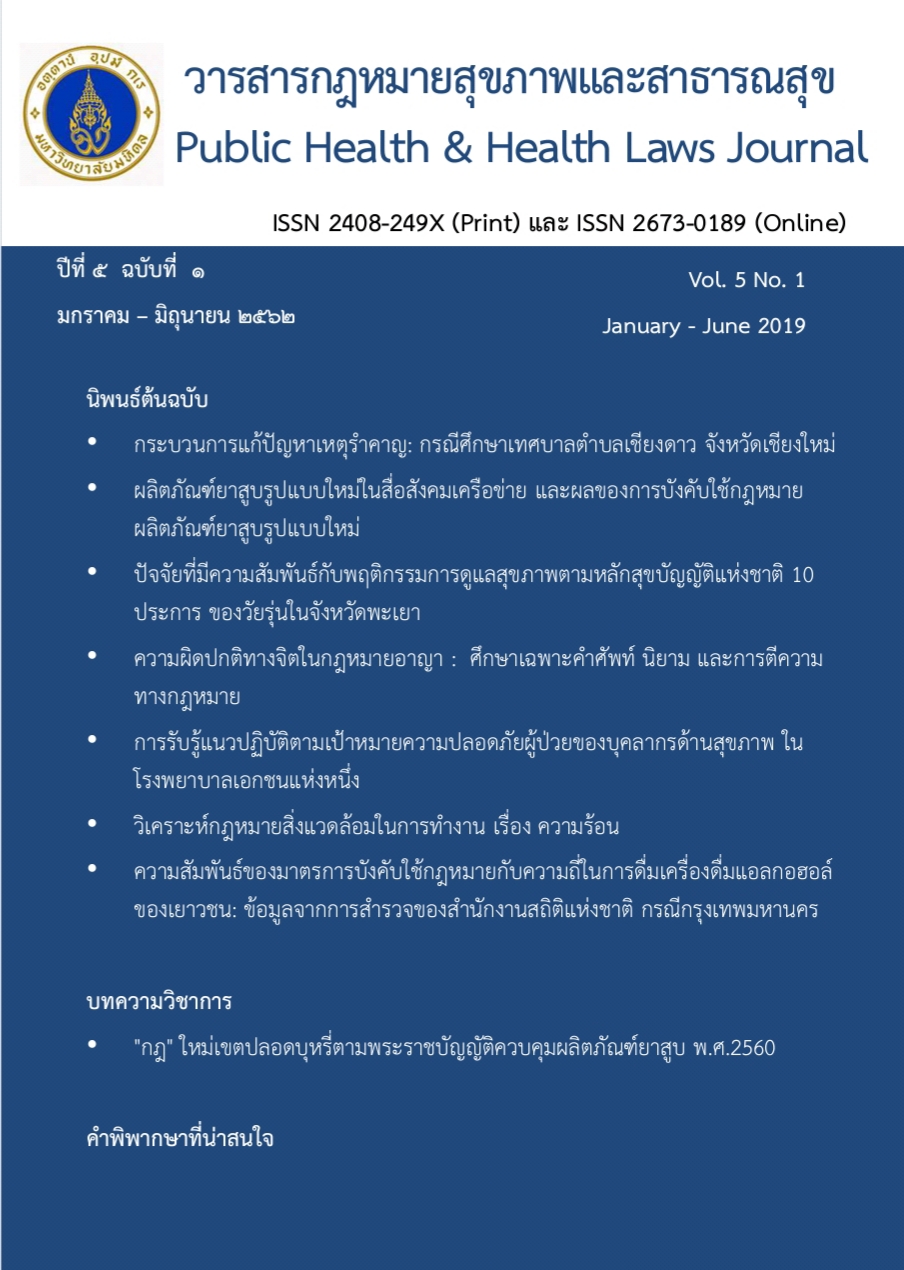
Downloads
Published
How to Cite
Issue
Section
License
Disclaimer and Copyright Notice
The content and information presented in articles published in the Journal of Law and Public Health Policy represent the opinions and sole responsibility of the respective authors. The editorial board does not necessarily agree with or assume any responsibility for the views expressed.
All articles, data, content, images, and other materials published in the Journal of Law and Public Health Policy are the intellectual property of the journal. Any individual or organization wishing to reproduce, distribute, or otherwise use the entirety or any part of such materials must provide proper citation.



