
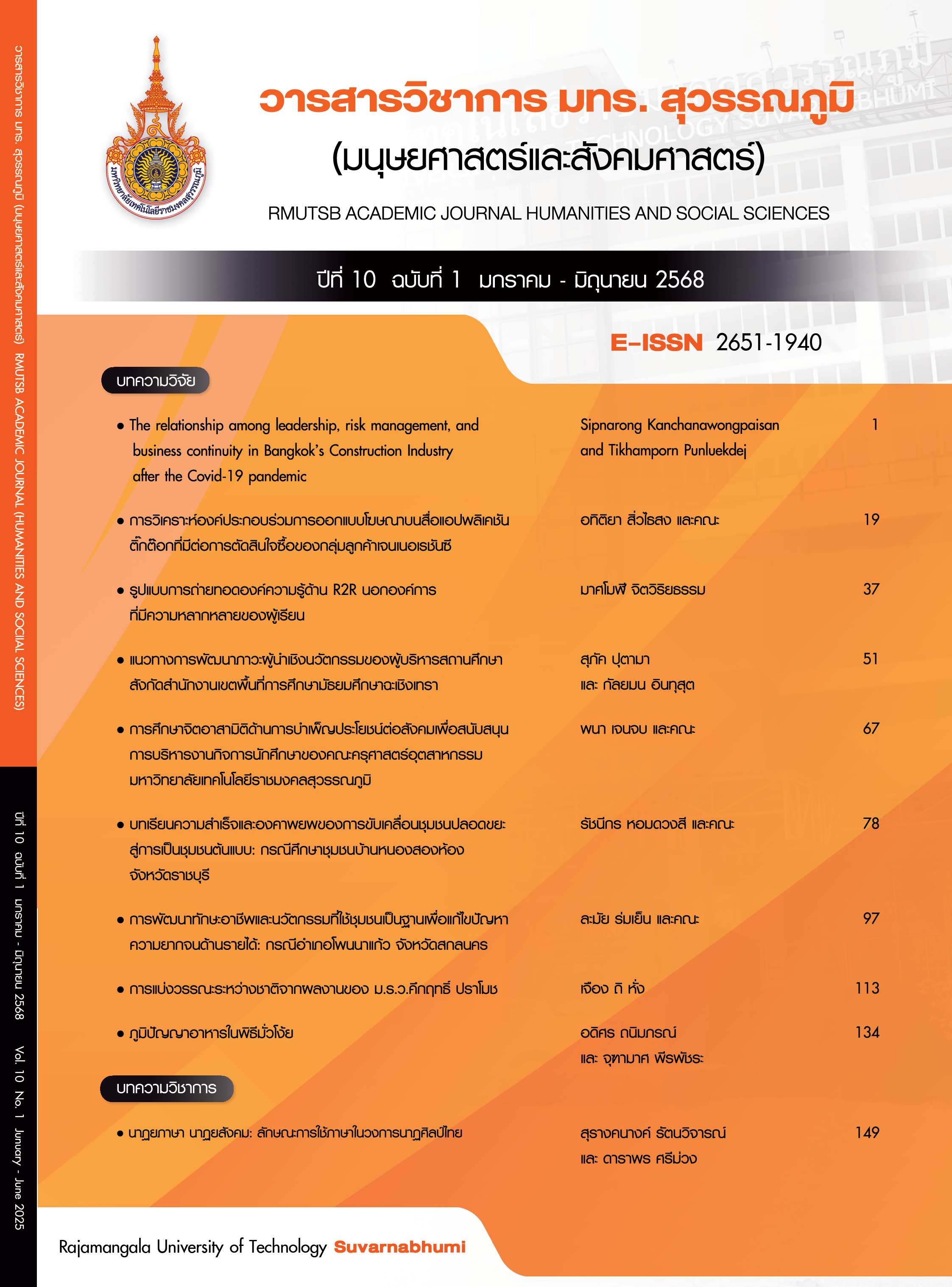
Development of vocational skills and community-based innovation to solve income poverty problems: The case study of Phon Na Kaeo District, Sakon Nakhon Province
Article Sidebar
Main Article Content
Abstract
This research aims to study problems, needs, careers, community-based innovations, and guidelines for implementing solutions to poverty problems in Phon Na Kaeo District Sakon Nakhon Province. It is qualitative research using in-depth interviews. There were 7 target groups and 12 experts focus group discussions from various sectors, including academia, government, private sector, and civil society. The results of the research found that the main problems of the target groups were unstable income, and run-down houses. The needs were stable income, good housing, good health, education, welfare, raising laying hens, and growing medicinal plants. Suitable careers and innovations include integrated agriculture, such as growing herbs, raising laying hens, processing rice, etc. The results of using innovations and appropriate careers show that the target group can reduce household expenses, increase income, and create alternative careers. In this regard, there is coordinated management between the educational sector, the public sector, the private sector, and civil society. It is important to solve the problem of poverty. Suggestions for solving poverty problems include: 1) developing appropriate models and promoting the participation of target groups, 2) supporting funding knowledge technology and resources to develop monitoring and evaluation systems, 3) driving economy according to the Sufficiency Economy Philosophy, 4) developing health, education, and promote strength of mind, 5) promoting the participation of all sectors with the shared goal of reducing household expenses of the poor, increasing their income, and improving their quality of life.
Article Details

This work is licensed under a Creative Commons Attribution-NonCommercial-NoDerivatives 4.0 International License.
References
Arnés, E., Díaz-Ambrona, C. G., Marín-González, O., & Astier, M. (2018). Farmer Field Schools (FFSs): A tool empowering sustainability and food security in peasant farming systems in the Nicaraguan Highlands. Sustainability, 10(9), 3020. DOI:10.3390/su10093020
Assefa, T., & Abay, K. M. (2022). The vicious cycle of poverty and smallholder agriculture: Evidence from Ethiopia. Sustainability, 14(10), 6144.
Creswell, J. W. (2014). Research design: Qualitative, quantitative, and mixed methods approaches (4th ed.). Thousand Oaks, California: SAGE.
Fitriani, A., & Rahmawati, D. (2022). Village-owned enterprises as a strategy for rural development in Indonesia: A case study of the BUMDes Program. International Journal of Development and Sustainability, 11(6), 124-135.
Heckman, J. J., & Kautz, T. (2012). Hard evidence on soft skills. Labour Economics, 19(4), 451-464.
Jaitae, A., Jumkead, D., Saotep, C., & Jaitae, S. (2024). The potential for enhancing the quality of life of children with special needs base on community participation in urban community: A case study of Suthep Sub - district Municipality, Mutanchiang District, Chiangmai Province. RMUTSB Academic Journal (Humanities and Social Sciences), 4(2), 249-259. (in Thai)
Kumar, P., & Parikh, J. (2020). The effectiveness of agricultural policies in supporting smallholder farmers in India. Land Use Policy, 99, 104841.
Lembani, D. K. (2021). The challenges of rural education in Zambia. International Journal for Research in Social Science and Humanities, 7(8), 3-14. DOI: 10.53555/ssh.v7i8.1835
Mulgan, G., Tucker, S., Ali, R., & Sanders, B. (2007). Social Innovation: what it is, why it matters, how it can be accelerated. London: University of Oxford, Young Foundation.
Muñoz-Céspedes, E., Ibar-Alonso, R., & de Lorenzo Ros, S. (2021). Financial literacy and sustainable consumer behavior. Sustainability, 13(16), 9145. DOI: 10.3390/su13169145
Nguyen, T. H., & Le, Q. H. (2020). Vocational training for farmers in Vietnam: Enhancing productivity and income. International Journal of Vocational Education and Training, 22(2), 131-145.
Nguyen, T. H., Sahin, O., & Howes, M. (2021). Climate change adaptation influences and barriers impacting the Asian agricultural industry. Sustainability, 13(13), 7346. DOI:10.3390/su13137346
Office of the National Economic and Social Development Council (NESDC). (2023). Multidimensional poverty index (MPI). Retrieved March 6, 2024, from https://www.tpmap.in.th (in Thai)
Osei-Bonsu, K., & Amponsah, A. (2020). Agricultural education for sustainable development in Ghana: A case study of the farmer training and extension program. International Journal of Education and Development, 12(2), 145-158.
Otieno, D. J., & Otieno, F. A. (2022). The challenges and opportunities of smallholder farmers in accessing markets in Kenya. Heliyon, 9(1), e09184.
Silva, J. M., & Santos, R. D. (2019). Agricultural technology for smallholder farmers' empowerment in Brazil: A case study of the Embrapa Program. Technology in Society, 64, 101372. DOI: 10.1016/j.techsoc.2019.101372
Vaseenonta, C., Kirdmalai, N., Mankhoksoong, P., Sriprom, M., Vongsawat, K., Sanchon, P., Nuengsittha, N., Pukut, P., & Kanbut R. (2024). Creating a model of poverty alleviation policy in political areas, Kut Bak Subdistrict, Kut Bak District, Sakon Nakhon Province. Journal of Management Science, Sakon Nakhon Rajabhat University, 4(1), 13-28. (in Thai)
Westley, F., Zimmerman, B., & Patton, M. Q. (2006). Getting to maybe: How the world is changed. Toronto: Vintage Canada.
