
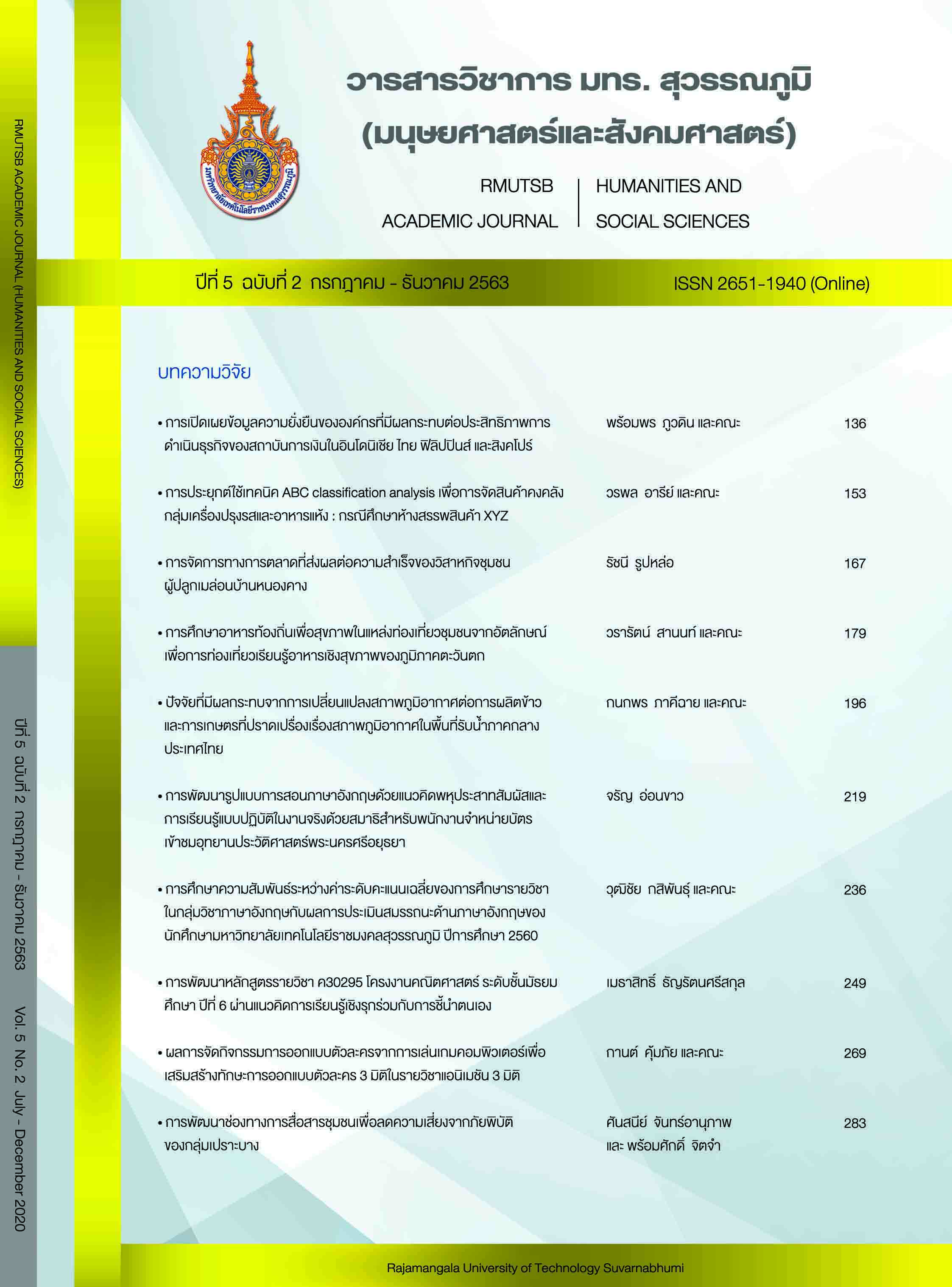
การพัฒนาหลักสูตรรายวิชา ค30295 โครงงานคณิตศาสตร์ ระดับชั้นมัธยมศึกษาปีที่ 6 ผ่านแนวคิดการเรียนรู้เชิงรุกร่วมกับการชี้นำตนเอง
Article Sidebar
Main Article Content
บทคัดย่อ
การวิจัยนี้มีวัตถุประสงค์เพื่อ 1) ศึกษาข้อมูลพื้นฐาน 2) พัฒนาหลักสูตร 3) ทดลองใช้และทดสอบประสิทธิผลของหลักสูตร และ 4) ปรับปรุงหลักสูตรรายวิชา ค30295 โครงงานคณิตศาสตร์ ระดับชั้นมัธยมศึกษาปีที่ 6 ผ่านแนวคิดการเรียนรู้เชิงรุกร่วมกับการชี้นำตนเอง กลุ่มเป้าหมายที่ศึกษา ได้แก่ นักเรียนชั้นมัธยมศึกษาปีที่ 6 ห้อง 1 จำนวน 30 คน ในภาคเรียนที่ 1 ปีการศึกษา 2562 เครื่องมือที่ใช้ในการวิจัย ประกอบด้วย แบบสัมภาษณ์ แบบวิเคราะห์เอกสาร แบบประเมิน แบบทดสอบผลสัมฤทธิ์ และแบบวัดเจตคติ วิเคราะห์ข้อมูลโดยใช้การวิเคราะห์เนื้อหา ค่าร้อยละ ค่าเฉลี่ย ค่าเบี่ยงเบนมาตรฐาน และค่าพัฒนาการสัมพัทธ์
ผลการวิจัยแสดงดังนี้ 1) ผลการศึกษาข้อมูลพื้นฐาน พบว่าครูผู้สอนวิชาคณิตศาสตร์ชั้นมัธยมศึกษาปีที่ 6 และหัวหน้ากลุ่มสาระการเรียนรู้คณิตศาสตร์มีความเห็นสอดคล้องกันและต้องการให้พัฒนาหลักสูตรรายวิชา ค30295 โครงงานคณิตศาสตร์ ระดับชั้นมัธยมศึกษาปีที่ 6 2) ผลการพัฒนาหลักสูตร พบว่าหลักสูตรรายวิชา ค30295 โครงงานคณิตศาสตร์ ระดับชั้นมัธยมศึกษาปีที่ 6 ผ่านแนวคิดการเรียนรู้เชิงรุกร่วมกับการชี้นำตนเอง มีองค์ประกอบที่สำคัญจำนวน 6 องค์ประกอบ ได้แก่ 2.1) หลักการ 2.2) วัตถุประสงค์ 2.3) สาระการเรียนรู้ 2.4) กระบวนการ 2.5) สื่อการเรียนรู้ และ 2.6) การวัดและการประเมินผล 3) ผลการทดลองใช้และทดสอบประสิทธิผลของหลักสูตร พบว่าผลสัมฤทธิ์ทางการเรียน การเรียนรู้แบบชี้นำตนเองและเจตคติทางคณิตศาสตร์ของนักเรียนหลังได้รับการจัดการเรียนรู้ตามหลักสูตรสูงกว่าก่อนได้รับการจัดการเรียนรู้ และ 4) ผลการปรับปรุงหลักสูตร พบว่าหลักสูตรมีข้อควรปรับปรุงด้านสาระการเรียนรู้ ด้านกระบวนการ และด้านสื่อการเรียนรู้
Article Details
เอกสารอ้างอิง
Beauchamp, C. (1981). A curriculum theory. Boston: Peacock.
Candy, P. C. (1991). Self-directed for lifelong learning: a comprehensive guide to theory and practice. San Francisco: Jossey-Bass.
Chaleerat, D., Thongpae, W., & Chaloeywares, N. (2015). Development of a training curriculum on basic mathematics knowledge in English language for Matthayomsuksa 1 students of international standard school. Journal of Education Naresuan University, 17(3), 100-108. (in Thai)
Charoenchim, S., Chatiya, T., Charoenchim, S., & Samakratkit, U. (2012). Self-directed learning ability of pre-service teacher faculty of education and development sciences Kasetsart University (research report). Nakhon Pathom: Kasetsart University. (in Thai)
Chomephulong, N. (2002). Local curriculum development and institution curriculum preparation. Maha Sarakham: Aphichat Printing. (in Thai)
Chukamphaeng, C. (2016). Curriculum research and development: concepts and processes. Bangkok: Chulalongkorn University press. (in Thai)
Dechakhup, P., & Yindesuk, P. (2018). Collaborative learning with PLC for development. Bangkok: Chulalongkorn University press. (in Thai)
Fedler, R. M., & Brent, R. (1996). Navigating the bumpy road to student-centered instruction, College Teaching, 44(2), 43-47.
Garrison, D. R. (1997). Self-directed learning: toward a comprehensive model. Adult Education Quarterly, 1(48), 16-18.
Griffin, C. (1983). Curriculum theory in adult lifelong education. London: Croom Helm.
Guglielmino, L. M. (1977). Development of the self-directed learning readiness scale (Doctoral dissertation). University of Georgia, Georgia.
Hiranoon, J. (2019). The development of training curriculum to enhance ability in creative industrial engineering curriculum development. RMUTSB Acad. J. (Humanities and Social Sciences), 4(1), 105-114. (in Thai)
Hopkins, C. D., & Antes, R. L. (1985). Classroom measurement and evaluation. New York: Peacock.
Institute for the Promotion of Teaching Science and Technology. (2003). Handbook of mathematics learning substance. Bangkok: Kurusapa Publishing House, Lat Phrao. (in Thai)
Intalapaporn, C., Patphol, M., Wongyai, W., & Pumsaard, S. (2015). Development of training curriculum to enhance the ability of STEM education learning management for primary school teachers. Veridian E-Journal, Silpakorn University, 8(2), 714-736. (in Thai)
Isoda, M., & Katagiri, S. (2012). Mathematical thinking: how to develop it in the classroom. Singapore: World Scientific.
Kanjanawasi, S. (2014). Traditional test theory. Bangkok: Chulalongkorn University press. (in Thai)
Knowles, M. S. (1975). Self-directed learning: a guide for learners and teacher. Chicago: Association Press.
Kusol, K., & Samienpetch, T. (2015). Self-directed learning ability as learning outcomes of problem-based learning of Walailak University Nursing Students. Journal of Nursing and Education, 8(3), 127-138. (in Thai)
Leelajaraskul, C. (1999). Mathematics camp package for development of mathematics camp activities. Bangkok: Institute for Academic Quality Development. (in Thai)
Meyers, C., & Jones, T. B. (1993). Promoting active learning: strategies for the college classroom. San Francisco, CA: Jossey-Bass Inc.
Ngaorangsi, K. (2017). Learning to be Thailand 4.0. In A Proceedings of academic conference of the teachers council of Thailand for the year 2017 (pp. 19-29). Bangkok: Office of the Teachers Council of Thailand. (in Thai)
Nilphan, M. (2011). Educational research methodology. Nakhon Pathom: Silpakorn University Printing House. (in Thai)
Nueangchaloem, P. (2013). Teaching and learning research Bangkok: Chulalongkorn University press. (in Thai)
Office of the Prime Minister. (2016). The 12th national economic and social development plan (2017-2021). Bangkok: Office of the Prime Minister. (in Thai)
Pharuetthikun, S. (2015). Learning management with active learning. Retrieved 17 May 2019, from http://km.buu.ac.th/article/frontend/article_detail/141 (in Thai)
Phasuk, P., Semheng, S., & Rakphoa, L. (2012). A Study of some factors affecting to self-directed learning readiness of Suan Dusit Rajabhat university students. Journal of Educational Evaluation Maha Sarakham University, 17(1), 143-160. (in Thai)
Rogers, C. R. (1969). Freedom to learn. Ohio: Charles E. Merrill Publishing.
Saiyot, L., & Saiyot, A. (1995). Educational research techniques. Bangkok: Children Club. (in Thai)
Saiyot, L., & Saiyot, A. (2000). Techniques for measuring learning. Bangkok: Children Club. (in Thai)
Sangthong, P. (2018). Developing learning achievement and teamwork skill by project based learning integrating with online learning of information technology 6 subject for Matayomsuksa 6 students. RMUTSB Acad. J. (Humannities and Social Sciences), 3(1), 14-29. (in Thai)
Saweangsri, B. (2016). The results of using mathematics teaching activities to promote learning achievement of undergraduate students (research report). Phranakhon Si Ayutthaya: Rajamangala University of Technology Suvarnabhumi. (in Thai)
Saylor, J. G., & Alexander, W. M. (1974). Planning curriculum for schools. New York: Holt, Rinehart and Winston.
Sinlarat, P. (2017). Need to change to a new paradigm: Thai teachers can teach children 4.0 to be effective. In A Proceedings of academic conference of the teachers council of Thailand for the year 2017 (pp. 3-18). Bangkok: Office of the Teachers Council of Thailand. (in Thai)
Smith, B. O., Stanley, W. O., & Shores, J. H. (1976). Fundamentals of curriculum. New York: World Book.
Sujjanan, J. (2010). Education and community development in the 21st century. Bangkok: Odeon Store. (in Thai)
Taba, H. (1962). Curriculum development: theory and practice. New York: Harcourt, Brace and World Nic.
Tough, A. (1971). The adult’s learning projects. Belmont California: Wadsworth.
Traimongkhonkun, P. (2012). Research design. Bangkok: Kasetsart University Press. (in Thai)
Tyler, R. W. (1949). Basic principles of curriculum and instruction. Chicago: University of Chicago Press.
Wananam, P. (2016). The study of mathematics projects and local knowledge to enhance student’s achievement. RMUTSB Acad. J. (Humanities and Social Sciences), 1(2), 191-201. (in Thai)
Wiangwalai, S. (2013). Learning management. Bangkok: Odeon Store. (in Thai)
Wiboonsri, Y. R. (2010). Measuring and creating achievement tests. Bangkok: Chulalongkorn University press. (in Thai)
Wongsuwan, S. (1999). Learning for the 21st century, construction based learning “Project". Bangkok: Curriculum Development Center of Ministry of Education. (in Thai)
