
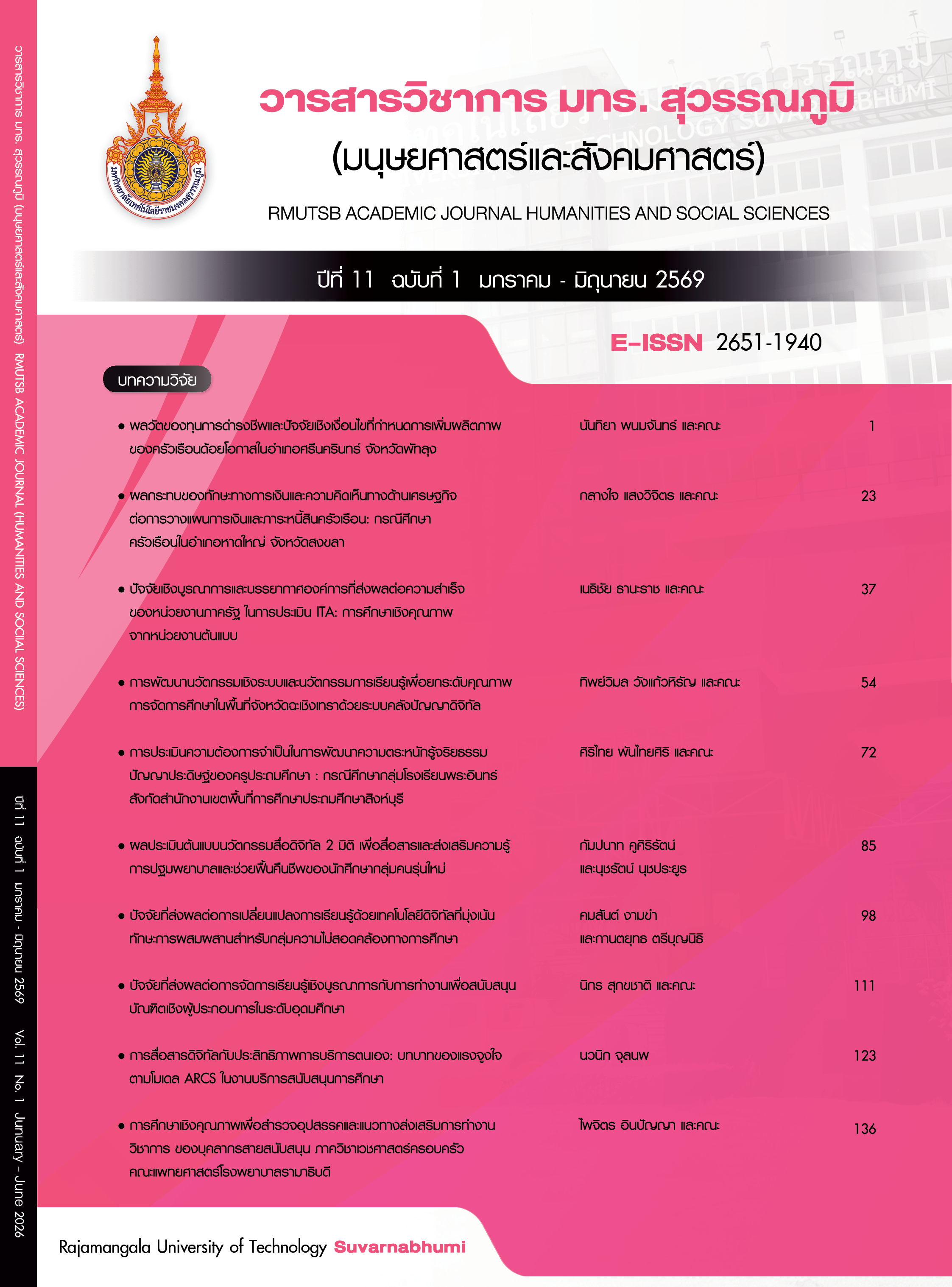
การสื่อสารดิจิทัลกับประสิทธิภาพการบริการตนเอง: บทบาทของแรงจูงใจ ตามโมเดล ARCS ในงานบริการสนับสนุนการศึกษา
Article Sidebar
Main Article Content
บทคัดย่อ
การวิจัยครั้งนี้มีวัตถุประสงค์ 1) เพื่อศึกษาระดับการรับรู้ของนักศึกษาใหม่ที่มีต่อการสื่อสารดิจิทัลตามโมเดล ARCS และ 2) เพื่อศึกษาอิทธิพลของการสื่อสารดิจิทัลตามโมเดล ARCS ที่มีต่อประสิทธิภาพการใช้บริการด้วยตนเองของนักศึกษาใหม่ การวิจัยนี้เป็นการวิจัยเชิงปริมาณด้วยวิธีสำรวจกลุ่มตัวอย่างคือนักศึกษาระดับปริญญาตรี ชั้นปีที่ 1 มหาวิทยาลัยสงขลานครินทร์ วิทยาเขตหาดใหญ่ ปีการศึกษา 2568 จำนวน 558 คน ซึ่งได้มาจากการเลือกแบบสะดวก เครื่องมือที่ใช้ในการเก็บรวบรวมข้อมูลคือแบบสอบถามออนไลน์ที่ผ่านการตรวจสอบความตรงเชิงเนื้อหาและมีค่าความเชื่อมั่นอยู่ในเกณฑ์ดี สถิติที่ใช้ในการวิเคราะห์ข้อมูล ได้แก่ สถิติเชิงพรรณนาและการวิเคราะห์การถดถอยพหุคูณ (multiple linear regression)
ผลการวิจัยพบว่า นักศึกษาใหม่มีระดับการรับรู้ต่อการสื่อสารดิจิทัลตามโมเดล ARCS โดยรวมอยู่ในระดับมาก และมีระดับประสิทธิภาพการใช้บริการด้วยตนเองอยู่ในระดับมากเช่นเดียวกัน ผลการวิเคราะห์อิทธิพลพบว่า องค์ประกอบการสื่อสารดิจิทัลตามโมเดล ARCS ทั้ง 4 ด้าน สามารถร่วมกันพยากรณ์และอธิบายความแปรปรวนของประสิทธิภาพการใช้บริการด้วยตนเองได้อย่างมีนัยสำคัญทางสถิติที่ระดับ .05 (ร้อยละ 75.7) โดยองค์ประกอบด้านความมั่นใจ (confidence) มีอิทธิพลต่อประสิทธิภาพการใช้บริการสูงที่สุด รองลงมาคือ ด้านความพึงพอใจ (satisfaction) ด้านความเกี่ยวข้อง (relevance) และด้านความสนใจ (attention) ตามลำดับ สะท้อนให้เห็นว่าการออกแบบการสื่อสารดิจิทัลที่มุ่งเน้นการสร้างความมั่นใจตามหลักจิตวิทยาของโมเดล ARCS มีบทบาทสำคัญยิ่งต่อความสำเร็จของการดำเนินงานระบบบริการตนเอง (self-service) องค์ความรู้ที่ได้จากการวิจัยครั้งนี้สามารถนำไปประยุกต์ใช้เป็นนวัตกรรมการสื่อสารเชิงรุกเพื่อยกระดับคุณภาพการให้บริการสาธารณะ และพัฒนาประสบการณ์ของผู้รับบริการในสถาบันอุดมศึกษายุคดิจิทัลได้อย่างยั่งยืน
Article Details

อนุญาตภายใต้เงื่อนไข Creative Commons Attribution-NonCommercial-NoDerivatives 4.0 International License.
เอกสารอ้างอิง
Bandura, A. (1997). Self-efficacy: The exercise of control. W H Freeman/Times Books/ Henry Holt & Co.
Charoenchaiya, C., & Wijijammaree, N. (2025). Influences of internal digital communication on promoting work driving forces among Generation Y and Z employees. Journal of Social Science Development, 8(5), 365-376. https://so07.tci-thaijo.org/index.php/JSSD/article/view/7953 (in Thai)
Fang, X., Ng, D. T. K., Leung, J. K. L., & Xu, H. (2024). The applications of the ARCS model in instructional design, theoretical framework, and measurement tool: A systematic review of empirical studies. Interactive Learning Environments, 32(10), 5919-5946. https://doi.org/10.1080/10494820.2023.2240867
Jingjit, S. (2025). The effectiveness of interactive infographics based on the health belief model on knowledge and dengue prevention behaviors among working-age adults. Academic Journal for Primary Care and Public Health Development, 3(1), 124-140. https://he03.tci-thaijo.org/index.php/AJHSD/article/view/4228 (in Thai)
Keller, J. M. (2010). Motivational design for learning and performance: The ARCS model approach. Springer. https://doi.org/10.1007/978-1-4419-1250-3
Kim, H. S., & Choi, B. (2025). The power of customer-to-customer self-service technology in enhancing customer-to-customer interactions. European Journal of Marketing, 59(1), 157-181. https://doi.org/10.1108/EJM-06-2023-0504
Lekudakorn, J. (2025). Public service in the digital age: Adapting government agencies to modernization. Journal of Public Administration and Local Innovation Buriram Rajabhat University, 3(1), 26-39. https://so17.tci-thaijo.org/index.php/JPALI_BRU/article/view/1022 (in Thai)
Loorbach, N., Peters, O., Karreman, J., & Steehouder, M. (2015). Validation of the instructional materials motivation survey (IMMS) in a self-directed instructional setting aimed at working with technology. British Journal of Educational Technology, 46(1), 204-218. https://doi.org/10.1111/bjet.12138
Ma, L., & Lee, C. S. (2021). Evaluating the effectiveness of blended learning using the ARCS model. Journal of Computer Assisted Learning, 37(5), 1397-1408. https://doi.org/10.1111/jcal.12579
Mairieng, N., & Chanchonyut, U. (2025). Production of motion graphic video media to provide knowledge about income generation from cactus. Arts of Management Journal, 9(3), 304-320. https://so02.tci-thaijo.org/index.php/jam/article/view/278221 (in Thai)
Parasuraman, A., Zeithaml, V. A., & Malhotra, A. (2005). E-S-QUAL: A multiple-item scale for assessing electronic service quality. Journal of Service Research, 7(3), 213-233. https://doi.org/10.1177/1094670504271156
Payapitaksakul, O. (2025). Transitioning to digital government: The future of Thai public services. Academic Graduate Journal, 3(4), 92-100. https://so18.tci-thaijo.org/index.php/A_GJ/article/view/1508 (in Thai)
Rakisarakul, T., Pijukkana, K., & Pigunthong, P. (2024). Development of digital media on social networks for public relations and promotion of sales of OTOP Nawatwithi community tourism products, Bang Sao Thong Subdistrict, Bang Sao Thong District, Samut Prakan. Journal of Mass Communication Technology, RMUTP, 9(1), 17-38. https://so05.tci-thaijo.org/index.php/jmctrmutp/article/view/269315 (in Thai)
Sangsawang, A., Daengmak, S., & Asampinpongs, V. (2025). Multimedia development to promote cultural tourism in Phra Nakhon District, Bangkok. Journal of Engineering and Industrial Technology, Kalasin University, 3(2), 56-71. https://doi.org/10.14456/jeit.2025.10 (in Thai)
Stan, V., Baltas, G., & Pourot-Feenstra, F. (2026). Self-service technologies in retail stores: How phygital retailing creates customer value and drives choice confidence. Information Technology & People, 39(1), 354-374. https://doi.org/10.1108/ITP-09-2022-0678
Wahyuni, I. N., Sariyatun, S., Muchtarom, M., & Alhakimi, H. (2025). Development of an interactive e-book based on the ARCS model to improve students’ Arabic writing skills. Al Bayan: Jurnal Jurusan Pendidikan Bahasa Arab, 17(1), 255-275. https://doi.org/10.24042/zc99y484
Yenyuak, C. (2025). Creative media for education of education personal. TMF Journal, 4(2), 1-25. https://so04.tci-thaijo.org/index.php/tmfjournal/article/view/275093 (in Thai)
Zaitouni, M., & Murphy, K. S. (2025). Self-Service Technologies (SST) in the U.S. restaurant industry: An evaluation of consumer perceived value, satisfaction, and continuance intentions. Journal of Foodservice Business Research, 28(2), 245-276. https://doi.org/10.1080/15378020.2023.2229582
