
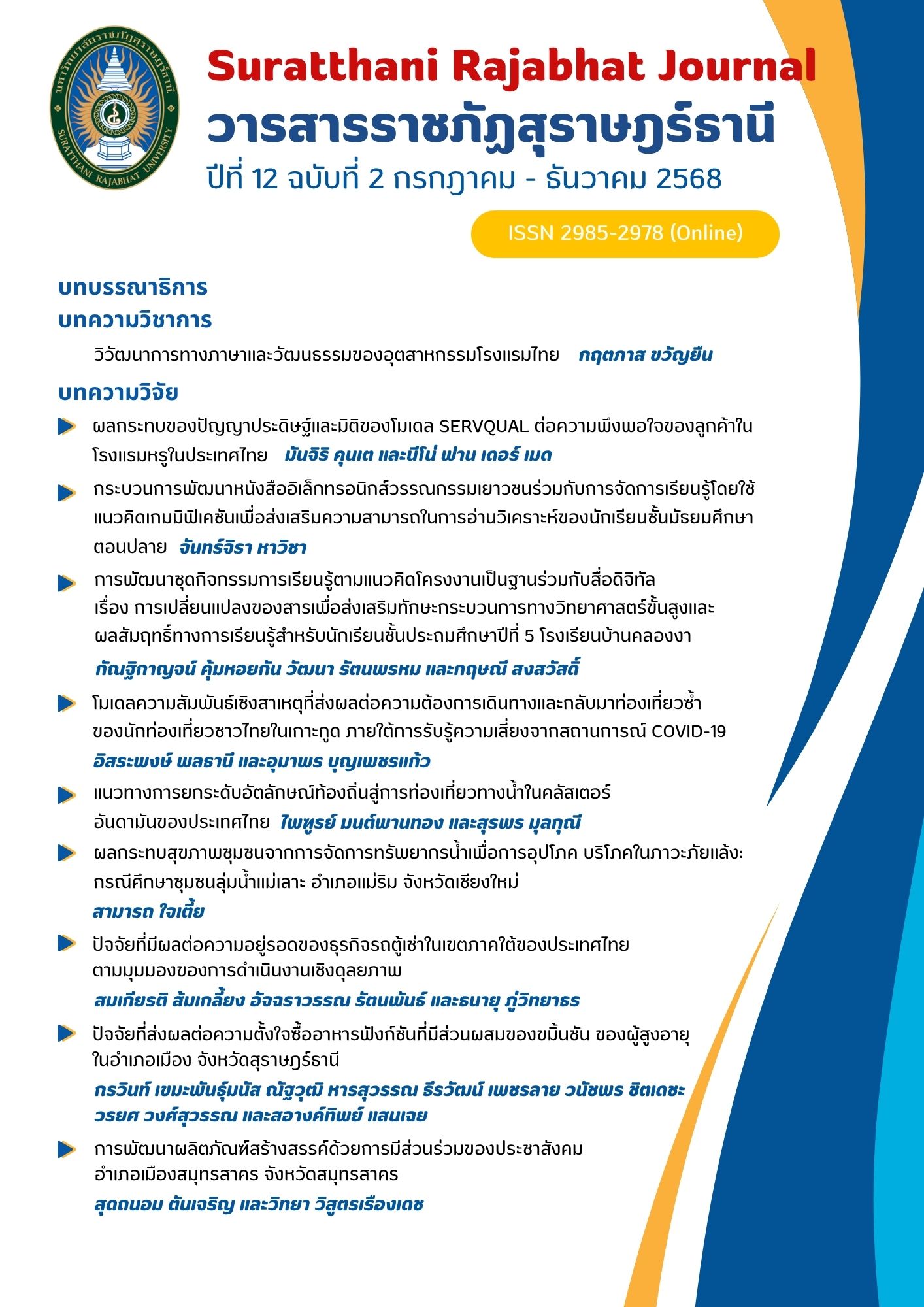
Linguistic and Cultural Evolution of the Thai Hotel Industry
Article Sidebar
Main Article Content
Abstract
This study explored the intersection of language, culture, and hospitality. By tracing the historical and linguistic evolution of the term “hotel” from its origins to its current Thai adaptation “โรงแรม” (roong-rɛɛm), the study examined the cultural significance within Thai hospitality. The study employed a multidisciplinary approach, combining historical analysis, linguistic study, and cultural exploration to reveal the unique characteristics of Thai hospitality, represented by the concept of “น้ำใจ” (náam jai), which symbolizes generosity and warmth. The findings provided valuable insights into the influence of cultural heritage on contemporary hospitality practices, emphasizing the potential for utilizing “Thainess” to create distinctive and memorable guest experiences and service offering in Thailand’s competitive hotel industry
Article Details

This work is licensed under a Creative Commons Attribution-NonCommercial-NoDerivatives 4.0 International License.
References
Angelo, R. M., & Vladimir, A. (2011). Hospitality Today: An Introduction (7th ed.). American Hotel & Lodging Association, Educational Institute.
Boonnak, R. (2020). Jaak "Ong Nam Jai" Samrub Nakderntang Phu Krahaai Suu "Tu Pan Sook" Samrub Pi Nong Phu Kadson!! [From the “Hospitality Jar” for travellers who are thirsty to the “Shared Happiness Cupboard”]. Manager Online. https://mgronline.Com/onlinesection/detail/9630000062502
Chon, K. (2019). Hospitality in Asia: A new paradigm. Routledge.
Chon, K. S., & Maier, T. A. (2021). Welcome to Hospitality: An Asian Perspective (1st ed.). Cengage.
Choovan, T. (2014). Raan Kafae Boran Paktai Nai Pajuban: Ruengrao Lomhaijai Lae Kwam Tatai Jaak Mum Nueng Khong Hat Yai [Ancient southern coffee shop at present: story, breath, and challenges from one corner of Hat Yai]. Rusamilae, 35(3), 37-48.
Christou, P.A. (2022). The History and Evolution of Tourism. CABI.
Coggen, P. (2020). More: The 10,000-Year Rise of the World Economy. Economist Books.
Dabphet, S. (2020). A search for Thai hospitality dimensions in hospitality and tourism industry. Journal of community Development Research (Humanities and Social Sciences), 13(2), 42-54. https://www.journal.nu.ac.th/JCDR/article/view/Vol-13-No-2-2020-42-54/1679
Fakfare, P., Talawanich, S., Pongwat, A., & Chon, K. S. (2019). Asianness in hospitality: the case of luxury hotels in Bangkok, Thailand. ASEAN Journal of Management & Innovation, 6(2), 77 - 92. https://doi.org/10.14456/ajmi.2019.22
Greenia, G. D. (2018). What is Pilgrimage?. International of Religious Tourism and Pilgrimage, 6(2), 7-15. https://arrow.tudublin.ie/ijrtp/vol6/iss2/3
Holloway, J.C. & Humphreys, C. (2022). The Business of Tourism (12th ed.). SAGE.
Intathep, L. (2014, January 6). Clay pot hospitality. Bangkok Post. https://www. bangkokpost.com/life/social-and-lifestyle/388140/clay-pot-hospitality
Jaroensook, A. (2022). Lak Karn Damnern Ngarn Rong Ram [Hotel Operation]. SE-ED.
Jensen, R. M. (2020). Chapter 6 Housing Pilgrims in Late Antiquity: Patrons, Buildings, and Services. In Collar, A. & Kristensen, T.M. (Eds.), Pilgrimage and Economy in the Ancient Mediterranean. (pp. 140-159). BRILL.
Kasivivat, S. (2018). Tourism Experience design. Seminar in tourism experience design. Institute of Development Administration, Bangkok, Thailand.
Kavises, J. (2020). Turakit Rong Ram [Hotel Business]. MACeducation.
Khan, I., Garg, R. J., & Rahman, Z. (2015). Customer service experience in hotel operations: An empirical analysis. Procedia - Social and Behavioral Sciences, 189, 266-274. https://doi.org/10.1016/j.sbspro.2015.03.222
Khanalizadeh, B. & Ranjandish, N. (2019). Exploring the effects of hotel development, economic growth and exchange rate on tourism industry: evidence for Iran. A Journal of Economic and Social Research, 5(1), 81-96. https://doi.org/10.32728/ric.2019.51/4
Kongpolphrom, W. (2018). Thainess realisation in selected travel websites. Journal of Thai Interdisciplinary Research, 13(4), 63-67. https://ph02.tci-thaijo.org/index.php/jtir/article/view/133513/111692
Laomanacharoen, S. (2019). Kaek Pai Krai Ma: Prawatsart Khong "Kaek" Lae "Jek" Nai Pratat Thai Jaak Nitatsakarn Ngarn Silapa [Kaek Pai Krai Ma: History of “Kaek” and “Jek” in Thailand through the art exhibition]. Matichon Weekly. https://www.matichonweekly.com/ column/article_259400
Li, L. (2019). Origins, changes, and integration: Cross-cultural art between Dali and the Kingdom of Sukhothai. Journal of Literature and Art Studies, 9(12). 1333-1338. https://doi.org/10.17265/2159-5836/2019.12.015
Lundberg, D. E. (1994). The hotel and restaurant business (6th ed.). Van Nostrand Reinhold Company.
Moussa, M., Doumani, T., McMurray, A., Muenjohn, N. & Deng, L. (2022). Western Culture Meets Eastern Culture: The Thailand Context. In: Cross-Cultural Performance Management, pp. 37-51 Palgrave Macmillan, https://doi.org/10.1007/978-3-030-91268-0_3
Nanthapaibool, J. (2013). Karn Rong Ram [Hotel Administration]. SE-ED.
Office of Royal Society of Thailand (ORST). (2011). Royal Institute Dictionary. Dictionary Royal Institute Version B.E. 2554. https://dictionary.orst.go.th/
Pang, J. M. (2020). Adopting “East Asian” cultures and themes in hotel branding: a study of the M. Mandarin. Asia Pacific Journal of Tourism Research, 25(10), 1085-1097.
Piuchan, M. (2023). Creating service with Thai hospitality: What does service providers highlight for hotel service in Thailand?. Journal of Environmental Management and Tourism, 14(8), 3034-3048. https://doi.org/10.14505/jemt.v14.8(72).05
Pookaiyaudom, G. & Tan, N. H. (2020). The Buppaesanniwas phenomenon: “Thainess” and national identity as a film tourism motivation. Journal of Tourism and Cultural Change, 18(4), 497-513. https://doi.org/10.1080/14766825.2019.1667365
Radojevic, T., Stanisic, N., & Stanic, N. (2019). The culture of hospitality: from anecdote to evidence. Annals of Tourism Research, 79, 102789. https://doi.org/10.1016/j.annals.2019.102789
Riedler, F. & Stefanov, N. (2021). The Balkan Route: Historical Transformations from Via Militaris to Autoput. De Gruyter.
Sann, R. & Lai, P-C. (2021). Do expectations towards Thai hospitality differ? The views of English vs Chinese speaking travelers. International Journal of Culture, Tourism and Hospitality Research, 15(1), 43-58. https://doi.org/10.1108/IJCTHR-01-2020-0010
Sookying, F., Sahachartkosi, K., Choihirun, S., Kerd-aon, P., & Intaraprapan, R. (2008). Pasa Thai: Wannakadee Lae Wannakam [Thai language: Literature]. Aksorn Charoen Tat.
Sucher, W., Pusiran, A. K., Dhevabanchachai, N., & Chon, K. S. (2013). The Influences of Asian Cultural Values in the Asian Hospitality Services. In The11th APacCHRIE Conference (pp. 21-24). Macau SAR, China.
Suksutdhi, T., & Boonyanmethaporn, W. (2022). An exploratory factor analysis of Thainess experience-centric service construction for boutique hotel guests. GeoJournal of Tourism and Geosites, 40(1), 96-103. https://doi.org/10.30892/gtg.40111-807
Sundayra, L. (2021). The application of Aisatsu in Japanese hospitality culture. In 5th International Conference on Sustainable Development (ICSD) 2021. (pp. 258-261). Thailand
Sweet, R., Verhoeven, G. & Goldsmith, S. (2017). Beyond the Grand Tour: Northern Metropolises and Early Modern Travel Behaviour. Routledge.
Tahiri, A., Kovaçi, I., Lekiqi, B., & Rexhepi, A. (2021). Tourism and hotel industry: definition, concepts and development – The case of Kosovo. Quality Management, 22(182), 110-115. https://www.researchgate.net/publication/351736008_Tourism_and_Hotel_Industry_Definition_Concepts_and_Development_-_The_Case_of_Kosovo
Zuelow, E. (2015). A history of modern tourism. Bloomsbury Publishing.
