
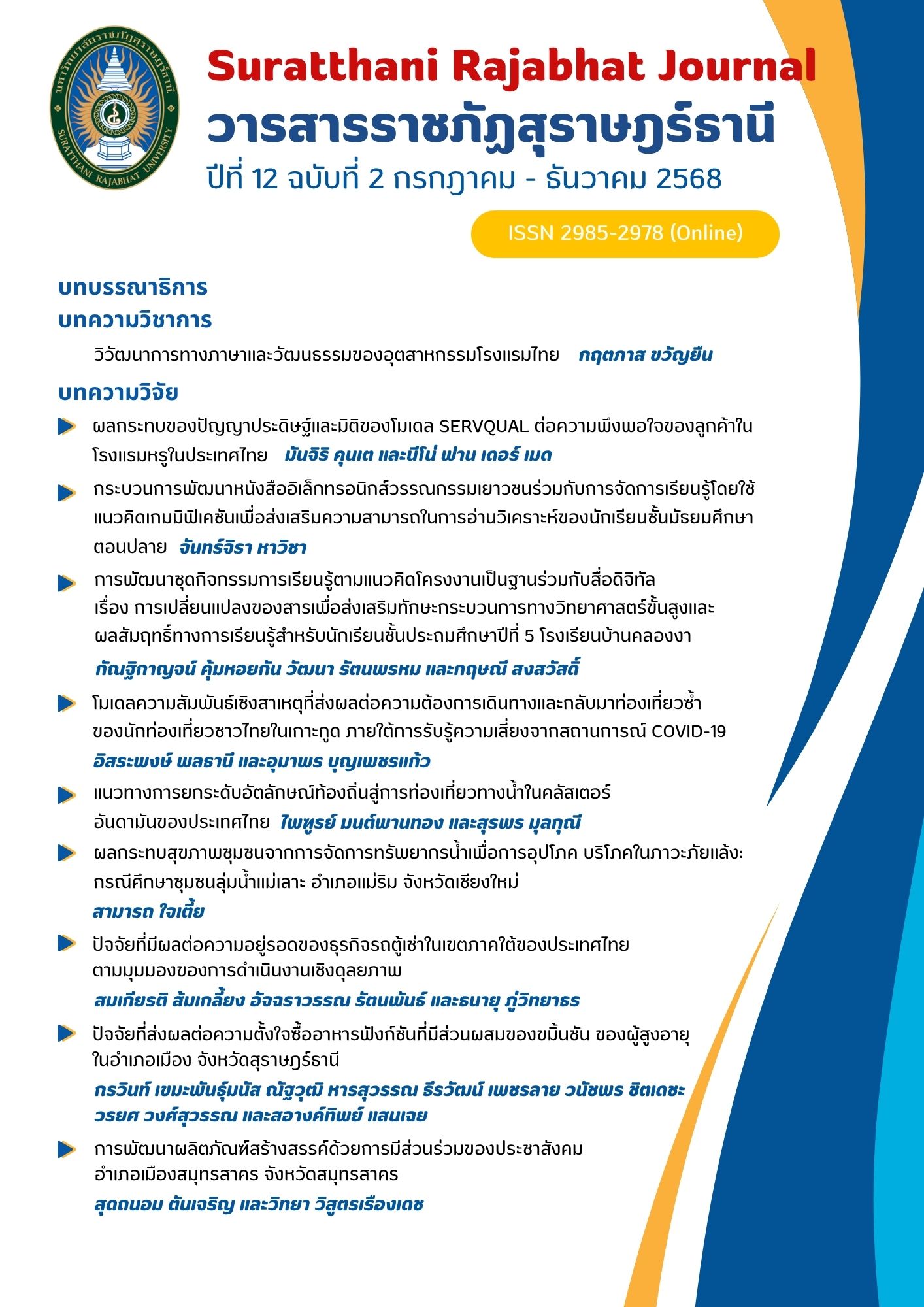
Community Health Impact of Water Supply Management during the Drought: A Case Study in Mae Laoh Watershed, Mae Rim District, Chiang Mai Province
Article Sidebar
Main Article Content
Abstract
The objectives of this research were to: 1) explore the problems related to water supply resources for domestic consumption; 2) analyse community health impacts resulting from water resource management during drought conditions; and 3) synthesize policy recommendations to reduce and prevent community health impacts from water resource management during drought condition through participatory processes. The research sample consisted of 180 residents, and 29 stakeholders. Research instrument included a questionnaire, informal interviews, and a workshop. Descriptive statistics and content analysis were used to analyse the data.
The results revealed that the main river and its tributaries contained low water levels, slow flow, and turbid. Shallow and artesian wells also showed decreased water levels. Regarding the village water supply system, residents expressed that the available water was not clean and insufficient for their needs. Water resource management during drought condition had both negative and positive impacts on community health. Negative impacts were associated with village water supply operations and household water usage needs, while positive impacts were related to participation in water resource management and conservation. Policy recommendations included increasing the number of water supply committees in each village, providing financial support, promoting equality in water use, and improving communication regarding water supply issues for domestic consumption during drought conditions. Moreover, community leaders and responsible organizations should establish cooperation with local educational institutions.
Article Details

This work is licensed under a Creative Commons Attribution-NonCommercial-NoDerivatives 4.0 International License.
References
Alaerts, G.J., & Kaspersma, J.M. (2022). Facing Global Transitions in Water Management: Advances in Knowledge and Capacity Development and Towards Adaptive Approaches. Water Policy, 24(5), 685 – 707. https://doi.org/10.2166/wp.2022.301
Bryan, K., Ward, S., Roberts, L., White, MP., Landeg, O., Taylor, T. & McEwen, L. (2020). The Health and Well - Being Effects of Drought: Assessing Multi - Stakeholder Perspectives Through Narratives from the UK. Climatic Change 163, 2073–2095. https://doi.org/10.1007/s10584-020-02916-x
Bureau of Food and Water Sanitation. (2022). WHO Global water, sanitation, and hygiene Annual report 2022. https://iris.who.int/server/api/core/bitstreams/b49e7ed8-c8b0-450f-acd9-9509a7139926/content
Cameron, C., Ghosh, S. & Eaton, S. (2011). Facilitating Communities in Designing and Using their Own Community Health Impact Assessment Tool. Environmental Impact Assessment Review, 31(4),433 - 437. https://doi.org/10.1016/j.eiar.2010.03.001
Cochran, W.G. (1977). Sampling Techniques. (3nd ed). New York: John Wiley and Sons Inc, 18 – 45.
Choudhary, S. (2021). Community Health and Its Importance. Primary Health Care, 11(2), 365. https://doi.org/10.35248/2167-1079.21.11.365
Cronbach, L.J. (1951). Coefficient Alpha and The Internal Structure of Tests. Psychometrika,16, 297–334. https://doi.org/10.1007/BF02310555
Dilling, L., Prakash, A., Zommers, Z. (2019). Adaptation Success a Flawed Concept?. Nat. Clim. Chang. 9, 572–574. https://doi.org/10.1038/s41558-019-0539-0
Ha , T.V., Ureyen, S. & Kuenzer, C. (2023). Agricultural Drought Conditions Over Mainland Southeast Asia: Spatiotemporal Characteristics Revealed from MODIS-Based Vegetation Time-Series. International Journal of Applied Earth Observation and Geoinformation, 121. https://doi.org/10.1016/j.jag.2023.103378
Julie, D.D. & Michelle H. B. (2000). Capacity Building: Linking Community Experience to Public Policy. Ontario: Population and Public Health Branch Atlantic Region, Health Canada, 6 – 15.
Jaitae, S. (2018). Community Health Impact of Degradation Water Quality and Policy Recommendation: Case Study of Li Watershed, Lamphun Province. Disease Control Journal, 44(1), 1 – 8, (in Thai). https://he01.tci-thaijo.org/index.php/DCJ/article/view/146455/107979
Jaitae, S. & Deethae, A. (2019).Community Health Impact Assessment: Concepts and Applications. Journal of Preventive Medicine Association of Thailand, 9(3), 423 - 433, (in Thai). https://he01.tci-thaijo.org/index.php/JPMAT/article/view/234844/161492
Jaitae, S., Rattanapunya, S. & Junta, J. (2020). River Degradation, Health Impact and Solving Problem base on Cultural Ecology. Phranakhon Rajabhat Research Journal (Science and Technology), 15(2), 18 – 33, (in Thai). https://li01.tci-thaijo.org/index.php/PRRJ_Scitech/article/view/188366/169887
Jaitae, S. & Ratanapanya, S. (2023). Village Water Supply System Management During Drought Conditions in Upper Li Watershed Community, Lamphun Province: Problems, Local Government Organization’s Roles, and Recommendations. Integrated Social Science Journal, Mahidol University, 10(1), 51 – 64, (in Thai). https://doi.org/10.14456/.v10i1
Kasemsuk, C. (2018). Public Participation Approach for Sustainable Community Development. Academic Journal of Humanities and Social Sciences Burapha University, 26(50), 169 -186, (in Thai). https://so06.tci-thaijo.org/index.php/husojournal/article/view/116188/89514
MacAllister, D.J., MacDonald, A.M., Kebede, S., Godfrey, S & Calow, R. (2020). Comparative Performance of Rural Water Supplies during Drought. Nature Communications, 11, 1099. https://doi.org/10.1038/s41467-020-14839-3
Matthew, B.M. & Huberman, A.M. (1994). Qualitative Data Analysis: An Expanded Sourcebook. (2nd ed.). California: SAGE publications, 69 – 104.
Namburi, S. (2019). Participation Theory in Public Administration. The Journal of Research and Academics, 2(1), 183 -197, (in Thai). https://so06.tci-thaijo.org/index.php/jra/article/view/179213/128700
National Integrated Drought Information System. (2023). Drought impacts on water utilities. https://www.drought.gov/sectors/water-utilities
Nummisri, S. (2012). Water Resource Management for Consumption and Water Supply in Yuam Watershed, Mae Hong Son Province. Chiang Mai Research Journal, 13(2), 169–184, (in Thai). https://doi.org/10.14456/rcmrj.2012.96123
Parker, L.J., Becker, K., Carroca, C. (2023). Chatgpt For Automated Writing Evaluation in Scholarly Writing Instruction. Journal of Nursing Education, 62(12), 721-728. https://www.scribd.com/document/745369114/parker-et-al-2023-chatgpt-for-automated-writing-evaluation-in-scholarly-writing-instruction
Prakongsri, P. & Kengchuwong, M. (2016). Lessons of Effective Management of a Hill Water Supply System for Community Use: A Case Study of Huay Nam Sai Community, Ban Janpen, Tambon Janpen ,Amphoe Tao Ngoy,Changwat SakonNakhon, (in Thai). https://www.ubu.ac.th/web/filesup/08f2016082509544248.pdf
Petersen, A., Simpson, D., Loebel, T., Evans, M., Geraci, P., Jankiewicz, S. (2022). Stone Tools and Archaeological Detective Work, Gleaning New Clues from an Old DuPage County Forest Preserve District Collection.Illinois Antiquity, 57(4). https://www.researchgate.net/publication/371910857_Petersen_et_al_2022_Stone_Tools_and_Archaeological_Detective_Work_Gleaning_New_Clues_from_an_Old_DuPage_County_Forest_Preserve_District_Collection
Saluang Subdistrict Administative Organization. (2022). Development Plan 2021 – 2022. (Mimeographed). Saluang Subdistrict Administative Organization. (in Thai).
Semmahasak, S., Atchariyamontree,A. & Semmahasak, C. (2016). The Assessment of Spatial Vulnerability and Its Impacts on Agroecosystem as A Result of Changing Climate in Mae Rim Watershed, Chiang Mai, (in Thai). http://cmruir.cmru.ac.th/handle/123456789/1480
Semmahasak, S., Atchariyamontree, A., Wattanakul, W. & Semmahasak, C. (2022). Farmers’ Adaptation to Climate Change Affecting Agroecosystem in Mae Rim Watershed, Chiang Mai Province.. Journal of Environmental Management, 18(2), 96 – 115, (in Thai). https://doi.org/10.14456/jem.2022.13
Seepeng, R. (2022). Participationon Water Management for Consumption of Nong Pho Sub-district Administrative Organization in Takhli District of Nakhon Sawan Province. Journal of Roi Kaensarn Academi, 7(2), 42 - 55, (in Thai). https://so02.tcithaijo.org/index.php/JRKSA/article/view/252517/171447
Sriwilai, K. (2008). Social Network in Forest Conservation of Mae Laoh Watershed, Saluang Subdistrics, Mae Rim District, Chiang Mai Province. [Unpublished master’s thesis]. Chiang Mai University, (in Thai). http://cmuir.cmu.ac.th/handle/6653943832/14342
Steward, J. H. (1955). Theory of Culture Change: The Methodology of Multilinear Evolution (244 p). Urbana, IL: University of Illinois Press.
Suriyajong, P., Jaitae, S. & Moolphate, S. (2018). Prevalence and Factors Associated with The Occurrence of Diarrhea in Children Under Five Years in Ban Thung Hua Chang, Lamphun Province. Ganesha Journal, 14(1), 17 – 32, (in Thai). https://so01.tci-thaijo.org/index.php/pikanasan/article/view/131523/98688
The Wrold Bank.(2023). Droughts and deficits. https://www.worldbank.org/en/news/immersive-story/2023/09/12/droughts-anddeficits-the-global-impacts
Petersen-Perlman, J.D., Aguilar-Barajas, I. & Megdal, S.B. Drought and Groundwater Management: Interconnections, Challenges,and Policy Responses. Current Opinion in Environmental Science & Health, 28. https://doi.org/10.1016/j.coesh.2022.100364
World Bank Annual Report. (2023). World Bank Annual Report 2023 : A New Era in Development (English). Washington, D.C. : World Bank Group. http://documents.worldbank.org/curated/en/099092823161580577
Yayawong, J. & Wongwatthanaphong, K. (2021). Drought Management Guidelines in The Area of Pong Daeng Sub-district Administrative Organization, Mueang Tak District, Tak Province. Journal of Modern Learning Development, 6(2), 86 – 99, (in Thai).https://so06.tci-thaijo.org/index.php/jomld/article/view/247430/168283
