
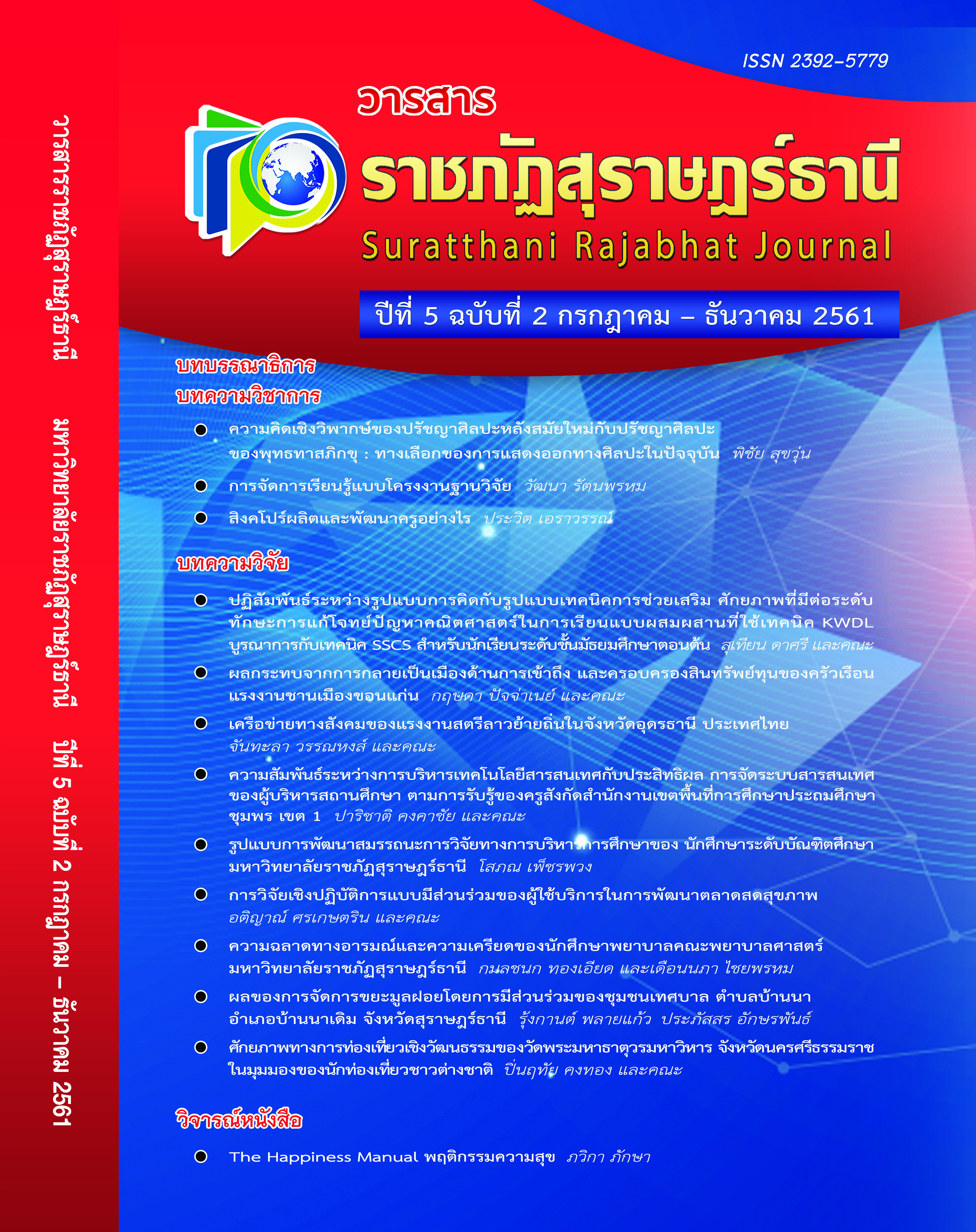
ศักยภาพทางการท่องเที่ยวเชิงวัฒนธรรมของ วัดพระมหาธาตุวรมหาวิหาร จังหวัดนครศรีธรรมราช ในมุมมองของนักท่องเที่ยวชาวต่างชาติ
Article Sidebar
Main Article Content
บทคัดย่อ
การศึกษานี้มีวัตถุประสงค์เพื่อศึกษาศักยภาพทางการท่องเที่ยวเชิงวัฒนธรรมของวัดพระมหาธาตุวรมหาวิหาร จังหวัดนครศรีธรรมราช โดยใช้ระเบียบวิธีวิจัยเชิงปริมาณ เก็บข้อมูลจากนักท่องเที่ยวชาวต่างชาติจำนวน 220 คน โดยใช้วิธีการสุ่มกลุ่มตัวอย่างแบบบังเอิญ (Accidental Sampling) วิเคราะห์ข้อมูลด้วยสถิติเชิงพรรณนา และสถิติเชิงอนุมาน (Inferential Statistics) ในการวิเคราะห์สถิติค่าที (t-test) และ ความแปรปรวนทางเดียว (One-way ANOVA)
ผลการศึกษาพบว่า วัดพระมหาธาตุวรมหาวิหารมีศักยภาพอยู่ในระดับมาก ในด้านสิ่งดึงดูดใจ การเข้าถึง และด้านการอนุรักษ์/ การรักษา ทั้งนี้มีความโดดเด่นเรื่องความมีคุณค่าทางประวัติศาสตร์ มีเอกลักษณ์และความหลากหลายทางวัฒนธรรมแต่ควรพัฒนาด้านสิ่งอำนวยความสะดวกโดยควรจัดให้มีห้องน้ำที่เพียงพอต่อจำนวนนักท่องเที่ยวและมีการรักษาความสะอาดอย่างสม่ำเสมอ ด้านกิจกรรมควรมีการจัดระเบียบและ เพิ่มการอำนวยความสะดวกในการสักการะและบูชาองค์พระบรมธาตุเจดีย์ให้แก่นักท่องเที่ยว และด้านบุคลากรควรพัฒนาเรื่องการสื่อสารภาษาต่างประเทศ ซึ่งทั้งสามด้านนี้ มีศักยภาพอยู่ในระดับปานกลาง ผลการเปรียบเทียบความแตกต่างของนักท่องเที่ยวชาวต่างชาติกับความคิดเห็นที่มีต่อศักยภาพทางการท่องเที่ยวเชิงวัฒนธรรมของ วัดพระมหาธาตุวรมหาวิหาร พบว่า ข้อมูลส่วนบุคคลของนักท่องเที่ยวแตกต่างกัน มีความคิดเห็นต่อศักยภาพทางการท่องเที่ยวเชิงวัฒนธรรมของวัดพระมหาธาตุวรมหาวิหาร ที่แตกต่างกันอย่างมีนัยสำคัญ
Article Details
เอกสารอ้างอิง
กระทรวงการท่องเที่ยวและกีฬา. (2558). ยุทธศาสตร์การท่องเที่ยวไทย 2558-2560. สืบค้นเมื่อวันที่ 15 สิงหาคม 2559, http://www.mots.go.th/ewt_dl_link. php?nid=7114.
การท่องเที่ยวแห่งประเทศไทยสำนักงานนครศรีธรรมราช. (2552). เที่ยวไทยครึกครื้น เศรษฐกิจไทยคึกคัก นครศรีธรรมราช. กรุงเทพฯ : กองผลิตอุปกรณ์เผยแพร่ ฝ่ายบริการการตลาด.
จิรา บัวตอง. (2557). Destination Thailand ดัชนีชี้วัดของประเทศไทยในฐานะจุดหมาย ปลายทางของนักท่องเที่ยว. TAT Tourism Journal, 3(4), 16-25.
จิรานุช โสภา และคณะ. (2554). ศักยภาพการจัดการแหล่งท่องเที่ยวเมืองมรดกโลก ของประเทศไทย กรณีศึกษา: อุทยานประวัติศาสตร์สุโขทัย-ศรีสัชนาลัย- กำแพงเพชรและอุทยานประวัติศาสตร์พระนครศรีอยุธยาเพื่อการท่องเที่ยว เชิงวัฒนธรรมอย่างยั่งยืน. กรุงเทพฯ : มหาวิทยาลัยราชภัฏสวนดุสิต.
ทัศนีย์ นาคเสนีย์ และเกศรา สุกเพชร. (2559). พฤติกรรมของนักท่องเที่ยวชาวไทย ในแหล่งท่องเที่ยวเชิงเกษตรในเขตภาคกลางตอนล่างของไทย. วารสารวิชาการ มหาวิทยาลัยราชภัฏกาญจนบุรี, 5(2), 4-14.
รัญจวน ประวัติเมือง. (2554). ศักยภาพการจัดการการท่องเที่ยวเมืองมรดกโลก : กรณี อุทยานประวัติศาสตร์พระนครศรีอยุธยาและสุโขทัย-ศรีสัชนาลัย-กำแพงเพชร. กรุงเทพฯ : มหาวิทยาลัยราชภัฏสวนดุสิต.
วงศ์ธีรา สุวรรณิน และคณะ. (2557). การศึกษาศักยภาพการท่องเที่ยวเชิงวัฒนธรรมของวัด
ในจังหวัดปทุมธานี. วารสารบัณฑิตศึกษา มหาวิทยาลัยราชภัฏวไลยอลงกรณ์ ในพระบรมราชูปถัมภ์, 8(3), 63-82.
วิรุจ ถิ่นนคร. (2558). แนวทางการปรับปรุงภูมิทัศน์เพื่อส่งเสริมคุณค่าและความสำคัญ ด้านมรดกทางวัฒนธรรม วัดพระมหาธาตุวรมหาวิหาร จังหวัดนครศรีธรรมราช สู่การเสนอชื่อเป็นแหล่งมรดกโลก. วารสารวิชาการ คณะสถาปัตยกรรมศาสตร์ จุฬาลงกรณ์มหาวิทยาลัย, 64, 155-270.
สถาบันบัณฑิตพัฒนบริหารศาสตร์. (2560). ปี 2026 การท่องเที่ยวทำให้เกิดการจ้างงานเพิ่มขึ้น 370 ล้านตำแหน่งงานทั่วโลก. Tourism Review, 3(1), 73.
สุมาลี นันทศิริพล. (2560). ศักยภาพการจัดการบริการผลิตภัณฑ์ทางการท่องเที่ยว เพื่อส่งเสริมการท่องเที่ยวเชิงวัฒนธรรม. วารสารวิจัยราชภัฏพระนคร สาขามนุษยศาสตร์และสังคมศาสตร์, 12(1), 138 - 151.
องค์การบริหารส่วนจังหวัดนครศรีธรรมราช. (2557). แผนพัฒนา 3 ปี 2557-2559. สืบค้นเมื่อวันที่ 20 สิงหาคม 2557, http://www.nakhonsi.go.th/policy/view/54.
Al-Oun, S., & Al-Homoud, M. (2008). The potential for developing community-based tourism among the Bedouins in the Badia of Jordan. Journal of Heritage Tourism, 3(1), 36 - 54.
Arthur, S. N. A., & Mensah, J. V. (2006). Urban management and heritage tourism for sustainable development the case of Elmina cultural heritage and management programme in Ghana. Management of Environmental Quality: An International Journal, 17(3), 299 - 312.
Ben-Dalia, S., Collins-Kreiner, N., & Churchman, A. (2013). Evaluation of an urban tourism destination. Tourism Geographies, 15(2), 233 - 249.
Brezovec, T., & Bruce, D. (2009). Tourism development: issues for historic walled towns. Management, 4(2), 101 - 114.
Burkart, A. J., & Medlik, S. (1974). Tourism - Past, Present, and Future (2nd ed.). London : Heinemann.
Caber, M., Albayrak, T., & Matzler, K. (2012). Classification of the destination
attributes in the content of competitiveness (by revised importance-performance analysis). Journal of Vacation Marketing, 18(1), 43 - 56.
Coolican, H. (2004). Research methods and statistics in psychology. Great Britain : Bookpoint Ltd.
Dickman, S. (1996). Tourism: An introductory text (2nd ed.). Sydney : Hodder Education.
Faul, F., Erdfelder, E., Lang, AG. & Buchner, A. (2007). G*Power 3: A flexible statistical power analysis program for the social, behavioral, and biomedical sciences. Behavior Research Methods, 39, 175 - 191.
Gaffar, V., Wetprasit, P. H. P., & Setiyorini, D. (2011). Comparative study of tourist characteristics on cultural heritage tourism sites: survey of tourist in Indonesia and Thailand heritage sites. Journal of Tourism, Hospitality & Culinary Arts, 3(3), 53 - 68.
Garrod, B., & Fyall, A. (1998). Beyond the rhetoric of sustainable tourism?.
Tourism management, 19(3), 199 - 212.
Hair, J. F., Money, A. H., Samouel, P., & Page, M. (2007). Research methods for business. England : John Wiley & Sons Ltd.
Ivanovic, M., Khunou, R., Pawson, T., Reynish, N., Tseane, L., & Wassung, N. (2009). Fresh perspectives: Tourism Development. Cape Town : Pearson.
Lacher, R. G., Oh, C. O., Jodice, L. W., & Norman, W. C. (2013). The role of heritage and cultural elements in coastal tourism destination preferences a choice modeling–based analysis. Journal of Travel Research, 52(4), 534 - 546.
Lee, C. F., Huang, H. I., & Yeh, H. R. (2010). Developing an evaluation model for destination attractiveness: sustainable forest recreation tourism in Taiwan. Journal of Sustainable Tourism, 18(6), 811 - 828.
Lopez-Toro, A. A., Diaz-Munoz, R., & Perez-Moreno, S. (2010). An assessment of the quality of a tourist destination: The case of Nerja, Spain. Total Quality Management, 21(3), 269 - 289.
McKercher, B., & So-Ming, B. C. (2001). Cultural distance and participation in
cultural tourism Pacific. Tourism Review, 5(1), 23 - 32.
McKercher, B., Ho, P. S. Y., du Cros, H., & So-Ming, B. C. (2002). Activities- based segmentation of the cultural tourism market. Journal of Travel & Tourism Marketing, 12(1), 23 - 46.
Neuman, W. L. (2006). Social research methods qualitative and quantitative
approaches (6th ed.). U.S.A : Pearson Education, Inc.
Popichit, N., Anuwichanont, J., & Chuanchom, J. (2013). A survey of destination
potential, tourism activities and future travelling intention towards tourism along the rivers in Phra Nakhon Si Ayutthaya Province. International Journal of Business and Social Science, 4(7), 116-122.
Prideaux, B. (2002). Building visitor attractions in peripheral areas-can uniqueness overcome isolation to produce viability?. International Journal of Tourism Research, 4(5), 379 - 389.
Rovinelli, R. J., & Hambleton, R. K. (1977). On the use of content specialists in the assessment of criterion referenced test item validity. Dutch Journal of Educational Research, 2(2), 49 - 60.
Sheng, J., & Lo, A. (2010). Evaluate the tourism potential of public museums in
Hangzhou: A supply-side perspective. Journal of Travel & Tourism Marketing, 27(3), 287 - 305.
Thomas, J. R., & Nelson, J. K. (1996). Research methods in physical activity (3rd ed.). U.S.A : Human Kienetics.
Vong, L. T. N., & Ung, A. (2012). Exploring critical factors of Macau's heritage
tourism: what heritage tourists are Looking for when visiting the city's Iconic heritage sites. Asia Pacific Journal of Tourism Research, 17(3), 231 - 245.
Zabkar, V., Brencic, M. M., & Dmitrovic, T. (2010). Modelling perceived quality, visitor satisfaction and behavioural intentions at the destination level. Tourism management, 31(1), 537 - 546.
