
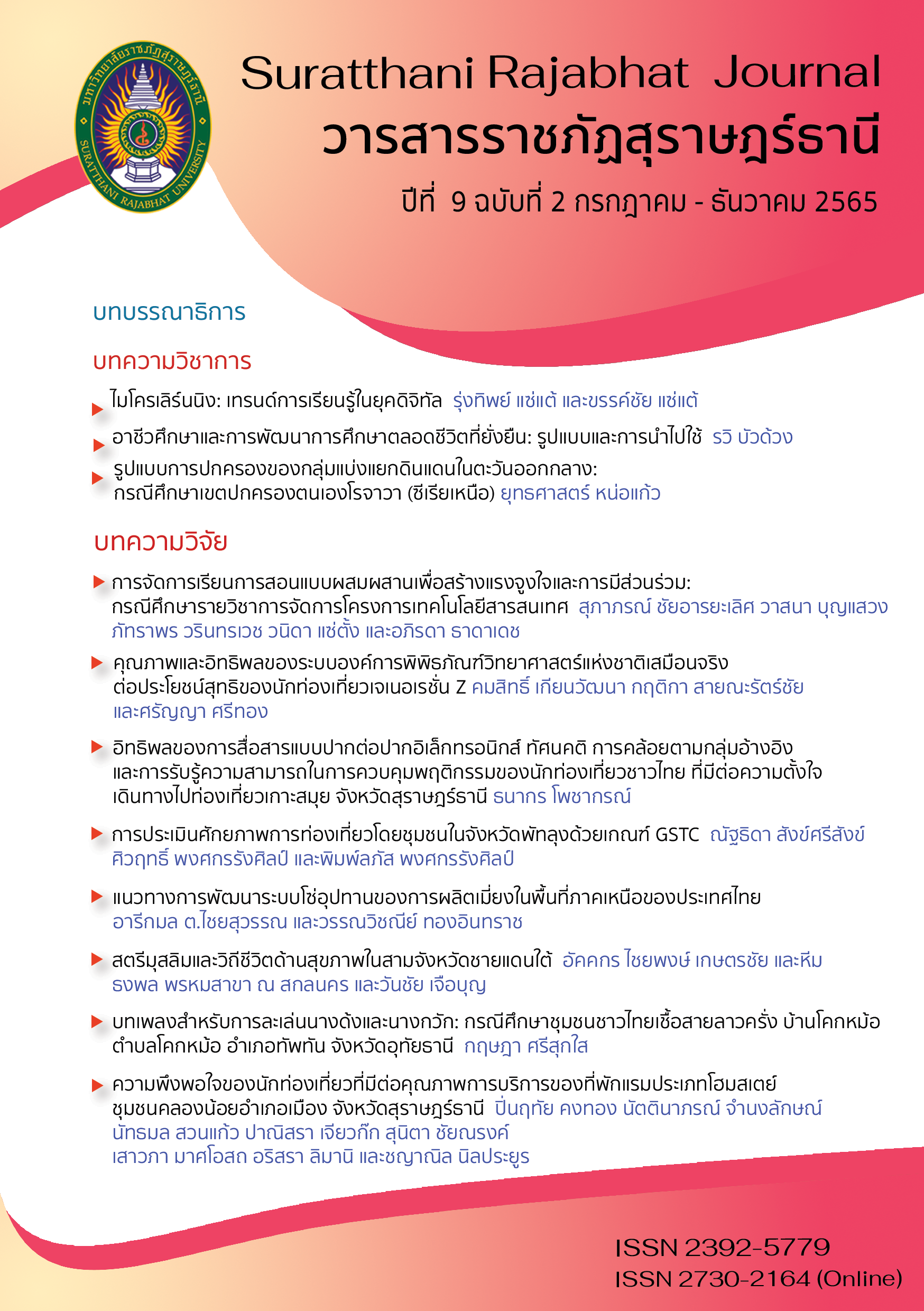
อิทธิพลของการสื่อสารแบบปากต่อปากอิเล็กทรอนิกส์ ทัศนคติ การคล้อยตามกลุ่มอ้างอิง และการรับรู้ความสามารถ ในการควบคุมพฤติกรรมของนักท่องเที่ยวชาวไทยที่มีต่อความตั้งใจเดินทางไปท่องเที่ยวเกาะสมุย จังหวัดสุราษฎร์ธานี
Article Sidebar
Main Article Content
บทคัดย่อ
อุตสาหกรรมการท่องเที่ยวมีความสำคัญต่อระบบเศรษฐกิจของประเทศไทยอย่างมหาศาล การสร้างความเข้าใจรูปแบบการสื่อสารบอกต่อและพฤติกรรมนักท่องเที่ยวจึงมีความจำเป็นในการช่วยกระตุ้นการท่องเที่ยวได้อย่างตรงจุด การวิจัยนี้มีวัตถุประสงค์เพื่อศึกษาปัจจัยการสื่อสารแบบปากต่อปากอิเล็กทรอนิกส์ ทัศนคติที่มีต่อพฤติกรรมการคล้อยตามกลุ่มอ้างอิง และการรับรู้ความสามารถในการควบคุมพฤติกรรมของนักท่องเที่ยวชาวไทย ที่มีอิทธิพลต่อความตั้งใจเดินทางไปท่องเที่ยวเกาะสมุย จังหวัดสุราษฎร์ธานี งานวิจัยเชิงปริมาณเรื่องนี้ ใช้เทคนิคการสุ่มตัวอย่างแบบใช้ความน่าจะเป็นด้วยวิธีแบ่งกลุ่มเพื่อให้ครอบคลุมทุกภูมิภาค เก็บข้อมูลด้วยแบบสอบถามกับกลุ่มตัวอย่างนักท่องเที่ยวชาวไทยที่เคยเดินทางไปเที่ยวเกาะสมุย จำนวน 478 คน วิเคราะห์ด้วยสถิติเชิงพรรณนาและทดสอบสมมติฐานด้วยการวิเคราะห์สมการถดถอยพหุคูณ
ผลการวิจัย พบว่า ปัจจัยด้านการรับรู้ความสามารถในการควบคุมพฤติกรรม (ß=.309) มีอิทธิพลต่อการตัดสินใจเดินทางไปท่องเที่ยวเกาะสมุย จังหวัดสุราษฎร์ธานี ของนักท่องเที่ยวชาวไทยมากที่สุด รองลงมา คือ ปัจจัยด้านการสื่อสารแบบปากต่อปากอิเล็กทรอนิกส์ (ß=.148) และด้านทัศนคติที่มีต่อพฤติกรรม (ß=.118) ตามลำดับ ในขณะที่ด้านการคล้อยตามกลุ่มอ้างอิง (ß=.040) ไม่มีอิทธิพลต่อความตั้งใจเดินทางไปท่องเที่ยวเกาะสมุย โดยผลการวิจัยมีค่าอำนาจการพยากรณ์ R2=.228 งานวิจัยสามารถอธิบายได้ว่าคำแนะนำและความคิดเห็นของคนที่มีความสำคัญต่อนักท่องเที่ยวไม่ได้ส่งผลให้นักท่องเที่ยวคล้อยตาม นักท่องเที่ยวส่วนใหญ่ได้รับข้อมูลการท่องเที่ยวเกาะสมุยผ่านสื่ออิเล็กทรอนิกส์ในรูปแบบต่าง ๆ ซึ่งจะเป็นประโยชน์ต่อสถานประกอบการทุกระดับที่ดำเนินธุรกิจเกี่ยวข้องกับเกาะสมุยในการวางแผนเพื่อพัฒนารูปแบบการสื่อสารทางการตลาดยุคใหม่ และการพลิกโฉมเพื่อดึงดูดนักท่องเที่ยวชาวไทยให้เดินทางมาเกาะสมุย
Article Details

อนุญาตภายใต้เงื่อนไข Creative Commons Attribution-NonCommercial-NoDerivatives 4.0 International License.
เอกสารอ้างอิง
กระทรวงการท่องเที่ยวและกีฬา (ก). (2563, 3 เมษายน). Tourism Economic Review รายงานสภาวะเศรษฐกิจการท่องเที่ยวไทยปี 2562. https://elibrary.tceb.or.th/Publication/Others/6121.
กระทรวงการท่องเที่ยวและกีฬา (ข). (2563, ม.ป.ป.). สรุปสถานการณ์ท่องเที่ยว เดือนมกราคม - ธันวาคม 2562. https://www.parliament.go.th/ ewtadmin/ewt/elaw_ parcy/ewt_dl_link.php?nid=2538.
กระทรวงการท่องเที่ยวและกีฬา. (2564, 27 กรกฎาคม). Policy Brief Tourism : COVID-19 ต่อภาคการท่องเที่ยวไทย ผลกระทบและแนวทางการแก้ปัญหาปีที่ 1 ฉบับที่ 1/2564. https://www.mots.go.th/news-view.php?nid=13492.
การท่องเที่ยวแห่งประเทศไทย. (2565, ม.ป.ป.). โครงการเราเที่ยวด้วยกัน. https://www.เราเที่ยวด้วยกัน.com/information.
การบินกรุงเทพ. (2562, ม.ป.ป.). รายงานประจำปี 2561. https://ba-th.listedcompany.com/misc/ar/20190318-ba-ar2018-th.pdf
Ajzen, I. & Manstead, A. (2007, January). Changing Health-Related Behaviours: An approach based on the theory of planned behaviour. https://www.researchgate.net/publication/232451543.
Ajzen, I. (1991). Theory of Planned Behavior. Organizational Behavior and Human Decision Process 50. Pp 179-211.
Alrwashdeh, M., Emeagwali, O. & Aljuhmani, H., (2019). The Effect of EWOM Communication on Purchase Intention and Brand Image : An Applicant Smartphone Brands in North Cyprus. Management Science Letters. 9. 505-518. 10.5267/j.msl.2019.1.011.
Amalia, R., Yahya, A., Nurhalis, N. & Idris, S. (2019). Impact of Electronic Word of Mouth on Tourist Attitude and Intention to Visit Islamic Destinations. Advances in Social Science, Education and Humanities Research, volume 292. Atlantis Press. DOI: org/10.2991/agc-18.2019.105
Arndt, J. (1967). Word-of-mouth Advertising: A Review of the Literature. New York, NY: Advertising Research Foundations, Inc.
Bae, S.Y. & Chang, P.J. (2021). The Effect of Coronavirus Disease-19 (COVID-19) Risk Perception on Behavioural Intention towards ‘Untact’ Tourism in South Korea During the First Wave of the Pandemic (March 2020). Current Issues in Tourism, 24:7, 1017-1035, DOI: 10.1080/13683500.2020.1798895
Bagozzi, R. P. & Burnkrant, R. E. (1979). Attitude Organization and the Attitude–Behavior Relationship. Journal of Personality and Social Psychology, 37(6), 913–929, DOI: 10.1037/0022-3514.37. 6.913
Bianchi, C., Milberg, S. & Cuneo, A. (2017). Understanding Travelers’ Intentions to Visit a Short Versus Long-haul Emerging Vacation Destination. Tourism Management, 59, 312-324, DOI: 10.1016/j. tourman.2016.08.013
Bone, P. F. (1992). Determinants of Word-Of-Mouth Communications During Product Consumption. Advances in Consumer Research Volume 19. Association for Consumer Research, Pp 579-583.
Brown, J., Broderick, A. J., and Lee, N. (2007). Word of Mouth Communication Within Online Communities: Conceptualizing the Online Social Network. Journal of Interactive Marketing. 21(3), 2–20. DOI: 10.1002/dir.20082
Cochran, W. G. (1977). Sampling Techniques Third Edition. Library of Congress Cataloging in Publication Data. https://archive.org/details/Cochran1977SamplingTechniques_201703/page/n1/mode/2up.
Howard, J. A. (1994). Buyer Behavior in Marketing Strategy 2nd Edition. Englewood Cliffs: Prentice Hall.
Huete-Alcocer, N. (2017) A Literature Review of Word of Mouth and Electronic Word of Mouth. Frontiers in Psycholog. DOI: 10.3389/ fpsyg.2017.01256.
Kantika Jittijarunglap. (2019). The Impact of EWOM on Online Shopping Behavior. [Master’s Thesis]. Thammasat University. http://www.jisb.tbs.tu.ac.th/wp-content/uploads/Kantika.pdf.
Kembau A. S. (2020). The Effect of Consumer Interaction on Social Media Towards Desire to Visit Tomohon City. Proceedings of the First International Conference on Applied Science and Technology (iCAST 2018)Atlantis Press. Advances in Social Science, Education and Humanities Research, Volume 298. DOI: 10.2991/assehr.k. 200813.038.
Kotler, P. & Keller, K. L. (2009) Word of Mouth. Marketing Management. Pearson International Edition. pp. 585.
Kunja S. R. and GVRK A. (2018). Examining the Effect of eWOM on the Customer Purchase Intention through Value Co-creation (VCC) in Social Networking Sites (SNSs). Management Research Review, 43(3), 245-269. DOI: 10.1108/MRR-04-2017-0128.
Lecinski, J. (2011, June). Winning the Zero Moment of Truth. https://www.t hinkwithgoogle.com/marketing-strategies/automation/2011-winning -zmot-ebook/.
Lewis, H., Schrier, T. & Xu, S. (2021). Dark Tourism. International Hospitality Review. Emerald Publishing Limited.
Litvin, S. W., Goldsmith, R. E., & Pan, B. (2008). EWOM in Hospitality and Tourism Management. Tourism Management. 29, 458–468. DOI: 10.1016/j.tourman.2007.05.011
Oliver, R. L. (1997). Satisfaction: A Behavioral Perspective on the Consumer. New York: Irwin/McGraw Hill.
Polat, I., Erdogan, D., & Sesliokuyucu, O. S. (2021). The Impact of Attitude and Subjective Norm on Airline Passengers’ Travel Intention in the COVID-19 Era. Anais Bras. de Est. Tur./ ABET,Juiz de Fora(Brasil),e-ISSN 2238-2925, v.11, n. único, pp.1 –15, Jan. Dez., 2021.
Sharma, S., Singh, G., Pratt, S. & Narayan, J. (2020). Exploring Consumer Behavior to Purchase Travel Online in Fiji and Solomon Islands?. International Journal of Culture, Tourism and Hospitality Research. 15(2), 227-247. DOI: 10.1108/IJCTHR-03-2020-0064.
Silverman, G. (2001) The Nine Levels of Word of Mouth. In The Secrets of Word of Mouth Marketing. American Management Association. Pp. 39-45. New York, United States. Amacom.
Soliman, M. (2021). Extending the Theory of Planned Behavior to Predict Tourism Destination Revisit Intention. International Journal of Hospitality & Tourism Administration, 22(5), 524-549, DOI: 10.1080/ 15256480.2019.1692755
Sujood, Hamid, S., & Bano, N. (2021). Behavioral Intention of Traveling in the Period of COVID-19: An Application of TPB and Perceived Risk. International Journal of Tourism Cities, 8(2), 357-378. DOI: 10.1108/I JTC-09-2020-0183.
Thorne, L. (2008). Word of Mouth Advertising Online and Off: How to Spark Buzz, Excitement & Free Publicity for Your Business of Organization. Florida: Atlantic Publishing Group.
UNWTO. (2020). World Tourism Barometer. https://www.webunwto.s3.eu-west-1.amazonaws.com/s3fs-public/20201/UNWTO_Barom20_01_January_excerpt_0.pdf.
Wang, Y., & Yu, C. (2017). Social Interaction-based Consumer Decision-making Model in Social Commerce. International Journal of Information Management, 37(3), 179–189. DOI: 10.1016/j.ijinfomgt. 2015.11.005
William G. Cochran. (1977, ม.ป.ป.). Sampling Techniques Third Edition. Library of Congress Cataloging in Publication Data. https://archive.org/details/Cochran1977SamplingTechniques_201703.
WTTC. (2020). Travel & Tourism - Global Economic Impact & Trends 2020. https://wttc.org/Portals/0/Documents/Reports/2020/Global%20Economic%20Impact%20Trends%202020.pdf?ver=2021-02-25-183118-360.
Zeithaml, Berry & Parasuraman. (1990). An Empirical Examination of Relationships in an Extended Service Quality Model. Marketing Science Institute Research Program Series, 12, 90-122.
