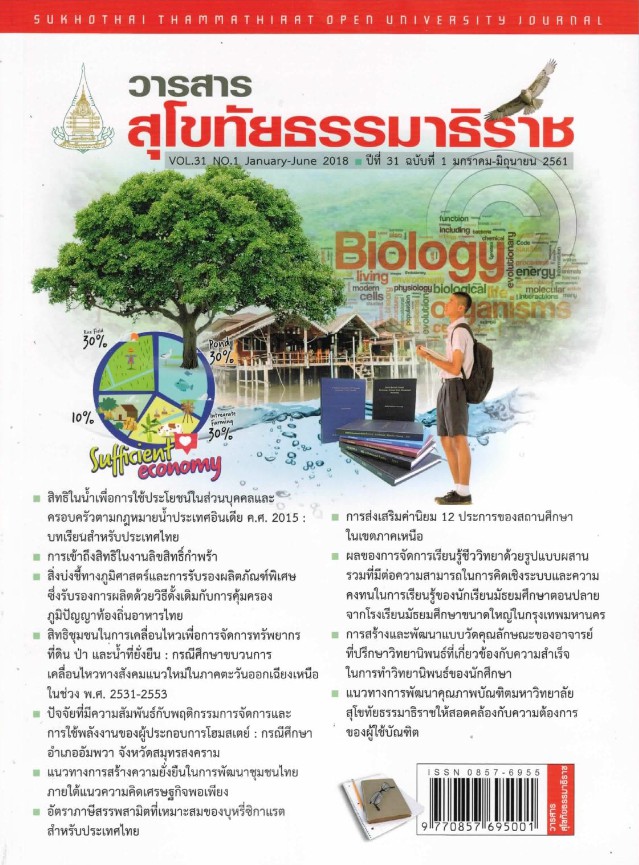
A Model for Sustainable Development in Thai Communities under the Sufficiency Economy Concept
Keywords:
Sustainable resource management, Sustainable development, Development communication, Sufficiency Economy, Cycle of FaithAbstract
In areas with severe natural disasters, effective environmental management has become necessary for sustainable community development. This research investigates three communities that have been successful in community development and water resource management, which include Dong Khee Lek in Prachin Buri Province, Phutham Phukratae in Khonkhaen Province, and Baan Lim Thong in Buriram Province. Using in-depth interviews together with participatory and non-participatory observation, the study found that the “Cycle of Faith” was a prerequisite for a successful process of sustainable development. This “Cycle of Faith,” when combined with the four main elements consisting of good leadership, proper solutions and ideas for development, efficient communication methods for development and intense attention to sustainable management of resources, have led the communities towards successful development. Moreover, during this development process, it is essential to build “awareness” of the community’s actual situation, which will lead to an attempt to put in practice the “knowledge” gained from the learning and thinking processes based on the community’s life ways. All these factors, in turn, trigger the power of “faith” that drives the community’s cycle of development to function endlessly
References
Charoensilp-oran, C. (1999). Development Discourse. Bangkok: Kledthai. (in Thai)
Hydro and Agro Informatics Institute. (2017). Community Natural Water Management Museum Inspired by the King’s Initiative. Bangkok: Ministry of Science and Technology. (in Thai)
Melkote, S.R. (2003). “Theories of Development Communication”. In M. Bella (Eds.), International and Development Communication: A 21st Century Perspective (pp.129-146). Sage Publications: California.
Mody, Bella. (2003). “Development Communication”. In M. Bella (Eds.), International and Development Communication: A 21st Century Perspective (pp.125-146). Sage Publications: California.
Office of the Royal Development Projects Board. (2007). Sufficiency Economy, the philosophy for life. Bangkok. (in Thai)
Office of the Royal Development Projects Board. (2010). The King’s Working Philosophy. Bangkok. (in Thai)
Phongpit, S. (2007). Sufficiency Economy (for lecturers). Bangkok: Phalangpunya. (in Thai)
Rifkin, S.B. (1996). “Paradigms lost: Toward a new understanding of community participation in health programmes.” Acta Tropica, 61, 79-92
Rogers, E.M. (1995). Diffusion of Innovations (4th ed.). New York: Free Press.
Roopkhamdee, W. (2008). Philosophy of Sufficiency Economy and Community Development. In Sufficiency Economy Philosophy and Sustainable Development Center (editor.). Philosophy of Sufficiency Economy and Development Management (pp.179-201).
National Institute of Development Administration. (in Thai)
Thongpakdee, N. (2007). Philosophy of Sufficiency Economy: Background and Meaning. NIDA Development Journal. Vol.47, No. 1, pp.1-24. (in Thai)
White, K. (1999). “The Importance of Sensitivity to Culture in Development Work.” In T. Jacobson & J. Servaes (Eds.), Theoretical Approaches to Participatory Communication (pp. 17-50). Cresskill, NJ: Hampton.
Downloads
Published
How to Cite
Issue
Section
License
บทความที่ได้รับการตีพิมพ์เป็นลิขสิทธิ์ของวารสารมหาวิทยาลัยสุโขทัยธรรมาธิราช
ข้อความที่ปรากฏในบทความแต่ละเรื่องในวารสารวิชาการเล่มนี้เป็นความคิดเห็นส่วนตัวของผู้เขียนแต่ละท่านไม่เกี่ยวข้องกับมหาวิทยาลัยสุโขทัยธรรมาธิราช และคณาจารย์ท่านอื่นๆในมหาวิทยาลัยฯ แต่อย่างใด ความรับผิดชอบองค์ประกอบทั้งหมดของบทความแต่ละเรื่องเป็นของผู้เขียนแต่ละท่าน หากมีความผิดพลาดใดๆ ผู้เขียนแต่ละท่านจะรับผิดชอบบทความของตนเองแต่ผู้เดียว
ห้ามนำข้อความทั้งหมด หรือบางส่วนไปพิมพ์ซ้ำ เว้นแต่จะได้รับอนุญาตจากกองบรรณาธิการวารสาร

