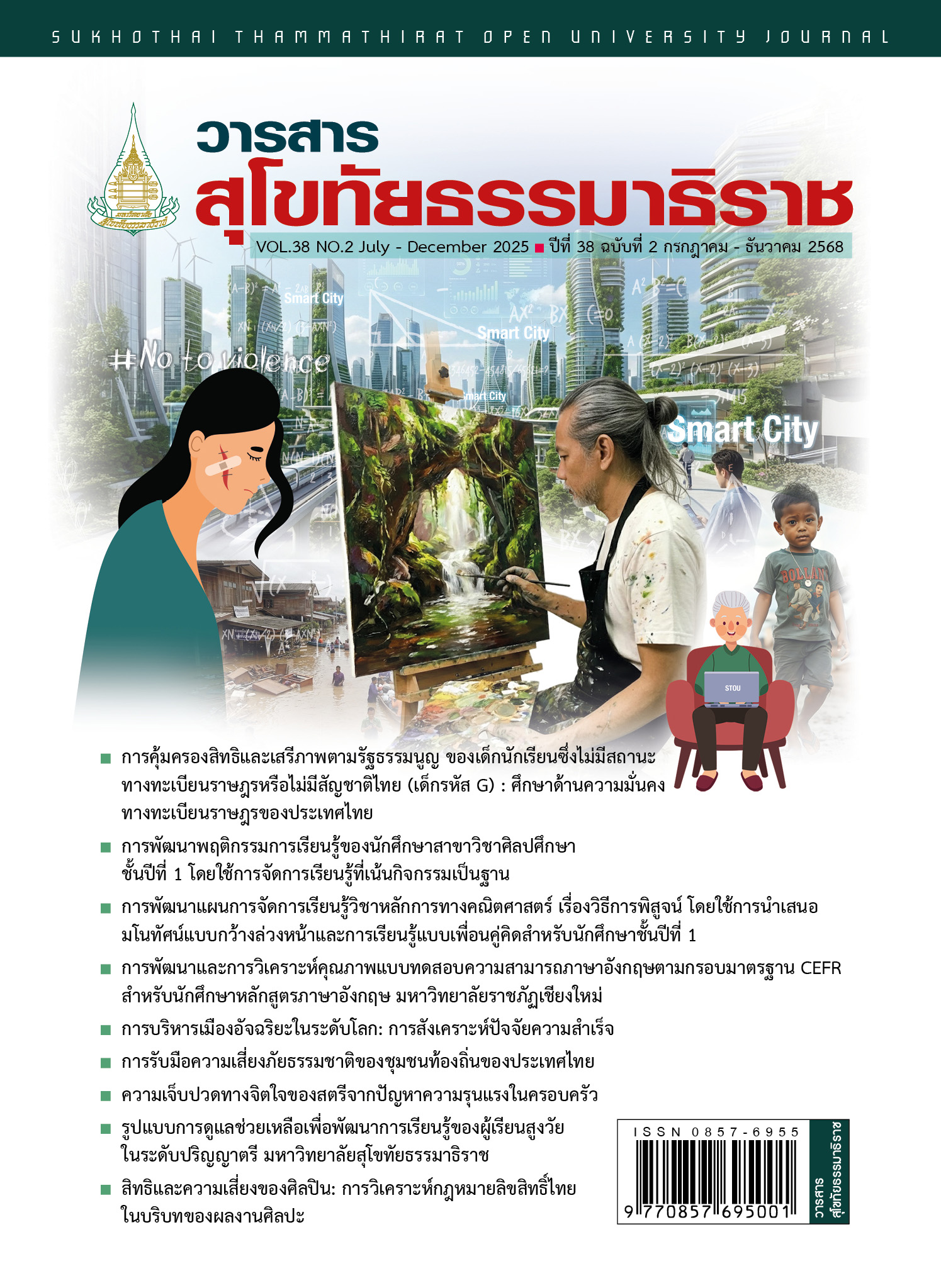
Development of Learning Behavior for First Year Student in Art Education Program by Using Activity - Based Learning
Keywords:
Learning behavior, Activity based learning, Art educationAbstract
This study aims to 1) develop the learning behavior using activity-based learning pre, during, and post class of first-year students in the Art Education program, 2) investigate the learning behavior affecting their self-behaviors, relationship with others and the attitude towards the curriculum after applying activity-based learning, and 3) measure the students' satisfaction after applying activity-based learning. The One Group Pretest - Posttest Design was applied to this study. By using random sampling, 25 students out of the total 95 students in the Art Education program were chosen as respondents. The "Three five-hour" plans of activity-based learning, totaling 15 hours, were applied in this study. The researcher assessed the learning behavior before and after class within the 277-108 code Composition subject. The process begins with the filling of learning behavior measurement form followed by the evaluation of the students' satisfaction after using the activity-based learning. The results found that the learning behavior score of the after-class session using activity-based learning was .05 significantly higher than before the class, and the self-behavior quality was at the highest level ( = 55.20, SD = 2.41). In addition, by using the activity-based learning, the satisfaction after class was observed to be of high quality (
= 4.15, SD = 0.43).
References
Bubpamas, C. (2023). A Development of Innovation Creativity Skills of Early Childhood Teacher Students Acquired Activity Based Learning. Social Science Research and Academic Journal, 18(3), 63–78. Retrieved from https://so05.tcithaijo.org/index.php/JSSRA/article/view/265644. (in Thai)
Best, W. (1997). Research in Education (3rd ed). New Jersey: Prentice Hall Inc.
Chaiyong, S. (2022). “Equitable Classroom” The Concept of Learning Management that Leaves No One Behind the Classroom. CMU Journal of Education, 6(3), 14-28. Retrieved from https://so01.tci-thaijo.org/index.php/cmujedu/article/view/252625/171365. (in Thai)
Daosri, T., Thipkonglad, P., Khemphong, P., Dubsork, S., Pengpis, S., Wisarutphaisan, W., & Phutiariyawat, J. (2021). The study of the learning management approach of school in the 21st century. Journal of Social Science and Humanities, 11(1), 61-76. (in Thai)
Faculty of Education. (2567). Development Strategy Faculty of Education, 2024-2027. Retrieved from https://edu.psu.ac.th/page_id=701#Mission.
Festus, A. B. (2013). Activity-based learning strategies in the mathematics classrooms. Journal of Education and Practice, 4(13), 8-14. Retrieved from https://core.ac.uk/download/pdf/234634479.pdf.
Katkaew, N., Suwanro, K., & Jehlaeman, W. (2023). The Development of Learning Behaviorin Thai Subjectof Ninth Grade Students by Using Activity-based Learning. Journal of SaengkhomKham Buddhist Studies, 9(1), 1-20. Retrieved from https://so02.tcithaijo.org/index.php/jsbs/article/view/261355. (in Thai)
Kolb, D. A. (1984). Experiential learning: Experience as the source of learning and development. Englewood Cliffs, NJ: Prentice Hall.
Likert, R. (1932). A technique for the measurement of attitudes. Archives of Psychology, 22(140), 1-55.
Loedwathong, R. (2022). Development of Learning Achievement and Learning Behavior in Groups Work by Active Learning Management of Grade 11 Students, Nongsangwitthayayon School, Under the Local Administrative Organization, Chaiyaphum Province. Journalof Social Science Panyapat, 4(1), 1-8. Retrieved from https://so06.tci-thaijo.org/index.php/JSSP/issue/download/17394/4764. (in Thai)
Maun, R. (2016). Effective Teaching and Learning Management in Higher Education. Journal of Southern Technology, 9(2), 169–176. retrieved from https://so04.tci-thaijo.org/index.php/journal_sct/article/view/82156. (in Thai)
Sagunee, N. (2016). Development of Attitude, Achievement Motivation and Mathematics Learning Behavior of Ninth Grade Students by Using Activity-based Instruction. Master’s thesis. Chulalongkorn University, Bangkok. Retrieved from https://digiverse.chula.ac.th/Info/item/dc:16522. (in Thai)
Sagunee, N., & Makanong, A. (2017). The Development of Attitude, Achievement Motivation and Mathematics Learning Behavior of Ninth Grade Students by Using Activity-based Instruction. An Online Journal of Education, 12(2), 50-66. Retrieved from https://so01.tci-thaijo.org/index.php/OJED/article/view/110544/86654. (in Thai)
Skulmowski, A. (2024). Learning by doing or doing without learning? The potentials and challenges of activity-based learning. Educational Psychology Review, 36(1), 28. Retrieved from https://link.springer.com/content/pdf/10.1007/s10648-024-09869-y.pdf.
Sooksena, S., & Songserm, U. (2018) The Development of Learning Developing Activities through Activities-Based Learning with Flipped Classroom to Enhance The Desirable Characteristic of ASEAN Citizens in Secondary Students. Veridian E-Journal Silpakorn University, 11(2), 2967-2980. Retrieved from https://he02.tci-thaijo.org/index.php/Veridian-E-Journal/article/view/141819. (in Thai)
Sukjairungwattana, T., & Supannopaph, P. (2021). Guidelines for Silpakorn University Undergraduate Students towards Learning Behavior Development. Journal of Education, Prince of Songkla University, Pattani Campus, 32(3), 103-115. Retrieved from https://so02.tci-thaijo.org/index.php/edupsu/article/view/240275. (in Thai)
Thanin Intharawiset, T., Thanawat Jareoan-sa, T., & Yuang-so̜i, P. (2021). Reflection on Thai Education after COVID 2019. Journal of Legal Entity Management and Local Innovation, 7(4), 323-333. Retrieved from https://so04.tci thaijo.org/index.php/jsajournal/article/view/247120/169764. (in Thai)
Thongking, P. (2020). The Teacher’s Role and Creating a Positive Learning Environment in the 21stCentury Classroom. CMU Journal of Education, 4(1), 50-58. Retrieved from https://so01.tci-thaijoorgindexphp/cmujedu/article/view/226951. (in Thai)
Downloads
Published
How to Cite
Issue
Section
License
Copyright (c) 2026 Sukhothai Thammathirat Open University

This work is licensed under a Creative Commons Attribution-NonCommercial-NoDerivatives 4.0 International License.
บทความที่ได้รับการตีพิมพ์เป็นลิขสิทธิ์ของวารสารมหาวิทยาลัยสุโขทัยธรรมาธิราช
ข้อความที่ปรากฏในบทความแต่ละเรื่องในวารสารวิชาการเล่มนี้เป็นความคิดเห็นส่วนตัวของผู้เขียนแต่ละท่านไม่เกี่ยวข้องกับมหาวิทยาลัยสุโขทัยธรรมาธิราช และคณาจารย์ท่านอื่นๆในมหาวิทยาลัยฯ แต่อย่างใด ความรับผิดชอบองค์ประกอบทั้งหมดของบทความแต่ละเรื่องเป็นของผู้เขียนแต่ละท่าน หากมีความผิดพลาดใดๆ ผู้เขียนแต่ละท่านจะรับผิดชอบบทความของตนเองแต่ผู้เดียว
ห้ามนำข้อความทั้งหมด หรือบางส่วนไปพิมพ์ซ้ำ เว้นแต่จะได้รับอนุญาตจากกองบรรณาธิการวารสาร

